Video
Emerging American Identity: John Dickinson’s Letters from a Colonial Farmer in Pennsylvania
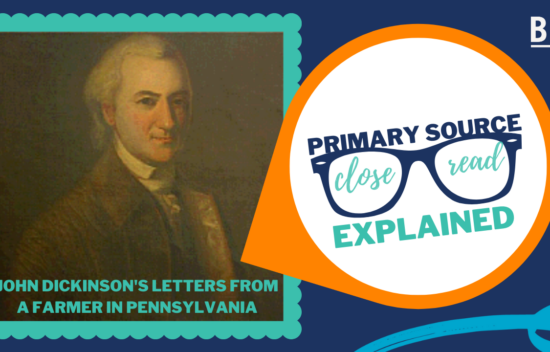
Watch
Founding Principles
Natural/Inalienable Rights, Liberty, Consent of the Governed
About this video
What led to British culture’s fading and American culture’s emergence in the colonies? In this episode of Primary Source Close Reads Explained, Kirk examines John Dickinson’s “Letters from a Farmer in Pennsylvania” from 1767 and 1768. Dickinson offers strong words about taxation of the colonies yet does not call for full-blown independence. Why might Dickinson be opposed to a revolution in these letters? In what ways does his writing showcase the slow emergence of American culture in the British colonies?
How can words, written and spoken, change history? “Primary Source Close Reading: Explained,” dives even deeper into some of the most pivotal pieces that shaped the America we know today. Join BRI’s Director of Content, Kirk Higgins, as he takes a detailed look at the language contained in the most formative documents, speeches, and court cases throughout the history of the United States. Learn the true meaning and story behind the writing that fashioned the country in a way you can easily digest!
0:05 Have you ever been to a party or a celebration? Odds are we all have, and probably fairly recently. One of the ways we tend to mark important moments in our lives or achievements is to gather together as a community. We celebrate accomplishments, honor achievements, and remember loved ones. Well, on June 6, 1765, a party was held in Burlington, west New Jersey.
0:29 Don’t worry, I wasn’t invited either. Now, even though we couldn’t make it, the Pennsylvania Gazette was nice enough to record the details for us, so we can feel like we didn’t miss out. According to the paper and historian Brendan McConville in his book The Three Faces of King George, the quote, gentlemen of the council and the General Assembly, together with the mayor and corporation
0:51 and many of the magistrates and principal inhabitants, went at noon in procession to the house of His Excellency, our governor. There they were greeted by William Franklin, made toasts, and a small can salute was fired. Sounds like a good time. The crowd was also invited to see a beautiful portrait that they had recently been gifted.
1:11 So what portrait were they invited inside to admire? And what were these colonists in North America celebrating? Well, the birthday of King George III, of course. Yes, that King George III, the one who in just a few short years would receive the colonies’ Declaration of Independence. And yes, these celebrations were sincere. They were having a birthday party for the king, even though he was thousands
1:33 of miles away on the other side of the Atlantic Ocean. It may seem a strange image now, but before independence, the colonies were considered loyal subjects of His Majesty the King and part of the British Empire. And they demonstrated that loyalty through toasts, celebrations, and iconography, meaning statues and portraits. Yes, despite discussions of salutary neglect, in the distance between Britain
1:57 and the colonies, colonial culture metered that of England. Slowly, over time, this royal and British culture faded and a new American culture emerged. These changes matter as we try to understand how and why the colonies move towards independence and how the revolution played out. One early writer who demonstrated this emerging American identity is John Dickinson.
2:19 Dickinson, a landowner and lawyer in Pennsylvania, wrote extensively against acts passed by Parliament that he believed were in violation of the colonist’s rights as Englishmen. In 1767 and 1768, he wrote twelve letters in opposition to the township acts which were passed by Parliament to raise revenue and reinforce their right to directly tax the colonies.
2:41 In examining Dickinson’s letters, we can see both the arguments that the colonists were making against British authority and also get a glimpse of how the colonists saw themselves on the eve of the revolution. So let’s take a look. Now, today we’re going to take a look at John Dickinson’s letter number five. But as we look at the document let’s remember our context. This is 1767.
3:03 That’s four years after the end of the French and Indian War, where Britain defeated France and took a consolidated position in North America. It’s also eight ish years before the Declaration Independence, and it’s also 160 years after the settlement at Jamestown was founded in. So, a lot of times passed, the colonies were living under British rule for all of that time.
3:26 But now we are getting to the point where the colonists are beginning to resist and come up with the language for resisting British authority in North America. So this is a picture of John Dickinson and he is who wrote these letters. So Dickinson begins, my dear countrymen, perhaps the objection to the late act imposing duties upon paper, et cetera, might have been safely rested
3:46 on the arguments drawn from the universal conduct of Parliament’s ministers from the first existence of these colonies to the administration of Mr Greenville. All right. So again, we’re looking at not only the arguments that Dickinson is putting forward, but also how he is conceptualizing himself as a member of the British Empire. So he starts out with My dear countrymen,
4:07 so he’s associating himself with those he’s writing to. So sometimes it’s easy for us to think about, well, Britain is a separate country than the United States, and obviously today that is the case. But in 1767 and 1768, it’s important to remember that those weren’t different countries. This would be like you writing a letter to someone in another state. It’s all one at this point. And so he’s writing this letter even though he’s at a distance,
4:29 even though he’s in the colonies and separated from Great Britain. That relationship does matter, but they are considered to be the same members of the Empire together. So perhaps to the late act imposing views upon paper, etc, or might have been safely rested on the argument drawn from the universal conduct of Parliament’s ministers for the first existence of these
4:49 colonies, the administration of Mr Greenville. Who’s Mr Gerenville? Well, he’s a prime minister who had passed previously a Stamp Act. That act had been repealed. And so now we’re objecting to new acts here. These are the Townshend Acts, part of the Revenue Acts also being objected to. The Townshend Acts were passed to raise revenue and also, again, reinforce Parliament’s authority over the colonies.
5:13 That’s going to be important. Laying out here is that we made these arguments for the Stamp Act. That act was repealed by Parliament. We shouldn’t have to argue this again, but here we are doing it again. But the indisputable, the acknowledged and exclusive right of the colonies to tax themselves. Right? So those two things are going to be really important.
5:36 But the indisputable, the acknowledged, exclusive right of the colonies to tax themselves could be reasoned that in a long period of more than 150 years, no statute was ever passed the sole purpose of raising revenue on the colonies. And how clear, how cogent must that reason be to which every parliament and every minister for so long as time submitted, not a single attempt to innovate.
5:59 All right, it’s kind of complicated language, but what are you saying? These two lines are going to be what’s most important to pull from here. He acknowledged the exclusive right of the colonies to tax themselves. What he is objecting to is that Parliament is imposing taxes on the colonists in order to raise revenue, which is something that had never been done up until the late acts that were being passed.
6:22 Parliament, again, is trying to enforce and say that, no, we have the right to do this and we’re going to do this. And here is John Dickinson speaking on behalf of some colonists. How many colonists? Hard to say. There’s different conversations about how many loyalists versus patriots versus people who are just kind of in the middle and want to go about their daily lives and not worry about all this political stuff.
6:45 Where did this come from? Well, this is John Dickinson’s perspective. Staging this argument. No taxation without representation is a way of starting to think about this. This is an early form of that. But what he’s saying is we can’t be taxed for revenue as colonies. Parliament has never done this before and they shouldn’t be doing this now. England, in part of the course of years in Great Britain and other parts,
7:07 was engaged in several fierce and expensive wars. England has been fighting a lot around the world. He gets it. Troubled with some tumultuous bold parliaments governed by many daring and wicked ministers, yet none of them ever ventured to touch the palladium of American liberty. That’s really powerful, right? Palladium is this sort of bastion, this protection, this wall of protection, this holy temple of American liberty,
7:31 this idea that you’re not going to touch American liberty. Now, what he’s talking about here is, again, keep in mind, one empire, one nation, one country deployed. American liberty are the rights of the colonists to exist as they have for a long time, taxing themselves, passing their own legislation, and for Parliament to only come in and tax them, they haven’t done that before.
7:51 So this is a new thing. So all these governors, all these people, all these ministers that existed have never passed legislation that has touched this pallet of American liberty. When it was necessary to raise money, the colonies, the requisitions of the Crown, were made and dutifully complied with. The Parliament from time to time regulated their trade. Now the rest of the empire, to preserve their independence and the connection of the whole in good order.
8:13 So it’s just saying, we as colonies have always done our part. We have worked to allow you to control our trade. We understand our place in the empire, we understand that we are subservient to Great Britain, to the Crown, to Parliament. We understand that relationship. And yet now you are taking steps that are violating sort of how that relationship is set up.
8:35 So he goes on to say, the people of Great Britain, in support of their privileges, boast much of their antiquity. It is true they are ancient. Yet it may well be questioned if there is a single privilege of a British subject, supported by longer, more solemn or more uninterrupted testimony than the exclusive right of taxation in his colonies. How would they bear this was the case, their own?
8:57 What would they think of a new prerogative claimed by the Crown? Let our liberties be treated with the same tenderness and it is all we desire. What’s he saying? Well, saying Britain rests a lot of its identity on this idea of British liberty. That liberty has been around for a long time, going back to Magna Carta, for example, which was in 1215.
9:19 That’s several hundred years ago at this point. And what he’s saying is that tradition that is very valued by British people and we understand it. But what he’s disturbing is saying we as colonists, though we be a far apart, we also have that same tradition. And not only that, but there are a few traditions within the British Empire that uphold that liberty that have been around longer or existed more clearly than
9:43 that of the colonies, can’t be directly taxed by Parliament. And so he’s both associating himself with the same British history. That’s the identity piece. And he’s taking from that argument to say, because we are the same, we understand this, this is a violation of our liberty. And then he goes further and says look, if this happened in Britain, if the Crown was to come up with a new what he called a prerogative,
10:06 which is a new right or law or thing that the King said he can do, that the British people did not recognize or understand or had not been a part of that tradition, they will be up in arms about it. So why is it different in the colonies? Again, in John Dickinson’s mind here, it should be no different. The North American colonies are an extension of Great Britain, and though they be apart and that distance
10:28 does change the relationship slightly, they’re all a part of this one big British empire and have the same history of tradition and rights. So he goes on, every one of the most material arguments against the legality of the Stamp Act operates with equal force against the act now objected to. But as they are well known, it seems unnecessary to repeat them here. All right, so we had the Stamp Act, that was repealed.
10:49 Now these new Revenue Acts are coming in. What he’s saying is, the same problems that exist with the Stamp Act exist with these acts, and yet they’ve been passed. What’s going on here? And he also cops out, says, I’m not going to repeat myself because you all know why we objected to stand back. But just suffice it to say, same arguments apply. So he goes on and says but I’ll look at one of these arguments. The general one shall be considered
11:11 at present that though these colonies are dependent on Great Britain. Though she has legal power to make laws for preserving that dependence. Yet it is not necessary for this purpose nor essential to the relationship between the mother country and her colonies. As we eagerly contend by the advocates for the Stamp Act that she should raise money on them without a consent. All right, here we have it again.
11:32 No taxation without representation. We’re not consenting to this taxation, we’re not consenting to these taxes. We don’t have an opportunity to, and so we cannot be taxed in this way. But again, thinking about his identity, he’s reinforcing again the dependence on Great Britain, that Britain has the right to reinforce that dependence, and that the relationship between them is that of the mother country to their independent colonies.
11:55 He is not at all advocating that the North American colony is somehow separate and independent. What he is arguing for is a particular relationship within the empire, that the colony should exist within. Important line here, that she should raise money on them without their consent. Keep in mind, no taxation without representation. We do that over and over again. Where does it come up? Well, it’s here. And why does it come up?
12:15 Again, because of this relationship. But again, it’s important to keep in mind these are British colonists, so they consider themselves British first and foremost. But we’re beginning to see these signs where that distance is starting to show that there’s some difference between them, even though they’re reinforcing, that they are all part of the same empire. Hitherto, Great Britain has been contented
12:37 with her prosperity, moderation has been the rule of her conduct. But now a general, humane people that so often has protected the liberty of strangers is inflamed into an attempt to tear privilege from her own children, which, executed, must, in their opinion, sink them into slaves. And for what? For a pernicious power not necessary to her as her own experience may convince
13:00 her, but horribly, dreadful and detestable to them. All right, there’s this kind of flowery language, but I included it just to reinforce this is how we see seeing this as a betrayal almost, of what the British Empire stands for, which is this idea of liberty. It’s this idea of that they are the one colonial power in the world that sort
13:21 of represents this tradition of independence and of rights. So it concludes seems extremely probable that when cool, dispassionate posterity shall consider the affectionate intercourse, the reciprocal benefits and the unsuspecting confidence that has subsisted between these colonies in the parent country for such a length of time,
13:44 with the bitterest curses, the infamous memory of those men whose pestilential ambition, unnecessarily want and cruelty first open the forces of civil discour between them and first turn their love into jealousy and first taught these provinces, filled with grief and anxiety, to inquire. Where is maternal affection? He writes it in Latin
14:05 to really reinforce what is happening. Why are you doing this? Now, there’s a couple of ways to look at this. He’s really laying it on thick here. And on the one hand, you can say, well, he’s really kind of primed the pump for independence later on. But keep in mind, 1767, 1768. This is eight ish years before the Declaration of Independence.
14:26 John Dickinson is not arguing for independence and the columns at this time would have no idea that that was going to even happen. So, going back, why is Dickinson arguing that these acts are unjust? We’re saying, look, we’re not represented. This is a violation of our liberty. But how is he saying, well, that gets to the articulation of this colonial identity. Dickinson is seeing this relationship within the empire.
14:47 He’s saying that there are certain things that Britain can do as it’s superior, as the one that is sort of sovereign over its land, but that the laws that they’re making and passing are in violation of that relationship and of a tradition that has lasted between Great Britain and the colonies for, as I said, 160 years. He said over 150 years. Right.
15:08 So since Jamestown, these kinds of relationships have existed. What does it say about colonists and their identity? Remember, we started by talking about a celebration of the king in 1765. So it’s two years before this letter was written. Those celebrations are ongoing. There are portraits of King Georgia up there and there are celebrations of royal birthdays. There’s the honoring of the royal family and of Parliament,
15:28 a recognition of the authority of Parliament within the colonies. What we’re beginning to see here is an articulation of the colonists seeing themselves in a certain way as slightly different from Britain. Now, why that’s the case, it’s a great historical question. Is it because they are feeling that their liberties violated? Is it because the distance is just making it too great?
15:49 Is it because of this solitary neglect that’s existed between Britain and the colonies for so long? It’s a lot of ways to get at that question and that’s what’s really interesting. Now. As for John Dickinson. To show that I’m sincere about saying that he’s not arguing for independence. John Dickinson would go on to be at the signing of the Declaration for Independence. And he actually voted against independence at the very last moment.
16:10 Really pushing and trying to get the colonists at the time of the Continental Congress to see that their position with Great Britain would be better if they did not break with the empire. He thought it was better if they stayed connected. However, once independence was passed, John Dickinson put his name on the Declaration of Independence and was on board for the movement. So all that to say, John Dickinson, interesting guy,
16:32 but looking at colonial identity, it’s important to keep in mind what was happening at these different stages and how that identity begins to emerge in form that eventually leads to independence. Always keeping in mind the particular years we’re looking at. So I hope you enjoyed this. I hope you come back to the channel and check out more of our primary source documents that we take a look at.
16:52 We also look at image primary sources. We also have scholar talks with different scholars all the time. We have new stuff coming up on the channel, so please come back and check us out. Thanks for joining today. Oh no, the video is over. Oh, come on. Don’t be so sad. Don’t you know that the Bill of Rights Institute has tons of videos on American history, government and civics from primary source document breakdowns to historical image analysis,
17:16 whether you’re studying for a test or just interested in learning more, they’ve got something for you. Oh, well, in that case, I better check out this video. And don’t forget to subscribe so you aren’t so sad again.
Standards
Related Resources

Use this primary source text to explore key historical events.

Why did John Dickinson not sign the Declaration of Independence? What were his opinions on government and the of the the Townshend Acts?

This Lesson will provide additional context for the Colonial Identity: English or American? Point-Counterpoint.