Video
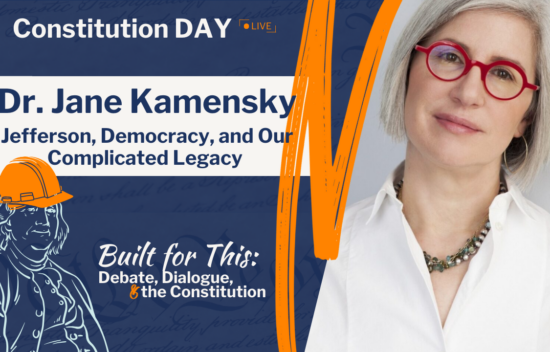
Jefferson, Democracy, and Our Complicated Legacy with Dr. Jane Kamensky | Constitution Day Live 2024
Watch
About this video
Join Dr. Jane Kamensky, President of Monticello, as she reflects on her journey from academia to leading one of America’s most historic landmarks. In this compelling interview, Dr. Kamensky dives into Thomas Jefferson’s complex and paradoxical legacy, his relationship with John Adams, and Monticello’s pivotal role in promoting civil discourse. Discover how Monticello uses historical education and innovative visitor experiences to foster a deeper understanding of Jefferson's life and the American experiment.
0:00 Doctor Jane Kamensky, thank you so much for joining the Bill of rights today. So happy to be here. David. Thanks for coming down to Monticello. It’s a pleasure to be here. You’ve been with Monticello as president since early 2024. Can you tell us just a little bit about your journey to joining this institution and how you got here? Sure. Happy to do that. So I left the classroom to come down to a much larger and in many ways, more public classroom. I had been in research one institutions in higher ed for three decades when the search firm, looking for a new president and CEO for Monticello reached out. And one of the things that I had been doing in my university teaching was looking to build two way bridges between scholars and teachers and the general public,
0:46 around questions of historical and civic importance. And this felt like a way to answer that call at scale. Excellent. You know, one of the things that I’m intrigued by your background is that you’ve written three biographies. I believe seven books total award winning. You note in one of your biographies that writing such is like a portrait, and you’re writing about a portrait artist. Could you just tell us a little bit about the craft of writing a biography? Sure. And and Monticello is a biographical site. one of the things that I love about the genre is the the ability to take large, abstract questions, questions about huge historical forces.
1:34 and root them through one person’s life and think about the ways that we make history as individuals, but also that history makes us. And that always is a dynamic process. I think it works, in similar ways for great men and women and for ordinary people like me. were products of our time, and we shape our time through individual action. I’m an accidental biographer. the first biography I wrote started out as a history of coffee consumption in the United States, and I found that, the stories were sort of routing through one place and then, from one place to one individual. And I found that kind of life and times sometimes.
2:19 And life genre of biography, a way to open up big questions. and that is precisely what Monticello does, right? It’s the home of, it’s the home of Thomas Jefferson and the family members who lived with him in the house, and the enslaved people who built the place and made it run. so it’s biographical and it’s also a cohort, study, of people who didn’t necessarily want to be together. And I think there’s no story about the American founding and the ongoing working out of what it means to live in a republic that you can’t see through the eyes of those people, looking at each other, looking at the world, looking backwards, looking forward.
3:05 So I believe in biography as an enterprise. I’m also interested in it as an ethical enterprise. Right. You, you want to write somebody about somebody in ways that are profoundly true and evidence based, and also that would allow them to recognize themselves. Right. so, so to me, as a biographer, to get somebody right means that you’re bringing the analytic lens of your own moment, but also thinking, if, John Singleton Copley, my artist, read this, or his mother, read it, would she recognize her son? I’m not limited to her, or his worldview, but I want to I want to think through them in a way.
3:51 that, that has the integrity of, as close to belonging to their world as one could get. That that person might recognize themself, in your portraiture. One of the challenges I can imagine as you’re doing this kind of accidental or serendipitous, and then it becomes intentional, is that there’s an enormous, amount of research that you can do for anybody in this process of writing a biography. How do you know when you’re done? Oh, I mean, the, I always think of that scene at the end of Aspire to historical novel possession, where the characters go to their graves, concealing a crucial secret that the, historians who are protagonists, literary scholars who are protagonists, never learn. so it’s never done right.
4:37 Like you, you accept that there are always going to be gaps in your understanding, historic history and biography or dynamic processes. working on biographies in the olden days, the evidence is pretty limited, right? So, we also deal with the fact, and this is true in Monticello’s work as well, that there are things that you would like to know that you never can. because people didn’t document themselves or weren’t allowed to document themselves in the case of the enslaved community or perhaps destroyed things that were private to them. biographers tend to love things that people in living their lives hate. For example, we love it when families are separated
5:22 because they have to communicate with each other. whereas, living a long and happy marriage in one household is my husband and I have been privileged to do, we haven’t left a lot behind about, our daily lives communicating with each other. But John Singleton Copley and his wife separated by the Atlantic in a period of revolution. they left letters, and that’s a great gift. Their pain is a great gift to the biographer. And speaking of pain, it’s it’s also the case that sometimes, as people are sifting through their life’s letters, that they decide to burn them, right? And then then historians are left with less to, to to work, work with. It’s I think we’re always even in 20th century work where there is an unscalable mountain of just
6:10 volume of documentation, but there are always gaps that we can’t see. Right? I think of those, pots in art museums where people are putting together sherds and, and in the contemporary practice of restoration, you show the gap. You don’t make it look like a facsimile of the thing you show the blank terracotta where there would have been figuration. I think there’s something similar in historical writing, and in interpreting in a site like this where we, you know, we have to be able to say we think this because of X, Y, and Z, but we don’t know this, because people didn’t talk about those things or because so-and-so was known to, to destroy their letters. it’s always tantalizing when you get a record that something was destroyed.
6:59 Gaps that we can’t see might be a good segue into Thomas Jefferson. We’re here at Monticello. Who was Thomas Jefferson? Thomas Jefferson was our greatest philosopher of human liberty on, the western side of the Atlantic. he was a polymath, interested in, questions of law and governance, in architecture and music and natural history and wine. he was our. He was a person of profound paradox, right? Our greatest philosopher of liberty, who was himself an enslaver of more than 600 people over the course of his lifetime. And to give it that extra sort of spiral twist.
7:46 Who knew that slavery was wrong? So who was painfully aware of his own paradox and contradictions? I think this makes him a very important figure, both to appreciate and to think with. Jefferson is good to think with, not only about his own accomplishments and limitations, but about the ways in which we are all creatures of paradox, incompletely understanding our world or understanding it well, but not able fully to act upon it. and striving in our different ways for transcendence. Right? We all like to believe that we have done something that will endure, even though all evidence suggests the contrary. I think Jefferson could not have predicted in 1776 that that second
8:35 paragraph of the declaration beginning we hold these truths would be the piece of his life’s work that endures. and it both encapsulates a man and his paradoxes and massively transcends an authorship, a time and place, a purpose of that document. So I think he’s also a good person to think with about human contributions and the ways that the text escapes the author, with profound and ongoing consequences for our experiment in self-government. That’s fascinating. So Jefferson can be a mirror for us. I’d like to explore that more, but you mentioned the arc that Jefferson in 1776 might not be able to see. What a profound, lasting effect those words he penned.
9:21 And we’re joined by others in in endorsing what became the Declaration of Independence. Do you think by the end of his life, he had an inkling that those things might be among the most important that he ever penned? I think, you know, the his selection of accomplishments for his tombstone is the, you know, in addition to elements of correspondence where he reflects on the declaration and its ongoing importance. but he, you know, he curates a life of preposterous accomplishment down to three things for his tombstone writing the Declaration of Independence, of which he then calls himself the author, crafting the Virginia Statute for Religious freedom and founding the University of Virginia. his time as secretary of state, his work in the Continental Congress and the Virginia State House,
10:10 as ambassador, as president of the United States. None of that makes the cut. so I think he realizes that it has achieved profound and enduring importance. Lives to the 50th anniversary of the declaration, a moment of, of great celebration in the United States. but in 1776, the young, redheaded 30 something is just taking a committee assignment that he doesn’t particularly want. And acting, he says, and I think, says both rightly and, and with a little bit of leisure domain acting just as a scribe for, quote, unquote, the American mind. so it’s a, you know, I think about this when I’m called on to serve on some committee that I don’t want.
10:57 is this going to be the Declaration of Independence? Probably not. Yeah. What a what an incredibly productive committee. And perhaps the Constitutional Convention, where Jefferson was not was one of those places where actually committee work left a, a profound, legacy. You know, I think of three months of committee work. Most of that would consider that a sentence or sort of, not something that we’d look forward to. Jefferson had throughout his lifetime a really interesting relationship with John Adams. One of the things that we’re exploring this year with teachers and students and our fellow Americans, is how we live together with disagreement. Freedom makes possible disagreement. And disagreement makes possible freedom.
11:44 Exactly. Can you talk just a little bit about the relationship that Jefferson and Adams had, together? What characterized initially their their friendship? And then maybe we can talk a little bit about what led to that friendship breaking down. So they come up together in the, imperial struggle. Adams in Massachusetts. Jefferson in Virginia. they know of each other from writings, but none of them has ever met before the Continental Congress convene in Philadelphia. There’s, wonderful letters, especially from Adams, about what it’s like to meet those Virginians, with their very strange mores. and I think their initial encounters and the correspondence
12:31 around Congress reminds us that these are people from, nine and then 12 and then 13 separate republics actually getting to know, the opportunity for a common people hood through that encounter. they both believe that the, precious rights of English liberty have been encroached upon, by Parliament and then especially by the king. And they are, brothers, allies in struggle. and, Adams, who is first tapped for that committee, tasks Jefferson as primary author, I think, because he knows he’s a good wordsmith, from,
13:17 cause necessity of taking up arms and other previous documents, but also because he knows how important it is to have somebody who speaks from that other Republic of Virginia. if the thing is going to, carry unanimity in the Congress, they are first together and struggles over coalition, right? There’s the, the editing process of that Committee of five and especially the three lead authors of, Jefferson, Franklin and, and Adams and that Committee of five. And then there’s taking it to the broader Congress and hammering out some of the things that, that Jefferson held most dear. Right. his paragraph about, the international slave trade and the responsibility
14:04 of the king of England, as he saw it for foisting that, that pernicious institution on the colonies was something he believed in passionately. and it was just line after line after line excised. so compromise is painful, which is one of the things that their, friendship is forged in is this, painful institution of compromise that also allows for human flourishing. Right? Like no compromise, no union. which is the struggle in 1776 again, as the articles are working their way through between 1777 and 1781 and then again with the Constitutional Convention, again with the Reconstruction amendments.
14:52 so a relationship forged and compromise that then comes apart over, toxic partizanship. Right. they are they are some of the original partizans in the contested election of 1796 and then, again in 1800, they have widely divergent views about what will lead to the flourishing of the young United States, whether it’s, sort of mercantile and financial and rooted through England or whether it’s idealistic, rural, revolutionary and, and admiring of France. Jefferson takes the side of France in small government. Adams, a more imperial and, financial ized view of the United States.
15:39 And it comes apart hotly, to the point where Adams doesn’t attend Jefferson’s inauguration. they both believe in the peaceful transfer of power, a crucial American principle. But Adams can’t quite bring himself to witness it in a period of profound family sadness as well as political sadness. And they go their separate ways. and the relationship is knit up, beginning, a dozen or so years later with an exchange of letters, where they decide over time and over, a frank and polite, respectful exchange of views that they have more in common as believers in the American project than they do dividing them.
16:27 I was reading some of those letters recently and was interested in the role that family plays. you know, it’s often the case for me when I sit down to do cross ideological work, which I believe in and which is one of the things that I think brought me to Monticello, on which Monticello models, you know, if you’re looking for a place where you can see commonality and your hope for the world, ask about somebody’s household and what they want for the next generation, and it starts that way. Hey, I was thinking about your kids. and they rebuild enough trust to talk profoundly about issues. They don’t smooth away their disagreements, but they do find that
17:12 civic friendship that allows this, wonderful epistolary correspondence, well published. It’s easy to, to find it out there and, and modern format to flourish to the end of their lives. Right. They die on the same day, which is an almost too good to be true ending. You wouldn’t believe it in a movie. and they both die loving the country, even though in some ways their visions for it remain as dissimilar as they were in 1800. and even though both is a bit, both are a bit rueful about the way that things have panned out. they also die knowing that they can’t quite keep their hands around the thing that they have created more comfortable for Jefferson, who really believes
17:59 in ceaseless experimentation than for Adams, who, who was a formalist in a whole set of ways. The point about family is so interesting. I think Abigail Adams, in their long correspondence with John Adams, seem to have oftentimes is a little bit more prudence, shall we say. She was more temperate, more willing to say, well, really, does your ego have to lead the way here? And very few people could say that to to John Adams. What role did she play, if any, in your reading? They had 1200 lives. That’s among the richest of the, the, the bodies of of letters in a republic of letters. What role did Abby play in the reconciliation? So initially she keeps them apart, right?
18:46 I mean, she is the protector of her husband and partner in a marriage that is more of a true partnership than many we see in, in the pre-modern era. And, while she has been, you know, a fiercely loyal friend of Mr. Jefferson’s in the 1770s and 1780s, she’s quite protective of John early on, and, and it’s a little bit of a break on their, on their reconciliation. so I think you see the, the shaping hand of family on the Adams side, through the, you know, the the wonderful correspondence of that family held at Mass Historical Society. You’ve talked a little bit about this
19:32 incredible repository of letters that we have across this entire era. What what significance did it hold as a, as a whole for, for, for the time and also for this, this kind of rapprochement between Jefferson and Adams. People referred to, Western civilization at this time as a Republic of letters, which meant the printed page, but also the importance of candid epistolary exchange. Jefferson wrote over 22,000 in his lifetime, and was kept his outgoing as well as his incoming correspondence through the polygraph machine. and I think in the rapprochement between Adams and Jefferson, the form plays a role, in that it is so mediated.
20:21 Right. You you sit and think about what you’re going to write. when you look at, an 18th century quill pen and, an a piece of 18th century woven paper, this is not a speedy technology. so you’re it’s reflective. You’re, you’re thinking and editing yourself. you might have a waste book where you’re crossing out what you don’t mean to say. And then between Charlottesville and Boston would have been a week in each direction on a good day, right? If the post road wasn’t washed out by mud. And, so when you received something that makes you feel hot, you have a moment to step away from it and not fire something. You know, they’re not tweeting at each other. I think that’s really important. I like to think that they could have made it up in the same room.
21:10 but the distance initially, I think, really helped. you can see in the correspondence that they answer each other pretty rapidly. you know, the, Adams doesn’t let a letter from Jefferson sit for weeks. but if there’s a message for us in our current partizanship, I think the Republic of Letters says, take a bit, take a breath. a strategy they often use in their exchanges that, we think about in arts, civic education, work together, ask a question. and the letters encourage modulation that way. Sometimes in archaic technology is better for civic life.
21:55 That’s such a great point. I think of many other parallels, you know, in the in the rise and kind of tempestuous ness leading up to the 1800 election, which if people have not read about this, you really should. It is an incredibly incendiary thing with allegations that were just a scurrilous as anything that’s that’s being sent forth back and forth now via the via Twitter. How do we draw from the stand down from that in this civic friendship? That’s such an important term, civic friendship. It’s a it’s a category right now that seems almost beyond our reach in our era. Now, if you think of that pitch that you reach where everything is political and it’s very difficult to get
22:42 beyond the Partizanship, there are certain steps that can be taken. Does the is the friendship, the restoration of the the friendship of Adams and Jefferson? Tell us about some practical steps you just pointed to one of them. Think before you, before you attack, maybe don’t attack at all. Right. Let that let that moderation as a virtue lead the way rather than your haste to get out there and be what Amanda Ripley has called a conflict entrepreneur, how do you how do we step back from the the precipice that we’re at right now and say we actually want to reverse ratchet because we’ve ratcheted very high now into this extremely, hyper political, polarized moment, how to how can we stand back and wonder, Jefferson and Adams teach us on that front? I mean, I think the, they start from a basis of trust
23:31 and they return to a basis of trust. And part of that is recognizing that there are crisis entrepreneurs standing between them. Right? I mean, one of the one of the things that I think about in my own civil discourse work is who doesn’t want this conversation to happen, right? The, you know, part of the reason that we are so polarized is there are tons of incentives to polarization, right? Not just the dopamine hits that any of us who are on social. I’m not, get from, that, you know, that rush of negative affect. But, you know, there are there are funding streams that, that attach to, in-group passion rather than, coalition solidarity.
24:17 so think about who benefits when, when we are polarized and, Jefferson and Adams initially fall out because of the Partizan press, in, in large measure, there’s a wonderful book which you probably know called The Tyranny of Printers. using the contemporary, 18th century phrase by Jeff Paisley at University of Missouri. there’s a widespread acceptance that the newspapers are partizan organs, and, Adams seeks to control them. And Jefferson initially doesn’t, but is pretty hard. by the Partizan press. So one of the things that they recognize is how badly they have been served, by being whipsawed by, the 18th century
25:05 news cycle, which is, as you said, much slower, but, but just as passionate. I think the, the starting 1 to 1. And in small groups. Right. Like you, you know, it’s really hard to build trust on a platform. one of the things that I love about the ways that civil society organizations like Brave or Angels or Stand together or living room conversations are proceeding is trying to find people, in small groups where they are to take a small risk, with somebody else, and then they start small. Right. how’s your son doing? I was so sorry to hear. Or I was so delighted by, by his advance. And, in this quest, rather than, let’s dig
25:54 right back into the, to the pain point. I guess the last thing I would say is, and you and I have worked on this together through advocating for American democracy to think about and teach the virtues of coalition, right? That, the virtues of abridging some of what you want to get more of what you need, and figuring out what the things are that you care about, that the largest number of people who disagrees with you cares about and how you can have that conversation with them in a language that embraces you all. So I think Jefferson and Adams got to a point where they were looking for something other than the maximum infliction of pain, like the opportunity to inflict pain was always there.
26:43 is more available to you with someone that you have trusted and loved, than it is with the stranger through the screen. and stepping back and thinking that there is a higher possibility than winning the point. I feel like that’s fallen out of favor in our in the way we conduct our classrooms, the way we conduct our political campaigns, the way that we conduct our social lives. And we would be better, following Jefferson and Adams on that path. Cruelty sometimes seems to be the point today. Right? Owning your your whoever your enemies are. Right. This has become part of our lexicon. Even media bubbles are no modern innovation, right?
27:29 The you just mentioned the kind of tyranny that could be set. Those who use our newspapers as as weapons. How do we as individuals, whether we’re omnivores and we’re trying to consume a lot of news or we’re right now really fearful or just tired of it? How do we begin to challenge ourselves to read other things? You know, one of the things that I loved about our work together in the project that you mentioned, advocating for American democracy is that in our first halting steps, we had to do a lot of getting to know one another and getting to know even the terminology. What are we going to call this? What is our country called? Is it a constitutional republic? It is a is it a constitutional democracy? The term that we landed on all of that kind of navigation help to build some of those bridges.
28:16 But it was clear that many of the people who were participating, what became quite a large effort of hundreds of individuals were open and had to be open throughout to the idea that their world, their media bubbles had to be expanded and that they’d made a practice of that. I fear that one thing that we’re facing now is that people are embracing the idea that, hey, I’m in my bubble and I really like being in my bubble. How do we begin to pull people. Dangerous out there? It’s dangerous out there. Yeah. You don’t. You couldn’t possibly trust or or start reading The rival, you know, whatever the rival might be, you know, media. And it seems like we’re going to have to, take some of those first halting steps in order to be able to rebuild those bonds of trust. So I think there are media organs that are taking that as their mission now.
29:03 Right. Like I think The Atlantic has, a notice, a plural chorus of serious voices. Right. The, so I guess I’m thinking about how we look for the places I, I, you know, at Monticello and in my own historical and civil society work, I am a center out person. and how we find, how we find and broaden centers rather than, oh, you’re listening to MSNBC, you should listen to one America. and I think that maybe fuels a cycle of, of rage where you’re just oscillating, back and forth, who is trying to do the good work of hearing each other?
29:50 and then asking people you’re in conversation with, what are you reading that you’re that you care about, that I’m not reading. I’m amazed at the number of people I talked to about, you know, who do you who do you read in the New York Times? op ed page who will say, like, oh, I, I will, I will never read Douthat. I only read Krugman. and it’s like, well, what if you didn’t read Douthat or Krugman, but you read David French all the time? or or Margaret Wrinkle, his, his statement, and and thought about those places where people are really reaching to be heard by people who are not in the tent. I also think centrism has a bad name.
30:36 I know this from my children. Right? Who, who told me they they hate centrists more than the radical extremes. which is just broken. Right. And which is precisely what? I’m a huge fan of the research enterprise. More in common, right. And their Hidden Tribes report tells us that’s exactly what’s going on. Is that the left most 8% and the rightmost 12% is driving 75% of the conversation. so, to, you know, to loudly embrace the, the crafting of centers and the moving out from centers and coalition politics as, as a way forward in a self-governing country.
31:22 And if we can find a historical exemplars that show us they took this path and it worked, and they took that path and it failed. then I think we have successful ways of bringing a vital past into a fractured present. It’s a beautiful vision. How do you foresee Monticello playing a role in that kind of work? Because every day you welcome visitors here, and every year there are tens of thousands that come to Monticello. They are from every walk of American life. They’re thrown into tour groups. Sometimes they might exchange ideas over the course of these wonderful tours. If people have not been to Monticello, I hope everyone hearing this will will come to this amazing place.
32:07 The tour guides are electric and the place is electric. You have an opportunity, perhaps, to inject some of this civic dimension that you’ve, you said at the outset of our conversation is so motivated you what do you want Monticello to do as part of this kind of recentering, if you will, of the United States of America? So I think that is our huge opportunity, right? We serve over 300,000 people a year on site and about ten times as many online. And as you suggest, they come from every state in the, in the nation, many zip codes within that state, within those states. they’re not sorted in the ways that we tend to be in our workplaces. Right? Sorted by educational level or by political tribe,
32:56 by zip code, which is the most profound sorting in American life. and, we deliver consistently across that broad audience. Hard history told with integrity and backed up by evidence. So I think, as teachers, we’re modeling evidence literacy. We’re modeling bravery. Right. You should be able to talk about hard things and know that not everybody in the room is going to agree with you and think about that as a virtue. to me, the secret sauce will be if we can encourage people more often to talk to each other. we are piloting a tour for 2025, 2026, I mean, centennial season. On the politics and partizanship of the early national period.
33:44 biographical themed around Jefferson and Adams. we know from visitors that they want to learn more about the politics of the early United States. I also think it’s comforting to know that it has been this bad before, and. And the work of ordinary humans can make it better, right? So, so it’s a lesson that we are not the first hyper partizan age. and then what we want to do following these tours is offer Jeffersonian seats of reason. where we invite people to sit down and break bread together and have, facilitator who is trained in cross ideological conversation, ask people to contemplate questions like, what do you love about the United States?
34:30 And what embarrasses you about the United States? What do you want to change? as in our conversation about Jefferson and Adams building on family familiarity, build out from food. Right. And the, there is a Face of Reason card that it’s recently been, digitized for us, with civic ed partners that starts with sort of appetizer questions. Right? Like, you know what? What are your favorite? What are your favorite foods? What do you dislike? and and builds to can we talk, you know, to strangers. Can we talk to strangers about the things we care about in this country? I would boil all that down to saying, I think that Monticello is a place
35:18 that can face boldly the, deep and and meaningful divisions of our past. Right. Like the division over slavery is not an unfortunate sideline. It is a meaningful decision about the morality of the United States. so that can face those things head on, but can also think about the we and we the people. You know, if we’re going to recover the center, we have to believe that it means something to be a people as well as 50 people in 50 states, as well as infinite, tribes and the households within those states. so I hope we can set a literal table that will help us, reinforce the importance of the we and help people discover it.
36:06 You know, I guess my fantasy would be that people who go through such an experience might exchange phone numbers and, right, like, let’s keep this up as a text chain. That would be the kind of small victory that, if people took that breadcrumb back to their communities. it’s an ongoing connection to us. Good for business. but it’s also, maybe it’s a seed and not a breadcrumb. It’s something you can plant, and think about how to harvest and share in a community chain. The reason I think that your vision, which is a bold and beautiful vision, can become reality, is that that same study that you cited more in common points to the fact that the people that are
36:52 kind of in the middle, not on the extremes, are deemed the exhausted, but they’re exhausted by what we have now, not by each other nor by those hard conversations. In fact, I think people want them. we know that from our teachers. We know that from our students all across the country and the teachers and students that that Monticello serves. I would venture to, to guess that they they, they similarly want to have those conversations and are eminently capable of them. I hope the Feast of reason, the Jeffersonian feast can lead to a time, you know, we as a nation, kind of given up on Thanksgiving. In a way, the idea that people can come together as families even and say, well, let’s talk about something other than I mean, sports are great. but you know, that idea that, well, you want to talk about anything
37:38 other than religion and politics and maybe religion and politics don’t have to be at the center. But being able to say, let’s talk about those things which might divide us because we’re bigger than those divisions, I think is is something that can be much more than just a pipe dream. But, but but a reality. I think there’s evidence, that the points in that direction. I’m so glad that you’re you’re pursuing that vision. Can you tell us just a little bit about this, this exhibit, that you’re that you’re that you’re planning? And will it be touching mainly on the election of 1800 and kind of the what led up to it, or we’d love a little preview for you. Yeah. So, you know, we’re going to we’re going to dig into how parties were formed. Right. the fear of faction that the founders events in the discussion around the Constitution,
38:25 and then the hyper partizanship of the 90s and early 1800s, so following Jefferson’s political career, after the nation. Right. it’s not just the stroke of a pen. We declaration is obviously preeminently important here, but the declaration lays down an ideal and destroys an old order. It does not create a new one. Right. The working out of that new one, takes the rest of, Jefferson and the founding generations lives and is ongoing. Right. We’re still what we’re describing is still that work of, of working out the founding. like all tours of Monticello, it needs to work through the, the geography and the collections in the house.
39:11 So asking questions like, why did Jefferson keep busts of Adams and Hamilton, his preeminent political rivals, always in plain sight? why did he, collect the death mask of Oliver Cromwell? among the treasures in his library with this, harbinger of how Republican republics can turn into tyranny. So, like, biography, house tour. Thanks. Very concretely, look at that and, and think about this large dynamic. I think one of the things we can teach on this tour is what healthy parties look like, right? What are parties for? I think you could ask that question on any street in the United States
39:58 and not get a convincing answer, unless you were talking to a political science, and straight parties are supposed to organize our differences in ways that, that don’t immediately go to the most profound cleavage and then crack the whole glass. so what are parties for? How do they undermine their own work? how are they functioning by the end of Jefferson’s life? What did it mean to be a Democratic Republican, as he called himself? what it mean? What did it mean to be a Federalist and then a wig? so I think working through the collections in the house and the sightlines that Jefferson crafted and the stage setting of his own epistolary life, which is at the center of the tour where he wrote his, his letters and copied his own letters.
40:46 can tell that abstract story in a way that, has a material and biographical center. We talk a lot about the power of place here. and I think, if one of our questions and, civic engagement, civic disagreement is how do hard stories land best? I think in a beautiful place where you can think through a small corner of a big thing. and, you know, looking at the fact that Jefferson’s bust of Adams is staring at him, through, through his whole life, that he’s collecting a lineage in, in his parlor that includes the great thinkers of, the English 17th and 18th century,
41:34 the explorers of the continent, and then creating a lineage of the first presidents of the United States. what are the stories about the republic and its fractures and futures that he’s trying to tell? I hope this will have, you know, be full of pregnant analogy. Right. we’re we’re not going to talk in this tour about the hyper partizanship of the 21st century. but it should remedy Jane Kaminsky. Thank you so much for joining us today. Thank you David, it was a total pleasure. Happy Constitution Day. To you too.
Standards
Related Resources

Why does the Constitution matter? In this special edition of Primary Source Close Reads, Kirk Higgins is joined by Anastasia Boden, practicing Constitutional lawyer at the Pacific Legal Foundation, to discuss the 9th and 14th Amendments to the United States Constitution. How have they been interpreted and used in Supreme Court decisions? Why are these Amendments--and the Constitution as a whole—so important to us today?

How did the Founders understand the principles of liberty and equality? Join us for Constitution Day as BRI Senior Teaching Fellow Tony Williams sits down with Professor Carol Berkin, distinguished historian, author, and expert on the American Revolution and women’s history, to explore the history of these principles during the Founding. How did the American Founding create a government and a civil society based upon the principles of liberty and equality? In what ways did the country fail to achieve the ideals and aspirations of liberty and equality for all Americans?

How can we talk about founding principles of liberty and equality without accounting for slavery? To explore this question, Mary went to George Washington’s Mount Vernon just outside of Washington, DC, and spoke with Director of Interpretation, Jeremy Ray. What does the design of the Greenhouse Slave Quarters reveal about the two sides of the plantation: the ornamental, public-facing greenhouse side and the functional, behind-the-scenes side where the people held in bondage lived? How can visiting historical places like Mount Vernon help us grapple with our complex story?

Do your rights end at the schoolhouse door? In a special episode of Fabric of History, Mary and Gary are joined by Nick Capodice, co-host and Education Outreach Producer for Civics 101, the podcast refresher course on the basics of how democracy works. What do the decisions of cases like Mahanoy Area School District v. B.L. teach us about the relationship between students’ rights and schools’ ability to enforce protocol? And what exactly is the difference between on-campus and off-campus speech? Listening Guide: https://bit.ly/CDLpodcast