Video
Grievance #9 of the Declaration of Independence
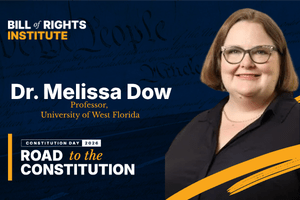
Watch
Founding Principles
Virtues
About this video
Can you trust the courts if judges answer to the king?
In Grievance #9 of the Declaration of Independence, Dr. Melissa Dow, professor at the University of West Florida, explains how King George III made colonial judges dependent on him for their jobs and salaries.
Instead of being paid by local legislatures, judges were paid by the Crown. That meant their loyalty could shift away from the people and toward the king, raising serious concerns about fairness and bias in the legal system.
This grievance connects to a bigger idea: separation of powers. Political thinkers like Montesquieu argued that liberty depends on keeping government powers separate, especially the courts from political control.
By influencing the judiciary, colonists believed the king was undermining one of the key protections of freedom: independent courts.
This is Part 9 of our 27-part series breaking down every grievance that led to the American Revolution, building toward Independence Day.
0:00 My name is Dr. Melissa Dow, and I would
0:02 like to lodge a complaint against King
0:04 George III. He has made judges dependent
0:08 on his will alone for the tenure of
0:10 their offices and the amount and payment
0:13 of their salaries. To understand this
0:15 grievance, we need to answer two
0:17 questions.
0:19 First, what specific action does the
0:21 Declaration object to in these lines?
0:24 Way back in 1701, the British government
0:27 had declared that judges in Great
0:28 Britain would be independent of royal
0:31 control. However, this law did not apply
0:33 to the colonies, and in 1772,
0:37 the colonists received word that their
0:39 judges would not be paid by local
0:41 legislatures, but would instead be paid
0:44 out of the royal treasury. This made
0:46 those judges answerable only to the king
0:48 himself, and it made them susceptible to
0:51 pressure from the king. The second
0:53 question is what is the principle behind
0:56 this objection? The great political
0:58 philosopher Montesquieu pointed to the
1:00 independence of the judiciary as one of
1:03 the great strengths of the British
1:04 system of government. As he puts it,
1:07 "There is no liberty if the judiciary
1:10 power be not separated from the
1:12 legislative and the executive." What he
1:15 is describing is the separation of
1:17 powers, the principle that governments
1:20 exercise different kinds of power, law
1:22 making, law enforcing, and controversy
1:25 deciding,
1:26 and that these different powers need to
1:28 be wielded by different sets of people
1:31 if liberty is to be protected. In this
1:34 grievance, the colonies declare that
1:37 King George has changed the structure of
1:40 their government in a way that threatens
1:42 the liberty of the very people he is
1:45 meant to protect.
Standards
Related Resources
What happens when a government disappears completely? In Grievance 6 of the Declaration of Independence, Dr. Mathew Goetz of the White House Historical Association breaks down what it meant when King George III dissolved colonial governments and left the colonies without leadership. Without functioning governments, colonists were left to defend themselves from both external threats and internal instability. This wasn’t just disorder, it challenged the very purpose of government. The Founders were influenced by the idea of the social contract, the belief that government exists to protect the people. When that protection fails, the agreement between the people and the government is broken. By shutting down colonial governments, Jefferson argued that the king violated that contract. And once that happened, the colonists believed they had the right to do something radical: form a new government. This is Part 6 of our 27-part series breaking down every grievance that led to the American Revolution, building toward Independence Day.
What happens when a government limits who can move in and where people can go? In Grievance 7 of the Declaration of Independence, Jennifer Seiter of the UVA Democracy and Capitalism Lab explains how the king restricted immigration and westward expansion, making it harder for people to settle and build new lives in the colonies. Fewer people meant fewer opportunities. Colonists believed growth brought economic opportunity through trade, labor, and new communities. But British policies, including limits tied to the Proclamation of 1763, kept settlers from moving west and expanding. By 1776, this wasn’t just about population control. It was about the future. Colonists saw these restrictions as a direct threat to their ability to improve their lives and build something better. This is Part 7 of our 27-part series breaking down every grievance that led to the American Revolution, building toward Independence Day.
Can justice really be fair if judges answer to the king? In Grievance #8 of the Declaration of Independence, Chris Canty, graduate student at George Washington University, explains how King George III blocked laws that would establish independent courts in the colonies. Colonists wanted judges to serve independently, protected from political pressure. In England, judges could hold office during “good behavior,” helping ensure fair decisions. But the king repeatedly rejected similar protections in the colonies and kept judges dependent on the Crown. For colonists, this wasn’t just a legal issue. It was proof that they were being treated differently than subjects living in England and denied the same protections under the law. The fight over independent courts became so important that the principle later appeared in Article III of the U.S. Constitution. This is Part 8 of our 27-part series breaking down every grievance that led to the American Revolution, building toward Independence Day.

Primary sources, videos, essays, lessons, and more about what led to the Declaration of Independence
What were the grievances laid out in the Declaration of Independence? Help students define each grievance through modern song lyrics in our interactive quiz leading up to Constitution Day. This Constitution Day, BRI is highlighting the years between the signing of the Declaration of Independence in 1776 and the Constitution in 1787.