Video
Grievance #8 of the Declaration of Independence
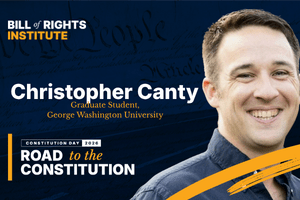
Watch
Founding Principles
About this video
Can justice really be fair if judges answer to the king?
In Grievance #8 of the Declaration of Independence, Chris Canty, graduate student at George Washington University, explains how King George III blocked laws that would establish independent courts in the colonies.
Colonists wanted judges to serve independently, protected from political pressure. In England, judges could hold office during “good behavior,” helping ensure fair decisions. But the king repeatedly rejected similar protections in the colonies and kept judges dependent on the Crown.
For colonists, this wasn’t just a legal issue. It was proof that they were being treated differently than subjects living in England and denied the same protections under the law.
The fight over independent courts became so important that the principle later appeared in Article III of the U.S. Constitution.
This is Part 8 of our 27-part series breaking down every grievance that led to the American Revolution, building toward Independence Day.
0:00 He’s obstructed the administration of
0:01 justice by refusing his assent to laws
0:03 for establishing judiciary powers. To
0:06 help us understand this, we’re going to
0:07 look at Jefferson’s first draft of the
0:09 Declaration of Independence where this
0:10 grievance had a little bit more to say.
0:12 He has suffered the administration of
0:13 justice totally to cease in some of
0:15 these states, refusing his assent to
0:17 laws for establishing judiciary powers.
0:19 Here we see that Jefferson makes mention
0:21 that one of the main issues at stake
0:22 isn’t just the king’s ability to veto
0:24 judicial legislation, but that those
0:26 vetoes are making increasingly difficult
0:28 to live life in the way an English
0:29 subject expected to live in the 1700s.
0:32 Jefferson’s major accusation in the
0:33 declaration was that the king was no
0:35 longer protecting the colonists’ rights
0:36 as English subjects.
0:38 These judiciary acts offer a glimpse
0:39 into exactly how English rights differed
0:41 depending on one’s location.
0:43 Beginning with the Act of Settlement in
0:44 1701, judges in England were appointed
0:47 for good behavior. This was designed to
0:49 ensure an independent judiciary unable
0:51 to be swayed by the whims of politicians
0:53 and thus more capable of protecting the
0:55 subjects’ rights. They desired to have a
0:56 similar system and several states
0:58 attempted to pass laws establishing good
0:59 behavior terms for their own judges.
1:02 But as noted before, all laws made in
1:04 the colonies had to be sent to the Board
1:05 of Trade and from there presented to the
1:06 king where he would consistently
1:08 disallow the provision mandating a
1:10 lifetime appointment. Going so far as to
1:12 identify in 1761 that judges in the
1:15 colonies would serve at the pleasure of
1:16 the crown. This was about more than
1:18 creating their own court system. Here
1:20 was proof that the king would not give
1:21 them the same rights as those that lived
1:23 in England. Ultimately, the desire for
1:25 an independent judiciary was so
1:26 fundamental to the founders’ belief in
1:28 government that Article 3 of the US
1:30 Constitution specifies that appointed
1:32 judges will hold their offices during
1:34 good behavior. Looking at how the king
1:36 clearly treated the English colonies
1:38 differently and with less regard for
1:39 their rights than subjects living in
1:41 England allows us to more fully grasp
1:43 Jefferson’s accusation that the king was
1:45 attempting the establishment of an
1:47 absolute tyranny over these states.
Standards
Related Resources
What happens when a government shuts down your representatives entirely? In Grievance #5 of the Declaration of Independence, C. David Carlson of Trinity Academy South Bend explains how King George III dissolved colonial legislatures when they pushed back against British policies. Colonial assemblies had a long history of self-government, managing local affairs and representing the people. But as tensions grew in the late 1760s and 1770s, those assemblies began coordinating resistance to British taxes. The response from the Crown was clear: shut them down. Massachusetts was one of the first, but it didn’t stop there. Other colonies faced the same fate, especially as they moved toward unified action through the Continental Congress. This wasn’t just a political disagreement anymore. Dissolving representative governments signaled something bigger: a shift from conflict over policy to a crisis over power and self-rule. This is Part 5 of our 27-part series breaking down every grievance that led to the American Revolution, building toward Independence Day.
What happens when a government disappears completely? In Grievance 6 of the Declaration of Independence, Dr. Mathew Goetz of the White House Historical Association breaks down what it meant when King George III dissolved colonial governments and left the colonies without leadership. Without functioning governments, colonists were left to defend themselves from both external threats and internal instability. This wasn’t just disorder, it challenged the very purpose of government. The Founders were influenced by the idea of the social contract, the belief that government exists to protect the people. When that protection fails, the agreement between the people and the government is broken. By shutting down colonial governments, Jefferson argued that the king violated that contract. And once that happened, the colonists believed they had the right to do something radical: form a new government. This is Part 6 of our 27-part series breaking down every grievance that led to the American Revolution, building toward Independence Day.
What happens when a government limits who can move in and where people can go? In Grievance 7 of the Declaration of Independence, Jennifer Seiter of the UVA Democracy and Capitalism Lab explains how the king restricted immigration and westward expansion, making it harder for people to settle and build new lives in the colonies. Fewer people meant fewer opportunities. Colonists believed growth brought economic opportunity through trade, labor, and new communities. But British policies, including limits tied to the Proclamation of 1763, kept settlers from moving west and expanding. By 1776, this wasn’t just about population control. It was about the future. Colonists saw these restrictions as a direct threat to their ability to improve their lives and build something better. This is Part 7 of our 27-part series breaking down every grievance that led to the American Revolution, building toward Independence Day.

Primary sources, videos, essays, lessons, and more about what led to the Declaration of Independence
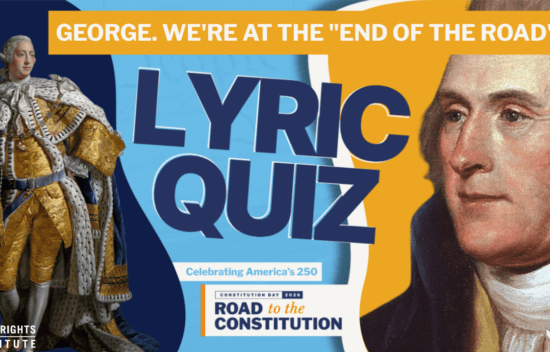
What were the grievances laid out in the Declaration of Independence? Help students define each grievance through modern song lyrics in our interactive quiz leading up to Constitution Day. This Constitution Day, BRI is highlighting the years between the signing of the Declaration of Independence in 1776 and the Constitution in 1787.