Video
Grievance #5 of the Declaration of Independence
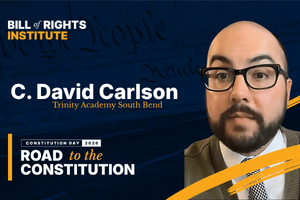
Watch
Founding Principles
About this video
What happens when a government shuts down your representatives entirely?
In Grievance #5 of the Declaration of Independence, C. David Carlson of Trinity Academy South Bend explains how King George III dissolved colonial legislatures when they pushed back against British policies.
Colonial assemblies had a long history of self-government, managing local affairs and representing the people. But as tensions grew in the late 1760s and 1770s, those assemblies began coordinating resistance to British taxes. The response from the Crown was clear: shut them down.
Massachusetts was one of the first, but it didn’t stop there. Other colonies faced the same fate, especially as they moved toward unified action through the Continental Congress.
This wasn’t just a political disagreement anymore. Dissolving representative governments signaled something bigger: a shift from conflict over policy to a crisis over power and self-rule.
This is Part 5 of our 27-part series breaking down every grievance that led to the American Revolution, building toward Independence Day.
0:00 Today, we’re going to be learning about
0:01 some of the history behind the fifth
0:03 grievance in the Declaration of
0:04 Independence, which reads, "He has
0:06 dissolved representative houses
0:08 repeatedly for opposing with a manly
0:10 firmness his invasions on the rights of
0:13 the people." The colonies of British
0:15 North America had a history of
0:16 representative self-government going
0:18 back to their earliest formation,
0:19 creating assemblies to manage local
0:21 affairs. The quality of the relationship
0:23 between the colonial governments and the
0:24 government in London ebbed and flowed.
0:27 Colonial laws required approval from
0:28 London, and London often vetoed laws
0:30 that it determined interfered with its
0:32 own interests. But, in the late 1760s
0:35 and into the 1770s, tensions truly
0:38 reached a crisis pitch. In 1768, the
0:41 Massachusetts colonial assembly began
0:42 encouraging colonial governments to
0:44 coordinate in their resistance against
0:46 British taxes. The king responded by
0:48 dissolving that assembly and threatening
0:50 to do likewise with any other colony
0:52 that followed the Massachusetts example.
0:54 North Carolina and Virginia soon faced
0:57 similar shutdowns. When the colonies
0:59 began to discuss forming a Continental
1:00 Congress in 1774 to direct a unified
1:03 policy toward the British, the king
1:05 again shut down the governments of any
1:07 colonies that looked inclined to
1:08 organize. This matters because the
1:10 British actually shutting down
1:12 long-standing local governments helped
1:14 push colonists to think that this wasn’t
1:17 just a misunderstanding about taxation
1:19 and representation, but that the British
1:21 really had tyrannical designs for
1:23 Americans. Dissolving colonial
1:26 assemblies represented a dramatic
1:28 escalation that helped propel what had
1:30 started as a tax dispute into a crisis
1:32 of sovereignty and a revolution.
Standards
Related Resources
What happens when a government ignores its own laws? In Grievance 2 of the Declaration of Independence, the colonists call out King George III for refusing to approve important colonial laws and then completely neglecting them. As Dr. Susan Brynne Long explains, this wasn’t just frustrating, it made it nearly impossible for colonial governments to function. At the core of this grievance is a bigger idea: government exists to serve the people. Influenced by Enlightenment thinking, the colonists believed that when a government stops doing its job, the people have a responsibility to respond. This wasn’t a one-time complaint either. Thomas Jefferson raised the same issue years earlier, showing just how long this problem had been building and why it became a breaking point in 1776. This is Part 2 of our 27-part series breaking down every grievance in the Declaration of Independence, leading up to Independence Day.
Why did the colonists start calling King George III a tyrant? It came down to one thing: representation. In Grievance 3 of the Declaration of Independence, the colonists push back against British policies that blocked westward expansion and limited representation in colonial governments. Even when new districts were created, they weren’t allowed a voice. For colonists, this wasn’t just about land, it was about power. More land should mean more representation. Without it, they believed their rights were being ignored. Thomas Jefferson made it clear: without representation, the people were subject to the unchecked will of the king. That idea helped transform “Farmer George” into something else entirely, the Tyrant King. This is Part 3 of our 27-part series breaking down every grievance that led to the American Revolution, building toward Independence Day.
What if your government made it harder for leaders to even meet? In Grievance 4 of the Declaration of Independence, @SavyPolitics from Utah Valley University explains how royal governors sometimes required colonial legislatures to meet in remote locations instead of their usual capitals. On the surface, it might seem minor. But the impact was real. Meeting far from population centers made it harder to access records, communicate with constituents, and even gather enough members to function. Colonists believed this wasn’t random. They saw it as a tactic to pressure legislatures into going along with British policies, especially during moments of political tension. Even if it didn’t happen often, it revealed something bigger: a distant government could manipulate how local power operated. This is Part 4 of our 27-part series breaking down every grievance that led to the American Revolution, building toward Independence Day.

Primary sources, videos, essays, lessons, and more about what led to the Declaration of Independence
What were the grievances laid out in the Declaration of Independence? Help students define each grievance through modern song lyrics in our interactive quiz leading up to Constitution Day. This Constitution Day, BRI is highlighting the years between the signing of the Declaration of Independence in 1776 and the Constitution in 1787.