Video
Grievance #3 of the Declaration of Independence
Watch
Founding Principles
About this video
Why did the colonists start calling King George III a tyrant? It came down to one thing: representation.
In Grievance 3 of the Declaration of Independence, the colonists push back against British policies that blocked westward expansion and limited representation in colonial governments. Even when new districts were created, they weren’t allowed a voice.
For colonists, this wasn’t just about land, it was about power. More land should mean more representation. Without it, they believed their rights were being ignored.
Thomas Jefferson made it clear: without representation, the people were subject to the unchecked will of the king. That idea helped transform “Farmer George” into something else entirely, the Tyrant King.
This is Part 3 of our 27-part series breaking down every grievance that led to the American Revolution, building toward Independence Day.
0:00 When King George III read the third
0:02 grievance of the Declaration of
0:03 Independence, he probably couldn’t
0:05 believe it. Americans had the gall to
0:07 accuse him of being a tyrant. After all,
0:10 he was a known admirer of the English
0:12 Constitution. Heck, the people even
0:14 called him Farmer George with endearment
0:16 for his interest in agriculture and his
0:17 love of traditional English values. So,
0:20 how could Thomas Jefferson and the
0:21 Continental Congress call him a tyrant?
0:23 Well, after the Seven Years’ War, George
0:25 III banned settlement past the
0:27 Appalachian Mountains to prevent future
0:29 conflicts with Native Americans. The
0:31 measure angered Americans more than the
0:33 king expected. Farmer George may have
0:35 had all the land he wanted in England,
0:37 but farmers in the colonies believed
0:39 that they should access the land they
0:40 had defended in the war. But, it wasn’t
0:42 just the land they wanted. They also
0:44 wanted more representation.
0:46 Similar to our state legislatures today,
0:48 colonies were divided into districts.
0:50 Gaining more territory meant adding more
0:52 districts, and adding more districts
0:54 meant more representatives in the
0:55 colonial assembly. But, the king and his
0:57 ministers worried this expansion would
0:59 defy proclamation and lead to another
1:01 war. So, the king and his Secretary of
1:03 State, Lord Hillsborough, created a new
1:05 policy. While the colonies were welcome
1:06 to add more districts, any new districts
1:09 would not be represented in their
1:10 colonial legislatures.
1:12 "If there is no representation to gain
1:14 from expansion," they thought, "perhaps
1:16 colonists would be content with the
1:18 borders as they were." Unsurprisingly,
1:20 Thomas Jefferson and others were
1:22 outraged by these measures that seemed
1:24 to use a bunch of legal fine print to
1:26 limit American prosperity. "Our
1:28 ancestors," he reminded the king in
1:30 1774, "were farmers, not lawyers.
1:33 Without the glorious right of
1:35 representation, Americans would have to
1:36 submit themselves as the absolute slaves
1:39 of the king’s sovereign will," Jefferson
1:41 claimed. By 1776, Jefferson had given
1:44 Farmer George an entirely new title, the
1:47 tyrant king.
Standards
Related Resources
What actually pushed the American colonies to declare independence? It wasn’t just one moment, it was a list of 27 specific grievances against King George III that built over time. In this first video of our 27-part series, Dr. C.C. Borzilleri breaks down the big idea behind the Declaration of Independence and where those grievances come from. From the influence of the Magna Carta to John Locke’s natural rights, the Founders weren’t starting from scratch. They were building on centuries of ideas about freedom, government, and the rule of law. So what happens when a government stops protecting people’s rights? That question is at the heart of the Declaration and this series is here to unpack every single grievance, one by one. This video kicks off our Constitution Day Live programming starting September 1. Follow along as we break down the Declaration in a way that actually makes sense.

On June 7, 1776, Richard Henry Lee brought what came to be called the Lee Resolution before the Continental Congress. This resolution stated “these United Colonies are, and of right ought to be, free and independent states ...” Congress debated independence for several days.
What happens when a government ignores its own laws? In Grievance 2 of the Declaration of Independence, the colonists call out King George III for refusing to approve important colonial laws and then completely neglecting them. As Dr. Susan Brynne Long explains, this wasn’t just frustrating, it made it nearly impossible for colonial governments to function. At the core of this grievance is a bigger idea: government exists to serve the people. Influenced by Enlightenment thinking, the colonists believed that when a government stops doing its job, the people have a responsibility to respond. This wasn’t a one-time complaint either. Thomas Jefferson raised the same issue years earlier, showing just how long this problem had been building and why it became a breaking point in 1776. This is Part 2 of our 27-part series breaking down every grievance in the Declaration of Independence, leading up to Independence Day.

Primary sources, videos, essays, lessons, and more about what led to the Declaration of Independence
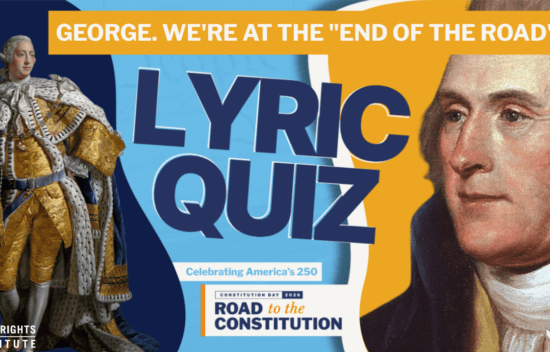
What were the grievances laid out in the Declaration of Independence? Help students define each grievance through modern song lyrics in our interactive quiz leading up to Constitution Day. This Constitution Day, BRI is highlighting the years between the signing of the Declaration of Independence in 1776 and the Constitution in 1787.