Video
Grievance #1 of the Declaration of Independence
Watch
Founding Principles
Natural/Inalienable Rights, Rule of Law, Consent of the Governed
Virtues
About this video
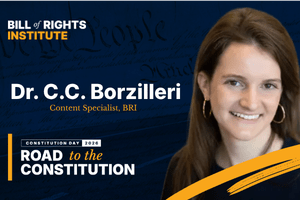
What actually pushed the American colonies to declare independence? It wasn’t just one moment, it was a list of 27 specific grievances against King George III that built over time.
In this first video of our 27-part series, Dr. C.C. Borzilleri breaks down the big idea behind the Declaration of Independence and where those grievances come from. From the influence of the Magna Carta to John Locke’s natural rights, the Founders weren’t starting from scratch. They were building on centuries of ideas about freedom, government, and the rule of law.
So what happens when a government stops protecting people’s rights? That question is at the heart of the Declaration and this series is here to unpack every single grievance, one by one.
This video kicks off our Constitution Day Live programming starting September 1. Follow along as we break down the Declaration in a way that actually makes sense.
0:00 I’m Dr. Cici Bursley, and today we’re
0:02 declaring independence.
0:07 When I teach the declaration, I like to
0:08 put it into context. But sometimes that
0:10 means more than 800 years of historical
0:12 place setting. Jefferson and the other
0:14 members of the Committee of Five were
0:15 tasked with wordsmithing the document
0:17 that would declare independence from the
0:18 British Empire. But they didn’t come up
0:20 with every idea that was inside it.
0:22 A lot of the founding principles that
0:23 they included come from the
0:24 Enlightenment era thinking that was
0:26 taking hold in the British Atlantic
0:27 world during the 17th and 18th
0:29 centuries.
0:31 Other ideas though were even older than
0:32 that.
0:33 In 1215, yes, 811 years before 2026,
0:38 England adopted the Magna Carta, binding
0:40 King John to the same principles that
0:41 governed his people. Well, that might
0:43 not seem particularly novel today,
0:45 consider the establishment of justice
0:47 that comes with the rule of law.
0:48 That principle, in theory if not always
0:50 in practice, means that regardless of
0:52 your power, money, social status, or
0:54 really cool hat, you had to follow the
0:57 law or face the consequences. So,
0:59 Jefferson was pretty ticked that the
1:00 king wasn’t following the law. And he
1:02 said that the stakes were the public
1:03 good itself. According to John Locke,
1:05 mascot of the Enlightenment and blank
1:07 slates everywhere, the whole purpose of
1:09 a government is to ensure the public
1:11 good, to guarantee the basic natural
1:13 rights that society, left to a state of
1:15 nature, might not necessarily
1:16 [clears throat] respect on their own.
1:17 So, what happens when the king and the
1:19 government don’t follow the law? They
1:21 don’t do the very thing that a
1:22 government exists to do?
1:24 Well, I don’t want to spoil anything
1:26 because we have 26 [clears throat] more
1:26 grievances to go. But maybe don’t get
1:29 too attached to life in the Royal
1:30 Palace.
Standards
Related Resources

On June 7, 1776, Richard Henry Lee brought what came to be called the Lee Resolution before the Continental Congress. This resolution stated “these United Colonies are, and of right ought to be, free and independent states ...” Congress debated independence for several days.

Primary sources, videos, essays, lessons, and more about what led to the Declaration of Independence
What were the grievances laid out in the Declaration of Independence? Help students define each grievance through modern song lyrics in our interactive quiz leading up to Constitution Day. This Constitution Day, BRI is highlighting the years between the signing of the Declaration of Independence in 1776 and the Constitution in 1787.
How did fundamental disagreements over slavery and its expansion lead to a devastating civil war that transformed the United States?