Video
Emancipation Proclamation | Primary Source Essentials
Watch
Founding Principles
Virtues
About this video
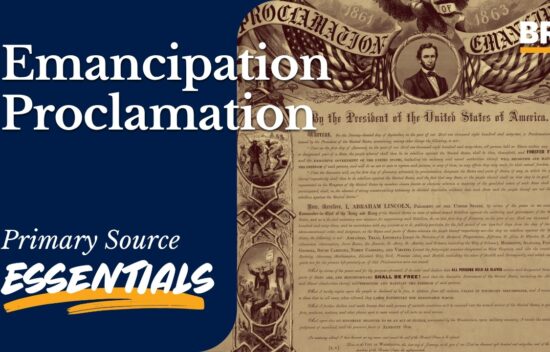
In this episode of Primary Source Essentials, explore how President Lincoln's Emancipation Proclamation. Learn how Lincoln used his war powers to strike at slavery in the rebellious states. Discover how Congress and Lincoln worked together to pass Confiscation Acts, ban slavery in U.S. territories, and enlist formerly enslaved men in the Union army. Understand the limits of the proclamation, Lincoln’s fear of Supreme Court reversal, and his push for the 13th Amendment to abolish slavery permanently.
0:00 Welcome to Primary Source Essentials. In this episode, we will briefly discuss the significance of Abraham Lincoln’s Emancipation Proclamation. When he was elected president in 1860. Abraham Lincoln opposed the expansion of slavery into the territories, and believes slavery violated the principles of the Declaration of Independence.
0:21 While he did not believe that he had the constitutional authority to outlaw slavery in states where it already existed. Southern states still seceded out of the fear that he would do so after the outbreak of the Civil War. President Lincoln and Congress relentlessly undermined slavery, where they had constitutional authority, especially in the rebellious states
0:43 of the Confederacy. In 1861 and 1862, Lincoln and Congress created the First and Second Confiscation Acts, protect and freeing runaway enslaved people, abolished slavery in Washington, D.C., and banned slavery in the territories. After the September 1862 victory in the Battle of Antietam.
1:06 President Lincoln issued his preliminary Emancipation Proclamation and told the Confederate states that they had 100 days to rejoin the Union, or their slaves would be freed. He said, I have never in my life felt more certain that I was doing right than I do in signing this paper.
1:27 On January 1st, 1863, Lincoln kept his promise and signed the Emancipation Proclamation, declaring the slaves in rebellious areas forever free with no compensation to slaveholders. Lincoln bases constitutional authority on his war powers as commander in chief, and upon military necessity to weaken
1:48 the enemy, the executive would enforce the proclamation through military emancipation. The Union forces would encourage enslaved people to run away to the Union lines. Significantly, they would be allowed to enlist in the armed forces. The Emancipation Proclamation did not apply
2:09 to the enslaved of the border states, because those states were not in a state of rebellion, and therefore the president had no constitutional authority there to free them. Moreover, it was a prudential move to keep the strategically important states in the Union. Lincoln ended his carefully constructed constitutional argument with a rhetorical flourish,
2:31 submitting the document to the considerate judgment of mankind and the gracious favor of Almighty God. During the war, and more than 650,000 enslaved persons were emancipated. Fearing that the end of the war would end his presidential war power, and that the Supreme Court under Roger Tawney would undo the proclamation.
2:55 Lincoln lobbied Congress to pass the 13th Amendment for never ending slavery throughout the land. Thanks for watching and check out the other videos in Primary Source Essentials.
Standards
Related Resources


This Presidents and the Constitution e-lesson focuses on Abraham Lincoln and the Emancipation Proclamation. Though he had always hated slavery, President Lincoln did not believe the Constitution gave him the authority to bring it to an end-until it became necessary to free the slaves in order to save the Union.

A scaffolded version of this primary source for elementary students.