Video
The Declaration of Independence Mini Documentary
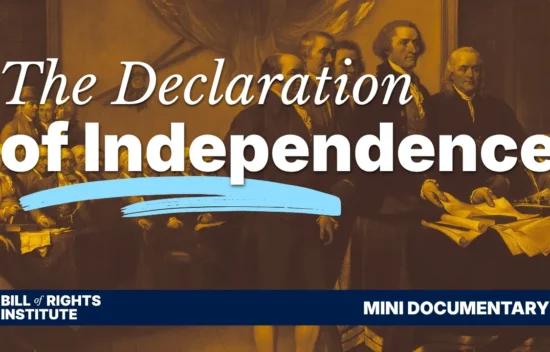
Watch
Founding Principles
About this video
The fight for American independence didn't begin with the Declaration of Independence. Even after the first battles of the Revolutionary War, many colonists still hoped to remain part of the British Empire. But as the war intensified and support for independence grew, the question facing the colonies became impossible to ignore: Should America remain under British rule or become its own nation?
Fueled by the ideas of Thomas Paine's Common Sense and the leadership of figures like John Adams and Richard Henry Lee, the Second Continental Congress took the first steps toward independence. A committee led by Thomas Jefferson drafted the Declaration of Independence, and on July 4, 1776, Congress adopted the document that announced the birth of a new nation. Its principles of equality, natural rights, and self-government would go on to inspire generations of Americans and continue shaping debates about freedom today.
This A250 Mini Documentary is part of a video series presented by the Bill of Rights Institute in honor of America’s 250th anniversary. From the founding moments to movements that shaped our national identity, the A250 series highlights the pivotal people, ideas, and events that have defined the American experiment over the past two and a half centuries.
0:04 In April 1775, the Revolutionary War erupted when the British and American colonies fought at the battles of Lexington and Concord. In June, the British suffered more than 1000 casualties at the Battle of Bunker Hill. Meanwhile, the Royal Navy burned coastal cities to the ground.
0:25 Despite the raging war on land and sea. The American colonists remained part of the British Empire. The war drove some patriots, like John and Samuel Adams of Massachusetts and their allies to support independence from great Britain. Other leaders, such as Pennsylvanian John Dickinson,
0:45 wanted to remain part of the British Empire. In January 1776, Thomas Paine’s pamphlet Common Sense became a bestseller and persuaded many Americans to support independence. Paine attacked monarchy and advocated a free government where the people rule.
1:06 He boldly asserted that tis time to part the debate in the colonies heated up that spring over the question of independence. The people’s representatives in South Carolina and New Hampshire wrote constitutions creating independent state governments. On May 15th, John Adams
1:26 offered a preamble that stated in no uncertain terms, the exercise of every kind of authority under the said Crown should be totally suppressed, and all the powers of government exerted under the authority of the people. On June 7th, 1776, Richard Henry Lee of Virginia
1:49 rose in the Second Continental Congress to offer the following resolution that these United States are and of right ought to be free and independent states, that they are absolved from all allegiance to the British Crown. On June 11th, Congress appointed a committee to draft a declaration of Independence.
2:13 John Adams, Benjamin Franklin, Thomas Jefferson, Robert Livingston, and Roger Sherman served on the committee. They concurred that Jefferson would draft the declaration on July 2nd. The Second Continental Congress unanimously adopted the resolution for independence from Great Britain. John Adams thought the day would be celebrated as the day
2:36 of national independence. He wrote Abigail Adams the following day. Yesterday, the greatest question was decided which ever was debated in America and the greater, perhaps never was or will be decided. The Second Continental Congress adopted the Declaration of Independence
2:57 on July 4th, 1776. Abolitionist Frederick Douglass called the principles of the declaration saving principles. Abraham Lincoln said the principles were the standard maxim for a free society. And President Calvin Coolidge said they were final principles.
3:21 Let us rededicate ourselves to those principles so that they may endure for another 250 years and be a reality for all Americans.
4:38 The Declaration of Independence asserted the self-evident truth that all men are created equal. As a universal principle of human nature, God had endowed humans with natural rights, including life, liberty, and the pursuit of happiness. America 250 celebrates
4:59 250 years of Americans making a claim on the Declaration’s principles and holding themselves to that standard.
Standards
Related Resources

On June 7, 1776, Richard Henry Lee brought what came to be called the Lee Resolution before the Continental Congress. This resolution stated “these United Colonies are, and of right ought to be, free and independent states ...” Congress debated independence for several days.

Primary sources, videos, essays, lessons, and more about what led to the Declaration of Independence
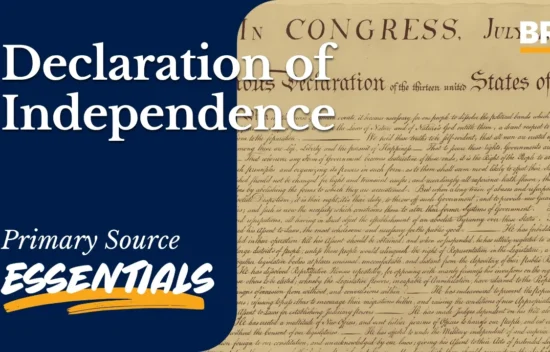
How does the Declaration of Independence support the principles of individual liberty and self-government? In this rapid-fire episode of BRI’s Primary Source Essentials and Declaration of Independence summary, learn the arguments made by the American colonists as they sought to free themselves of British control.