Video
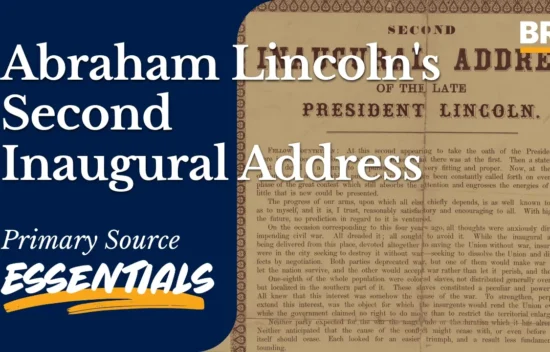
Abraham Lincoln’s Second Inaugural Address | Primary Source Essential
Watch
Virtues
About this video
In this episode of Primary Source Essentials, examine Abraham Lincoln’s Second Inaugural Address and its powerful message at the end of the Civil War. Delivered in March 1865 after four years of devastating conflict that claimed hundreds of thousands of lives, Lincoln resisted triumphalism and instead called for reconciliation, identifying slavery as the central cause of the war and urging Americans to move forward together as one nation.
Lincoln appealed to shared history, faith, and responsibility, emphasizing moderation, humility, and respect between North and South. His famous call for “malice toward none” and “charity for all” urged Americans to bind up the nation’s wounds, honor the sacrifices of those who died, and pursue a just and lasting peace to preserve democracy and advance freedom and equality.
0:00 Welcome to Primary Source Essentials.
0:02 In this episode, we are going to briefly examine how Abraham Lincoln’s Second
0:06 Inaugural Address demonstrates the civic virtues of moderation and respect.
0:12 At the end of the Civil War.
0:14 The Civil War had been fought since 1861,
0:18 resulting in the deaths of roughly 700,000
0:20 American soldiers in 1864.
0:23 The United States held a free election during the Civil War.
0:26 President Abraham Lincoln ran for reelection against General George
0:30 McClellan.
0:32 Lincoln was reelected for a second term
0:35 and was inaugurated on March 4th, 1865.
0:39 He could have sounded a triumphant note in his second inaugural,
0:43 but instead took the opportunity to try to reconcile
0:47 and heal the nation.
0:50 In his second inaugural, President Lincoln asserted that slavery
0:53 was the cause of the war, and even though both sides sought to avert the conflict,
0:58 the Confederate South was willing to go to war to defend the institution.
1:03 But Lincoln knew that for the nation to heal,
1:06 the sections had to reconcile and move on from this conflict.
1:11 To do this, he appealed to moderation, to our shared history
1:15 and finding common ground as Americans.
1:18 Both sides read the same Bible and prayed to the same God.
1:22 He says both expected a short war, but both lost countless
1:27 young men in this long, devastating war.
1:31 Lincoln states that the war was a divine punishment for the grave moral
1:36 evil of slavery, and that all Americans
1:39 North and South were complicit.
1:42 Thus, all were being punished with this terrible war.
1:46 Every drop of blood drawn with lash
1:49 shall be paid by another drawn with the sword, he says.
1:54 Lincoln finishes with an
1:55 appeal for moderation and respect,
1:58 with malice toward none, with charity for all.
2:02 Let us strive on to finish the work we were and to bind up the nation’s
2:07 wounds, to do all which may achieve and cherish
2:11 a just and lasting peace.
2:14 Lincoln was appealing to Americans to unify in a way that honored
2:18 the sacrifice of the brave soldiers who paid the ultimate price in the war.
2:23 The nation would have to heal for the United States to preserve
2:27 democracy and advance freedom and equality for all.
2:32 Thanks for watching and check out the other videos in Primary Source Essentials.
Standards
Related Resources


The text of Lincoln's speech and corresponding analysis questions.