Teaching Strategy
Source Stations
Students move in groups across stations to analyze a set of primary sources to answer a central learning question with a thesis statement. Groups work together to analyze, synthesize, and construct an argument based on evidence.
Strategy
Source Stations
Quick Overview
Students move in groups across stations to analyze a set of primary sources to answer a central learning question with a thesis statement. Groups work together to analyze, synthesize, and construct an argument based on evidence.
Skill Objective
Students will…
- Practice analyzing primary sources for meaning and significance
- Compare a variety of primary sources from one time period
- Construct an argument based on evidence
- Work collaboratively with peers during source evaluation
Content Objective
Students will…
- Engage with a wide range of sources and perspectives on the lesson content
- Encounter different forms of media from one time period, including written and visual
Civics Skills Connection
Disciplinary Literacy:
- Information literacy skills: Students compare evidence, identify patterns or contradictions, and assess reliability across a variety of sources.
- Media literacy skills: Students consider who created each source, when, and why, evaluating perspective and potential bias.
- Historical source skills: Students place each source within its historical, social, or cultural context to understand its significance.
_______
Prep ahead
- Identify and print primary sources for student examination.
- The number of sources will vary by topic and group size, but try to aim for groups of 2-4 students getting to rotate through at least 3-5 different sources for the activity.
- Develop 1-3 guiding questions for each source, focused on sourcing, content, and perspective. A consistent theme or structure to these questions will strengthen students’ ability and confidence to analyze documents going forward. For example:
- What does the author’s role or job tell us about how or why they produced this document?
- What specific words in this text help you understand its meaning?
- What is the relationship between the author and the audience of this document?
- Write a central question for students to address in their final rotation.
- Prepare the stations by placing copies of the primary sources and accompanying guiding questions at each station location in the classroom. These can be posted on a wall, laid on a table, or even placed on the floor as long as there is enough room for student groups to access and view the materials.
Strategy Steps
- Divide students into groups of 2-4 and divide them across the station locations to start.
- Students spend 5-15 minutes at each station, depending on the number of sources to be covered, age range of students, and depth of the questions at each station.
- During this time students independently view or read the source, discuss the source with their group, and consider/record their answers to the guiding questions.
- Groups rotate through the stations during the class period to encounter and consider the range of sources provided.
- When groups have visited each source, educator gives students the central question to consider as they reflect on every source they have seen.
- Groups spend one last rotation period considering the sources together to synthesize and assess different ways the topic has been portrayed, recounted, or analyzed across the stations.
- Students consider the central question for the lesson objective that the educator has posed, and they write a thesis statement together that relies on the evidence of the sources that they have encountered.
Customizations
- Option 1: Shuffle it
- After students have moved with their groups throughout the sources, shuffle the groups and have them return to one source with new peers to compare how their groups approached the document and the questions. After returning to the larger group after this exercise, encourage students to consider the interpretive role of historians and learners and the way that people can look at one document but come away with a range of understandings.
- This could also be accomplished by having students return at the end to their “favorite” source and sharing their interpretations with other students who also liked that one best.
- Option 2: Assign it
- Based on the thesis they came up with in groups, students write a paragraph or short essay about their analysis.
- Option 3: Extend it
- Students write down questions that they still have about the topic after looking at all of the sources, and they describe one more source that they would want to examine. Students should think creatively about what this could be – a letter from a central figure, a photograph of a specific moment, or for later periods of time a video or audio recording that answers key questions.
- Option 4: Scale it
- Adjust the number of sources, number of students in each group, or amount of time at each station to affect the activity’s impact on student engagement, interpersonal learning, source comparison, and time management.
- Option 5: Scaffold it
- Distribute BRI’s VIEW graphic organizer for use with primary sources to give a more structured approach to students. Providing definitions of key words in each source would also help student understanding.
Standards
C3 Framework
- D3.3.6-8,
Check whether this resource aligns with your state’s standards →
Related materials
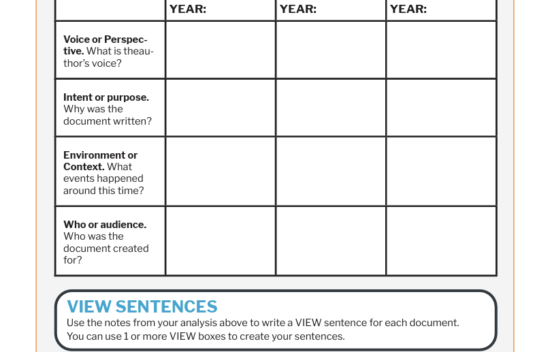
ActivityConstitution and Ratification “VIEW” Deconstructed DBQ Middle School Graphic Organizer
Graphic Organizer to guide students through accompanying documents.