Teaching Strategy
Editorial Page
Students compare textual and visual sources on one topic. They consider differences in presentation based on media type and the opinions of the person who created them.
Strategy
Editorial Page – Teaching Strategy
Quick Overview
Students compare textual and visual sources on one topic. They consider differences in presentation based on media type and the opinions of the person who created them.
Skill Objective
Students will…
- Consider media presentations of historical events and the variation of presentation by media type.
- Assess opinion and bias in primary sources.
- Craft arguments and understandings based on multiple sources of evidence.
Content Objective
Students will…
- Engage with primary sources related to a historical event.
- Compare and contrast forms of media from one period of history.
Civics Skills Connection
Inquiry Skills
- Inquiry based learning: students strengthen their media literacy skills to engage with different forms of information in an informed and careful way
- Problem based learning: students make sense of sources that may initially seem to contradict each other by investigating their VIEW components
- Project based learning: students take agency over their knowledge by entering into a conversation with historical sources rather than taking them exclusively at face value
_______
Prep ahead
- Identify at least two primary sources that show opinions on a single historical topic. One should be text-heavy while the other should be more visual.
- Print out the textual and visual source for each student.
- Students should have a general familiarity with the time period that the sources come from, including what key events might have been going on and what central figures are likely to be depicted in the sources.
Strategy Steps
- Lead students through VIEW analysis of the sources. This method works for both text-based and visual sources. To prompt student thinking, consider the following questions:
- Voice or perspective: Who produced this source?
- Intent or purpose: Why was this source created?
- Environment or context: What big events were going on at the time that might have prompted the source to be written or created?
- Who or audience: Who was the source created for? Was it meant to be public or private?
- Students work in groups of 2-4 to compare and contrast the VIEW analyses of each source. Then ask each group to write 1-2 clear sentences explaining what each source says in their own words, how they differ, and how they work together.
- Invite groups share their thinking either verbally or by writing their sentences on the board so that the whole class can see the range of interpretations.
- Close the activity by explaining the importance of media literacy. Consider saying: “Not only do the sources from the historical time period differ, but our interpretations of them are not all the same either. Information can be understood in lots of different ways, and part of the job of a history student, and of a good citizen, is to dig through as much information as you can to come to a clearer understanding of the past or the present.”
Customizations
- Option 1: Script it
- Have students write a scripted conversation between the text and visual authors. What would they agree on? How would they challenge each other? What type of resolution or compromise might they be able to reach?
- This option offers a creative opportunity for students to put their analysis into practice. By switching up the traditional analytical writing assignment, students get to take more creative ownership of their learning process and engage with the content more personally.
- Option 2: Assess it
- Based on the conclusions that each group shared in class, have students write a paragraph or short essay with a clear thesis statement and evidence drawn from each source to back up their claims. Instructors collect this writing to provide feedback to students.
Standards
C3 Framework
- D2.His.9.6-8,
Check whether this resource aligns with your state’s standards →
Related materials
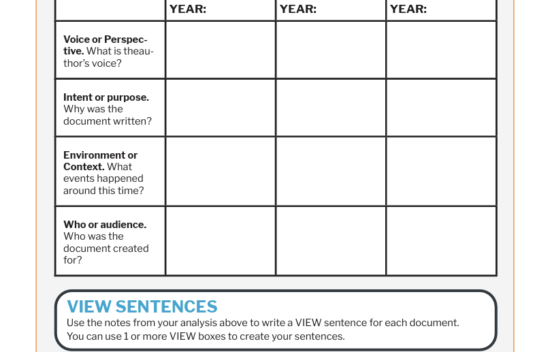
ActivityConstitution and Ratification “VIEW” Deconstructed DBQ Middle School Graphic Organizer
Graphic Organizer to guide students through accompanying documents.