

Economics Playlist
19 items

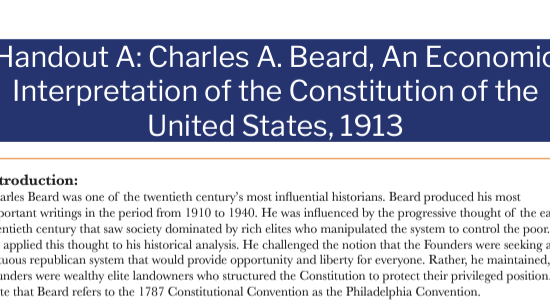
Primary Source: Charles A. Beard, An Economic Interpretation of the Constitution of the United States, 1913
Activity
Activity
Excerpted text from Charles A. Beard's "An Economic Interpretation of the Constitution of the United States" that asks students to evaluate his arguments for the motivation of the Framers.


The 1973 Oil Crisis and Its Economic Consequences
Essay - 2453 Words
Essay
2453 Words
What led to the shortage of gasoline in 1973?
Teaching History, Civics & Economics with the Hoover Institution at Stanford University
Webinar
Webinar
40 Min
This video is an overview of Building Blocks of Progress, which is presented in partnership with the Hoover Institution. Video supplements originally published on PolicyEd.org a product of Hoover Institution, Stanford University. Find it here: https://billofrightsinstitute.org/curricula/building-blocks-of-progress
This resource encourages students to consider the economic choices that actors make every day. The resource covers the role of individuals, government, and economic principles in creating a free society. Each lesson is paired with multiple videos developed by the Hoover Institution to create a rich, blended learning experience for students.

Understanding the Role of Constitutional Government in Promoting Economic Prosperity
Lesson - 8 Activities
Lesson
8 Activities
60 Min
Why is equality important for achieving prosperity? How does rule of law create a stable and predictable environment for economic prosperity? What is the proper role of the government in regulating the economy?
60 Min


Essay: Making Economic Decisions
Essay - 1509 Words
Essay
1509 Words
When we hear the term “economics,” we tend to think about ups and downs in the economy as well as graphs mysteriously depicting supply and demand. In reality, economics is vitally important subject because it is the study of making choices. More specifically, it is the study and practice of making choices in a world of limited resources (scarcity). You cannot go for a day without making economic decisions. For this reason, an understanding of economic thought makes you a more successful citizen.

Essay: Prices and Value
Essay - 1845 Words
Essay
1845 Words
Prices are created through interactions between sellers and buyers. Supply (sellers) and demand (buyers) is the first, most recognized model in economics. Demand represents the various numbers of items that consumers are willing and able to purchase at a series of different prices at a particular point in time.

Taxes and Regulation
Lesson - 3 Activities
Lesson
3 Activities
In America’s free society, entrepreneurs of many kinds start businesses that create the nation's wealth. The Founders established the federal government in the Constitution, and the American people ratified it to protect the rights and property of its citizens. That meant that national defense, court systems, and political administration all became part of the U.S. government. Therefore, some taxes were necessary to support the limited functions of this new government.

Saving and Investing
Lesson - 3 Activities
Lesson
3 Activities
60 Min
If, as individuals, we spend more than we earn, we can go bankrupt. The same is true with nations. If a nation spends on government services more than it takes in from tax revenue, it runs a deficit, and must borrow at interest to get back to even.
60 Min

The Economics of the North & South Before the Civil War | BRI’s Homework Help
Video
Video
5 Min
What economic issues split the North and South during the leadup to the Civil War? This Homework Help video explores this question and will help prepare you for your upcoming test!
5 Min

Federalism and the National Bank Debate
Lesson - 1 Activities
Lesson
1 Activities
How did the division of power for the United States shape early American history?

Mercantilism and the Colonial World
Lesson - 2 Activities
Lesson
2 Activities
Discover how mercantilism influenced the development of colonies in North America.

Major Industries of the 13 Colonies
Lesson - 2 Activities
Lesson
2 Activities
How did climate and available resources affect the development of the 13 Colonies?

Colonial Experience with Government and Economics
Lesson - 3 Activities
Lesson
3 Activities
75 Min
When European colonists came to North America, they faced the challenge of establishing societies that reflected their identity and mission for God. Experiments with economic and civil liberty followed in the name of the common good. Colonists and, later, the Founding generation became convinced that legally requiring individuals to commit their labor or their money towards a communal farm or church, with no regard for individual contribution or conscience, violated principles of justice. The link between economic liberty and the liberty of conscience became clear to many, and is responsible for liberating “a field without an horizon ... to the exploring and ardent curiosity of man.”
75 Min

International Trade
Lesson - 2 Activities
Lesson
2 Activities
For all of human history, people have desired things that people in distant lands possessed in abundance. From Australian opals to Chinese silk, Greek olive oil to French wine, Peruvian textiles to Florida oranges, from South African diamonds to Cuban tobacco, we have always wanted access to the best things different places around the world have to offer.
Prices and Value
Lesson - 5 Activities
Lesson
5 Activities
Prices are created through interactions between sellers and buyers. Supply (sellers) and demand (buyers) is the first, most recognized model in economics. Demand represents the various numbers of items that consumers are willing and able to purchase at a series of different prices at a particular point in time.

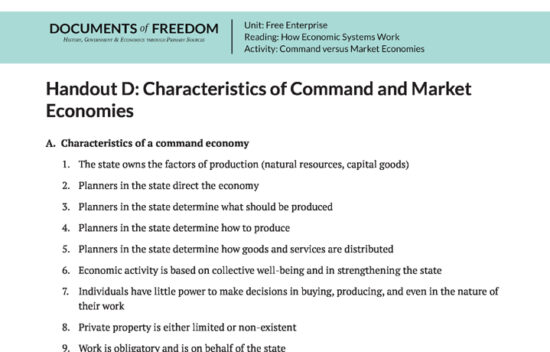
How Economic Systems Work
Lesson - 5 Activities
Lesson
5 Activities
60 Min
As buyers purchase goods and services, they signal to the producers what ought to be made. If people want to wear pants with farm animal designs, they buy them. Producers have to be observant to anticipate demand. As they see that the stock of cow pants is flying off the shelves, they will create many more of them. Buyers and sellers are able to communicate effectively using just money.
60 Min

Philanthropy
Lesson - 4 Activities
Lesson
4 Activities
60 Min
Philanthropy may be defined as the desire to promote the welfare of society by giving your own money to good causes. Philanthropy is not allocating the money of others, whether through taxes or government programs, to the less fortunate in society. Philanthropy is an action of one individual or one family giving to help others.
60 Min