Lesson
Civic and Constitutional Life Deconstructed DBQ Mini-Lesson
Guiding question
How can understanding the principles of the Constitution help citizens participate effectively in a democratic society?

Founding Principles
Objectives
- Students will engage in critical thinking to interpret historical perspectives using VIEW (Voice, Intent, Environment, Who).
- Students will practice document analysis skills through a Silent Discussion activity.
- Students will develop a thesis statement using historical evidence.
- Students will group sources based on similarities and historical themes.
- Students will develop a thesis that answers the guiding question using evidence from grouped sources.
Materials
Student Materials
- Document Set (choose 1)
- Deconstructed DBQ Assignment Sheet and Document Set
- Scaffolded Deconstructed DBQ Assignment Sheet and Document Set
- Documents contained within both sets include:
- Document A: Excerpt from the Preamble of U.S. Constitution (1787)
- Document B: Excerpt from First Amendment (1787)
- Document C: Excerpt from Tenth Amendment (1787)
- Document D: Excerpt from Federalist #51, James Madison (1788)
- Document E: Miranda v. Arizona (1966) – U.S. Supreme Court Decision
- Document F: Engel v. Vitale (1962) – U.S. Supreme Court Decision
- Documents contained within both sets include:
- Unit 4 Thesis, Grouping, and “VIEW” Deconstructed DBQ Graphic Organizer
- Civic and Constitutional Life Video
Teacher Materials
- Chart paper and markers (for Silent Discussion)
- Unit 4 Slide Deck
- Unit 4 Model Organizer and Scoring Guide Teacher Resource
- Unit 4 Deconstructed DBQ Document Set and Teacher Context Teacher Resource
Lesson Components
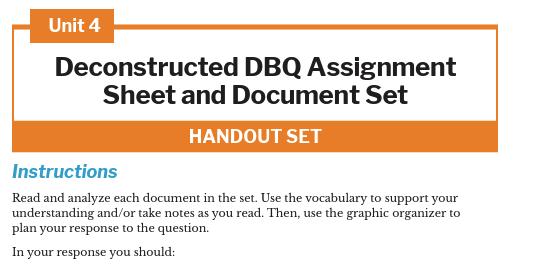
Document Set that addresses the question: how can understanding the principles of the Constitution help citizens participate effectively in a democratic society?
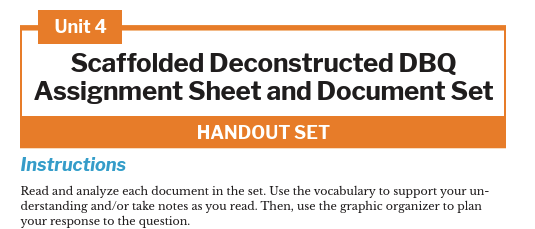
Scaffolded Document Set that addresses the question: how can understanding the principles of the Constitution help citizens participate effectively in a democratic society?
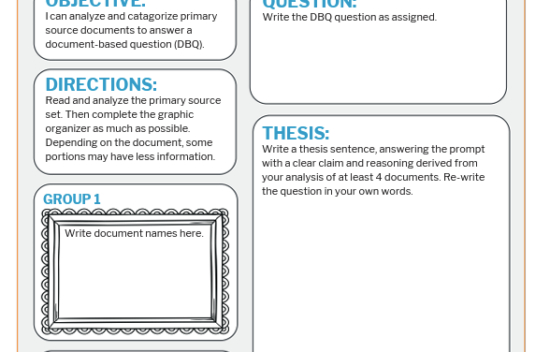
A student handout to aid in analyze of primary sources and develop a thesis in response to a historical prompt.
Lesson Components
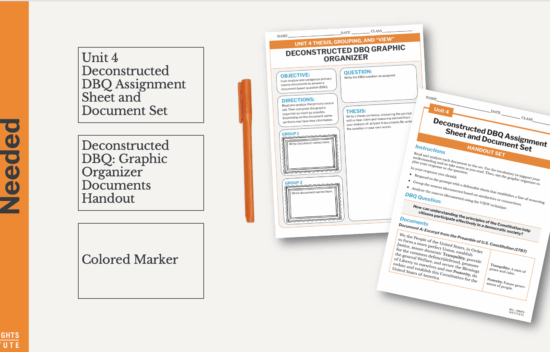
Help students practice the skill of analyzing primary sources using the VIEW framework (Voice, Intent, Environment, Who).
Document Set that addresses the question: how can understanding the principles of the Constitution help citizens participate effectively in a democratic society?
Scaffolded Document Set that addresses the question: how can understanding the principles of the Constitution help citizens participate effectively in a democratic society?
A student handout to aid in analyze of primary sources and develop a thesis in response to a historical prompt.
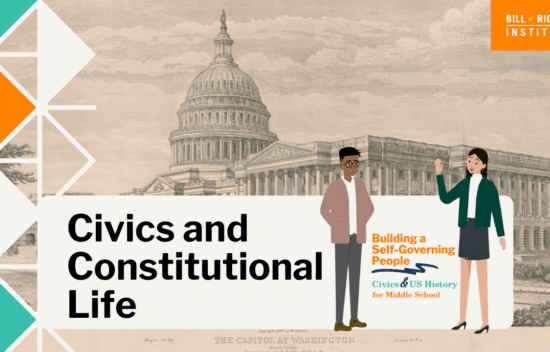
In this middle school history lesson, students explore Theodore Roosevelt’s 1883 speech "The Duties of American Citizenship". Delivered while he was still a New York State Assemblyman, Roosevelt’s words challenged Americans to take their civic responsibilities seriously, and his call to action still resonates today. What does it mean to be an active citizen, and how do the principles of the Constitution guide that responsibility? Using the VIEW method (Voice, Intent, Environment, and Who), students analyze Roosevelt’s speech to uncover his message about civic virtue, political participation, and working together for the common good.
Teacher support for implementing the.Unit 4: Civic and Constitutional Life Deconstructed DBQ.
Assess the Unit 4 Deconstructed DBQ.
Lesson plan
More Information
Facilitation Notes
- This is a mini-lesson intended to take 45-60 minutes and focus on a specific skill. It was created to accompany the mini-lesson teacher slide deck.
- This lesson is created to build upon the previous Deconstructed DBQ lessons. However, it can be implemented in isolation with additional supports. Modify using the scaffolding notes to fit your classroom.
- The goal is to help students develop the skill of analyzing primary sources using the VIEW framework (Voice, Intent, Environment, Who), group sources based on similar characteristics and create thesis statements.
- Common acronyms for primary source analysis include HIPP or HAPPY, but this lesson uses VIEW to structure analysis and writing.