Lesson
Early Republic Deconstructed DBQ Mini-Lesson
Guiding question
How did the Constitution influence decisions in the Early Republic?

Founding Principles
Objectives
- Students will provide historical context for primary source documents.
- Students will engage in critical thinking to interpret historical perspectives using VIEW (Voice, Intent, Environment, Who).
- Students will develop a thesis statement using historical evidence.
- Students will group sources based on similarities and historical themes.
- Students will develop a thesis that answers the guiding question using evidence from grouped sources.
Materials
Student Resources
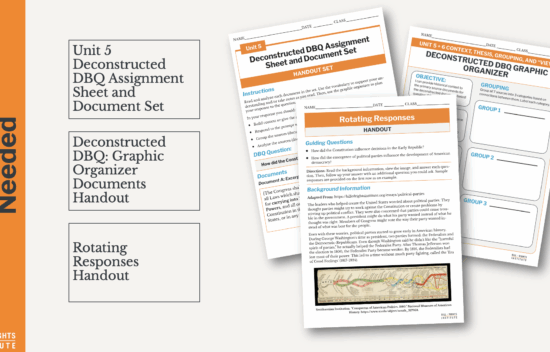
- Rotating Responses Handout
- Unit 5 Deconstructed DBQ Context, Thesis, Grouping, and VIEW Graphic Organizer
- Document Set (choose 1)
- Deconstructed DBQ Assignment Sheet and Document Set
- Scaffolded Deconstructed DBQ Assignment Sheet and Document Set
- Documents contained within both sets include:
- Document A: Excerpt from Article I Section 8 of the Constitution (1787)
- Document B: Excerpt from Federalist #10 James Madison (1787)
- Document C: Excerpt from George Washington’s First Inaugural Address (1789)
- Document D: Excerpt from Alexander Hamilton’s Opinion on the National Bank (1791)
- Document E: Excerpts from Thomas Jefferson opinion on the National Bank (1791)
- Document F: Excerpt from George Washington’s Farewell Address (1796)
- Document G: Excerpt from the Sedition Act (1798)
- Documents contained within both sets include:
- Early Republic Video
Teacher Resources
Lesson Components
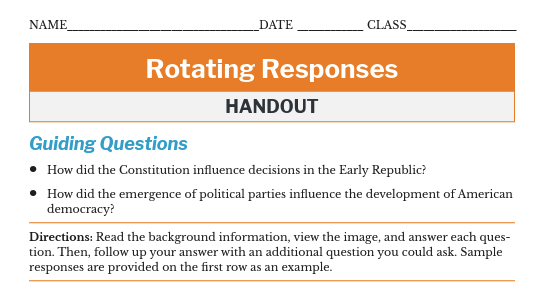
Student Response Handout that helps students analyze a political cartoon to build background knowledge for the deconstructed DBQ.
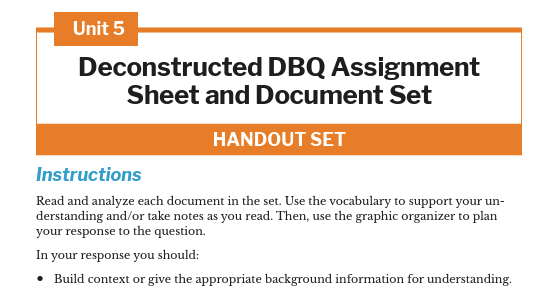
Document Set that addresses the question: How did the Constitution influence decisions in the Early Republic?
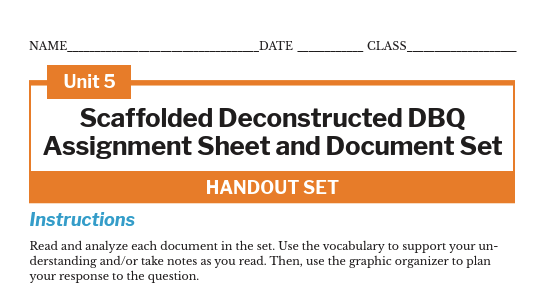
Scaffolded Document Set that addresses the question: How did the Constitution influence decisions in the Early Republic?
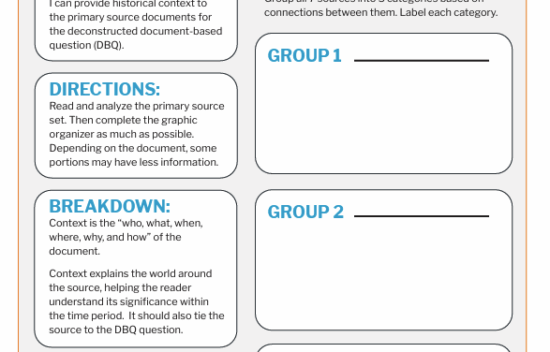
Analyze primary sources to answer a historical prompt.
Lesson Components
A pre-made slide deck to accompany this lesson.
Scaffolded Document Set that addresses the question: How did the Constitution influence decisions in the Early Republic?
Document Set that addresses the question: How did the Constitution influence decisions in the Early Republic?
Analyze primary sources to answer a historical prompt.
Student Response Handout that helps students analyze a political cartoon to build background knowledge for the deconstructed DBQ.
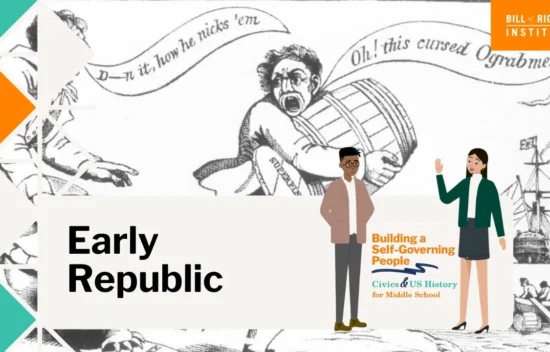
In this middle school lesson, students examine a political cartoon from 1807 to explore how the Constitution shaped decision-making in the early American Republic. Set during Napoleonic Wars, the lesson focuses on Thomas Jefferson and the controversial Embargo Act of 1807. As Britain and France interfered with American trade and practiced impressment, Jefferson and Congress faced constitutional questions about regulating commerce, separation of powers, and protecting national interests without going to war. Through guided analysis, students practice the historical thinking skill of providing context, asking who, what, when, where, why, and how to better understand the cartoon’s message. They evaluate debates between Democratic-Republicans and Federalists, consider principles like separation of powers and consent of the governed, and craft a clear thesis answering the essential question: How did the Constitution influence decisions in the early Republic?
Teacher support for implementing the Unit 5: Early Republic Deconstructed DBQ.
Rubrics to assess the Unit 5 DBQ.
Lesson plan
More Information
Facilitation Notes
- This is a mini-lesson intended to take 45-60 minutes and focus on a specific skill. It is created to accompany the mini-lesson teacher slide deck.
- This lesson is created to build upon the previous Deconstructed DBQ lessons. However, it can be implemented in isolation with additional supports. Modify using the scaffolding notes to fit your classroom.
- This mini-lesson introduces the new skill of providing context which will be built on in Unit 7: American Expansion with the introduction of the skill providing evidence.