Lesson
The Constitution “VIEW”ing Documents Deconstructed DBQ Mini-Lesson
Guiding question
What were the principles of the new Constitution and how did they shape the debate between the Federalists and Anti-Federalists during the ratification debate?

Founding Principles
Limited Government, Separation of Powers, Checks and Balances
Virtues
Objectives
- Students will analyze primary source documents to understand key historical events.
- Students will engage in critical thinking to interpret historical perspectives.
- Students will practice document analysis skills through the Game of Quotes activity.
- Students will develop a thesis statement using historical evidence.
Materials
Student Resources
- Document Set (choose 1):
- “VIEW”ing Documents Deconstructed DBQ Graphic Organizer
- Constitution and Ratification Video
Teacher Resources
Lesson Components
What were the principles of the new Constitution and how did they shape the debate between the Federalists and Anti-Federalists during the ratification debate?
Document Set that address the question: What were the principles of the new Constitution and how did they shape the debate between the Federalists and Anti-Federalists during the ratification debate?
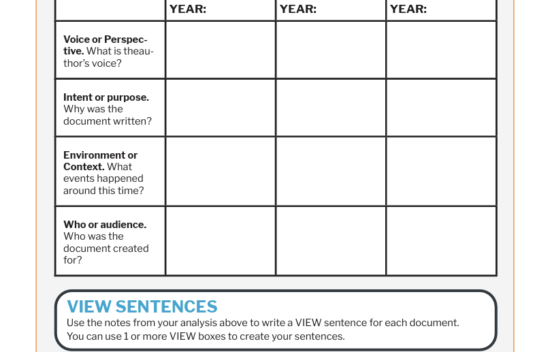
Graphic Organizer to guide students through accompanying documents.
Lesson Components
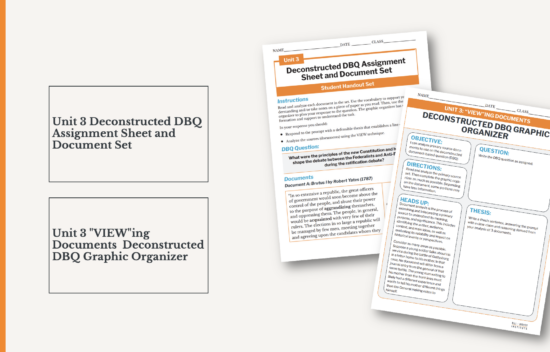
A pre-made slide deck to accompany this lesson.
Document Set that address the question: What were the principles of the new Constitution and how did they shape the debate between the Federalists and Anti-Federalists during the ratification debate?
What were the principles of the new Constitution and how did they shape the debate between the Federalists and Anti-Federalists during the ratification debate?
Graphic Organizer to guide students through accompanying documents.
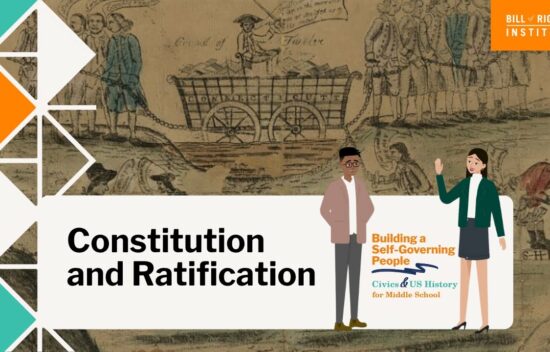
Guiding Question: What were the principles of the new Constitution and how did they shape the debate between the Federalists and Anti-Federalists during the ratification debate? About the Video Series: Our video resources in the Building a Self-Governing People middle school curriculum integrate primary source analysis with Document-Based Question (DBQ) skills to deepen student learning. Use them to launch your assessment lesson or to support students who need a refresher on DBQ strategies. Each video features two young professionals: a museum curator leading a gallery tour and an educator accompanying students on a field trip. The curator models how to analyze primary sources such as historical documents and artwork. Then, the educator demonstrates how to use that analysis to answer a compelling historical question. For guidance on how to use the videos within your lessons, refer to the unit’s Deconstructed DBQ Lesson Plans.
Teacher support for implementing the Unit 3: Constitution and Ratification Deconstructed DBQ.
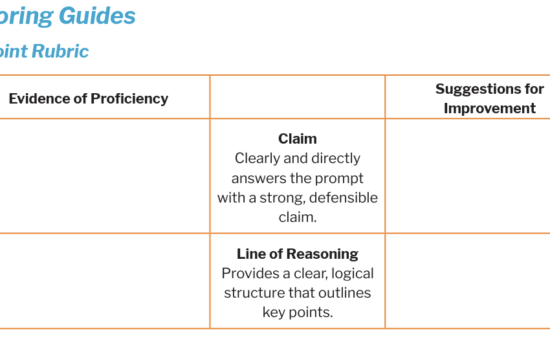
Lesson plan
More Information
Facilitation Notes
- This is a mini-lesson intended to take 30-45 minutes and focus on a specific skill. It accompanies the mini-lesson slide deck.
- The goal is to help students develop the skill of analyzing primary sources using the VIEW framework (Voice, Intent, Environment, Who).
- Common acronyms for primary source analysis include HIPP or HAPPY, but this lesson uses VIEW to structure analysis and writing.
- Encourage collaboration through discussion, peer review, and group activities.
Standards
Related materials
Guiding Question: What were the principles of the new Constitution and how did they shape the debate between the Federalists and Anti-Federalists during the ratification debate? About the Video Series: Our video resources in the Building a Self-Governing People middle school curriculum integrate primary source analysis with Document-Based Question (DBQ) skills to deepen student learning. Use them to launch your assessment lesson or to support students who need a refresher on DBQ strategies. Each video features two young professionals: a museum curator leading a gallery tour and an educator accompanying students on a field trip. The curator models how to analyze primary sources such as historical documents and artwork. Then, the educator demonstrates how to use that analysis to answer a compelling historical question. For guidance on how to use the videos within your lessons, refer to the unit’s Deconstructed DBQ Lesson Plans.