Lesson
Tiananmen Square and Courage

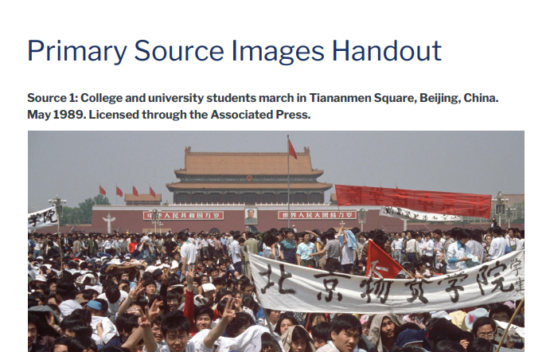
How did the anonymous individual who refused to yield to a tank during the crackdown on protesters at Tiananmen Square display the virtue of courage?
Founding Principles
Virtues
Guiding questions
Essential Question
- Why does being courageous when faced with fear and danger matter?
Guiding Questions
- What are some possible consequences of doing nothing in the face of injustice?
- What are the risks of acting courageously?
- What are the elements required to act courageously?
Learning Objectives
- Students will analyze the story of Tiananmen Square to identify acts of courage in the face of danger.
- Students will describe the complexities of choosing to act courageously in their daily lives.
- Students will observe primary source images using critical thinking and analysis skills.
- Students will reflect on the importance of courage in a democratic society.
Materials
Student Resources
Teacher Resources
- Analysis Questions
- Virtue in Action
- Journal Activity
- Sources for Further Reading
- Virtue Across the Curriculum
Lesson Components
Lesson plan
90 minClick a phase to open it
Key Terms
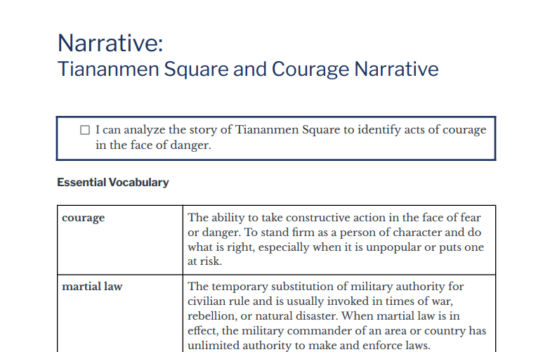
- Courage
- The ability to take constructive action in the face of fear or danger. To stand firm as a person of character and do what is right, especially when it is unpopular or puts one at risk.
- Martial law
- the temporary substitution of military authority for civilian rule and is usually invoked in time of war, rebellion, or natural disaster. When martial law is in effect, the military commander of an area or country has unlimited authority to make and enforce laws.
More Information
Procedures
- The following lesson asks students to consider the virtue of courage in the face of injustice.
- Students will engage with the story of Tiananmen Square, as they consider the question: Why does being courageous when faced with fear and danger matter?
- The main activity in this lesson requires students to read and analyze a narrative that explores how an unknown demonstrator courageously stood up against the Chinese government. Students may work individually, in pairs, or small groups as best fits your classroom. The analysis questions provided can be used to help students comprehend and think critically about the content. As the teacher, you can decide which questions best fit your students’ needs and time restraints.
- Lastly, the lesson includes sources used in this lesson for further reading and suggestions for cross-curricular connections.
Standards
Related materials

LessonAnne Hutchinson and Courage: In the Face of Adversity
How did Anne Hutchinson practice courage to support religious freedom in the American colonies?

LessonThe Pilgrims’ Courageous Journey
In this lesson, students will learn about the journey the Pilgrims took before landing at Plymouth Rock and settling in the New World. They will learn about the numerous setbacks they had to overcome in their journey and come to understand the courage often required to accomplish one’s purpose.

LessonThe Spirit of St. Louis: Charles Lindbergh and Courage
How did Charles Lindbergh the courage demonstrate during his cross-Atlantic flight? How can students act with courage in their own lives?

LessonNumber 42: Jackie Robinson and Courage
How did Jackie Robinson, who persevered through the integration of major league baseball, display courage? Students will see how they can courageously fight for equality in their own lives.