Lesson
The Resignation of Richard Nixon
Guiding question
Did President Gerald Ford best preserve, protect, and defend the Constitution by pardoning Richard Nixon?

Objectives:
Students will:
- Understand the sequence of events by which Gerald Ford became President.
- Assess the legitimacy of Gerald Ford’s presidency.
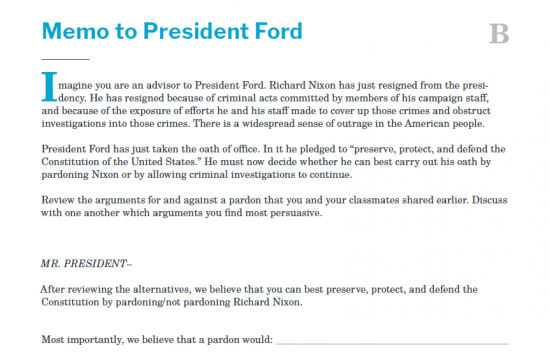
- Evaluate the legitimacy and wisdom of President Ford’s pardon of Richard Nixon.
Materials
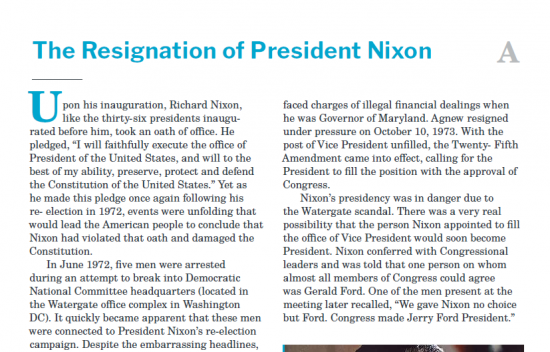
- Handout A: The Resignation of President Nixon
- Handout B: Memo to President Ford
Lesson Components
Lesson plan
More Information
To create a context for this lesson, students complete Constitutional Connection: Presidents and the Transfer of Power.
Standards
Related materials

How did Mark Felt lived up to the responsibility he believed he had to uphold the rule of law during the Watergate Scandal?

In this lesson, students will learn how Barbara Jordan sought justice during the Watergate scandal. They will also learn how they can protect justice in their lives.

In 1974, Richard M. Nixon became the only President in US history to resign from the presidency. After administration operatives were caught breaking into the Democratic Party headquarters at the Watergate office complex in Washington, DC, Nixon covered up the crime. A Congressional investigation produced a stunning revelation: The Oval Office had a recording system that taped all the President’s conversations. The tapes could prove whether Nixon himself had ordered the cover-up. The Supreme Court rejected Nixon’s claim that executive privilege allowed him to withhold the tapes. With members of his own Republican Party turning against him and the House drawing up impeachment charges that were sure to pass, Nixon resigned the presidency on August 9. The events raised serious questions about the definition, use, and abuse of executive authority.