Lesson
The Election of 1800, Adams v. Jefferson
Guiding question
What is gained and what is lost by giving political parties a role in electing our President?

Founding Principles
Objectives:
Students will:
- Understand the process originally established in the Constitution for electing a President.
- Recognize ways in which the original electoral process failed when political parties took a role in selecting candidates.
- Evaluate the role of political parties in sorting presidential candidates.
Materials
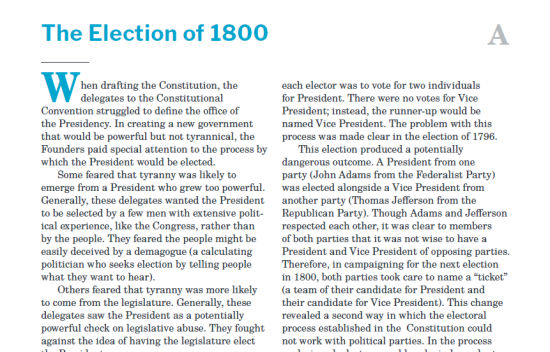
- Handout A: The Election of 1800
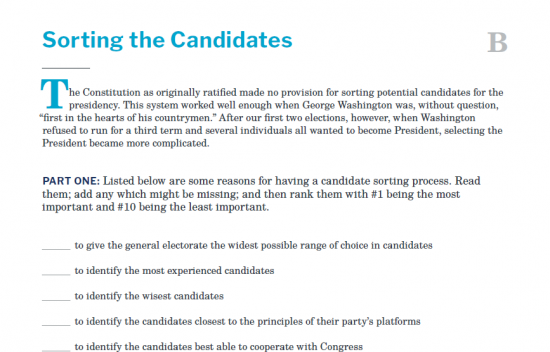
- Handout B: Sorting the Candidates
Lesson Components
Lesson plan
More Information
To create a context for this lesson, have students complete Constitutional Connection: Presidents and the Transfer of Power.
Standards
Related materials

Contentious elections are nothing new in U.S. history. This eLesson explores some of our most bitter presidential elections, and challenges students to analyze the value of a peaceful transfer of power within our governing system.

BRI Senior Teaching Fellow Tony Williams sits down with Jonathan White, associate professor of American Studies at Christopher Newport University and author of several books on the Civil War, to discuss his essay on the presidential election of 1824 in our new digital history textbook, Life, Liberty, and the Pursuit of Happiness. Together, they piece together the historical background behind one of the most contentious elections in American history. In 1824, none of the four candidates—Andrew Jackson, John Quincy Adams, Henry Clay, or William Crawford—were able to obtain a majority of the Electoral College vote. The Twelfth Amendment required the election be sent to the U.S. House of Representatives, where John Quincy Adams was chosen as the sixth U.S. president. Can we learn any lessons about democracy from contentious elections? Was the election a crisis or a demonstration of the successful workings of constitutional principles? About Jonathan White: Jonathan White is an associate professor of American Studies at Christopher Newport University and is the author or editor of ten books, including "Abraham Lincoln and Treason in the Civil War: The Trials of John Merryman and Emancipation" and "Emancipation, the Union Army, and the Reelection of Abraham Lincoln," which was a finalist for both the Lincoln Prize and the winner of the Abraham Lincoln Institute’s 2015 book prize. He serves on the Boards of Directors of the Abraham Lincoln Institute, the Abraham Lincoln Association, the Lincoln Forum, and the John L. Nau III Center for Civil War History at the University of Virginia. His most recent books include "Lincoln on Law, Leadership and Life" and “Our Little Monitor: The Greatest Invention of the Civil War." He is presently writing a biography of a convicted slave trader named Appleton Oaksmith. Check out his website at www.jonathanwhite.org/ or follow him on Twitter at @CivilWarJon.

The Election of 1824 was the first to be decided in the House of Representatives after the Twelfth Amendment was passed. Jackson received the most electoral votes and the greatest percentage of the popular vote (inasmuch as it existed in 1824), but the House voted for John Quincy Adams. In this lesson, students explore the election of 1824 and evaluate the Electoral College system.

The election of 1860 was the only election in our history that did not result in a peaceful transfer of power. As political developments changed the way the Constitution’s compromises on slavery were understood and applied, Americans from both North and South expressed fears about conspiracies to either impose or prohibit slavery throughout the nation. Fearing a loss of power within the Union, many Southerners revisited arguments about the nature of the Constitution. Some argued that the Constitution was a compact among the states, and that interpretation seemed to allow for states to secede, or withdraw from that compact. After the Republican candidate, Abraham Lincoln, was elected President in 1860—without even appearing on the ballot in ten Southern states—Southern states rapidly took action to secede from the Union, and President Lincoln took action to keep the Union together.

The US Constitution provides an orderly process for electing the President, as described in Article II and the Twelfth Amendment. However, in the election of 1876, two conflicting sets of electoral votes were submitted by each of four states. The Constitution provided no process for determining the legitimate set of votes. Acting outside any constitutional mandate, Congress created a special commission to investigate the returns from Oregon, South Carolina, Louisiana, and Florida. Voting along party lines, the commission ruled that Rutherford B. Hayes had won the disputed election.