Lesson
Rights and the Declaration of Independence
Guiding question
What is the American idea of religious toleration and religious liberty?

Founding Principles
Objectives
- Students will explain how the First Amendment protects religious freedom.
- Students will differentiate between religious toleration and religious liberty.
- Students will identify early legislation regarding religious liberty.
- Students will analyze Washington’s response to the Jewish congregation in Newport, RI.
Materials
Educator Resources
Student Handouts
- Rights and the Declaration of Independence Essay
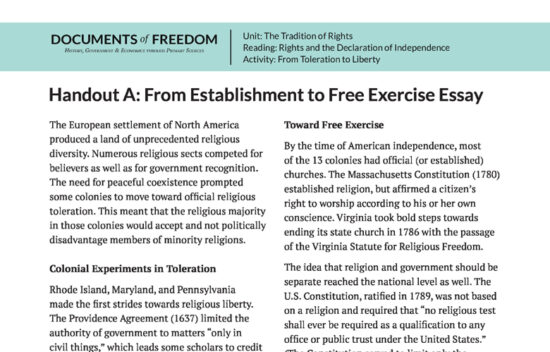
- Handout A: From Establishment to Free Exercise Essay
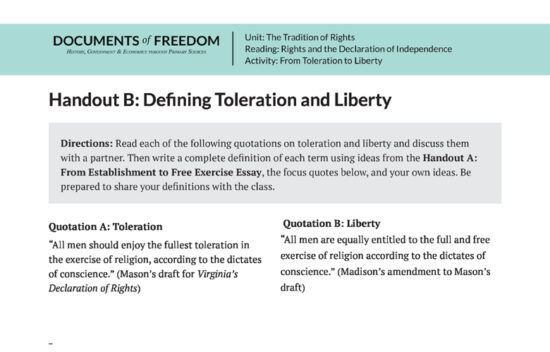
- Handout B: Defining Toleration and Liberty
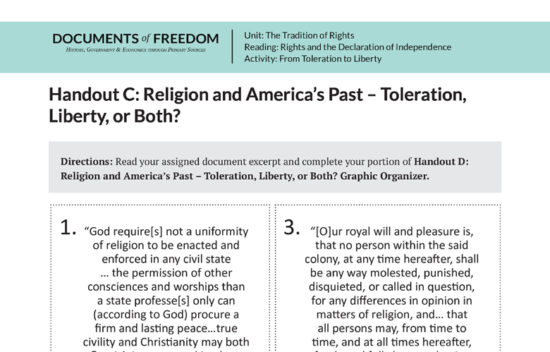
- Handout C: Religion and America’s Past – Toleration, Liberty, or Both?
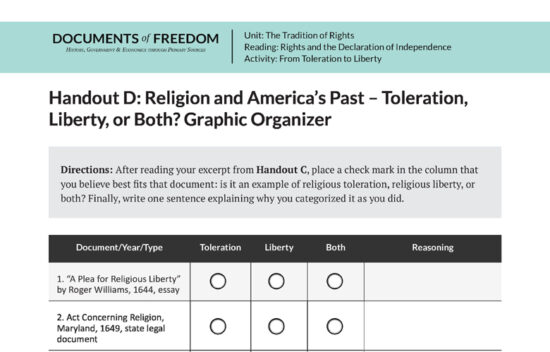
- Handout D: Religion and America’s Past – Toleration, Liberty, or Both Graphic Organizer
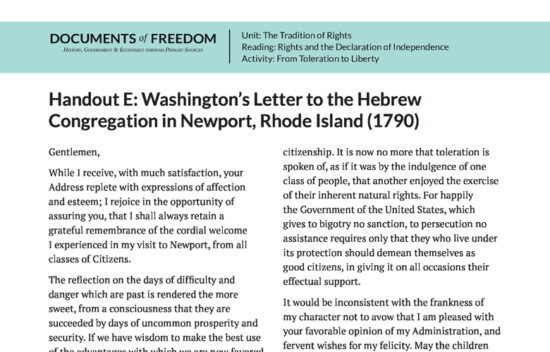
- Handout E: Washington’s Letter to the Hebrew Congregation in Newport, Rhode Island (1790)
Lesson Components
The Declaration of Independence, based in part on the philosophy of John Locke, was an "expression of the American mind". Going back to Magna Carta, British nobles had petitioned the monarch demanding limits to his power. But Locke argues and the Declaration of Independence asserts that legitimate government is based on the consent of the governed. Locke's ideas were too democratic, too revolutionary for his time in England, but a century later they had a firm hold in the American colonies, and in 1776 they were the basis of the original and most fundamental American statement of rights, the Declaration of Independence.
Lesson plan
Key Terms
- Bill of Rights
- Constitution
- Declaration of Independence
- Diversity
- Equality
Standards
Related materials

On June 7, 1776, Richard Henry Lee brought what came to be called the Lee Resolution before the Continental Congress. This resolution stated “these United Colonies are, and of right ought to be, free and independent states ...” Congress debated independence for several days.