Lesson
Lady Bird Johnson and the Highway Beautification Act In Pursuit Lesson Plan
Founding Principles
Virtues
Guiding questions
Essential Questions
- How did Lady Bird Johnson encourage the public to engage with an existing responsibility to care for the environment?
- How did Lady Bird Johnson do this through her environmental work?
Guiding Questions
- What problems did Lady Bird Johnson see in the environment around her, and why did she believe they mattered for the country?
- How did she work to address these concerns?
- What challenges did she face, and how did she persuade others to take these issues seriously?
- What civic virtues influenced her choices and impact?
Objectives
- The student will…
- Synthesize information about Lady Bird Johnson from several sources.
- Identify key civic virtues that Lady Bird Johnson practiced for the common good.
- Explain specific actions Lady Bird Johnson took practicing civic virtue.
- Analyze the impact of Lady Bird Johnson’s actions improving the quality of life in the United States.
Materials
Lesson resources
Analyze a diary entry by Lady Bird Johnson to examine how her personal observations, values, and reflections shaped her environmental leadership and civic commitments.
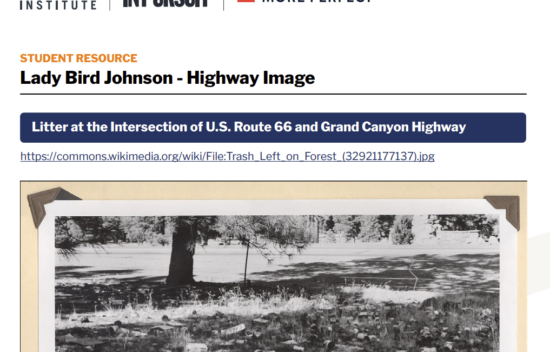
Evaluate an image of a littered highway to identify the impact of Lady Bird Johnson's lobbying efforts.
In this video, students learn how Lady Bird Johnson used justice and civic responsibility to improve communities across America. Motivated by her belief that all people deserve beautiful and healthy public spaces, she championed environmental conservation and the Highway Beautification Act. Her efforts inspired citizens to take pride in their communities and demonstrated how small actions can contribute to the common good. This video was based on an essay for In Pursuit written by First Lady Laura Bush. This video was made in conjunction with In Pursuit. In Pursuit is a landmark initiative of More Perfect, a bipartisan alliance of 44 Presidential Centers, National Archives Foundation, American Academy of Arts and Sciences, Karsh Institute for Democracy at the University of Virginia, and more than 100 organizations working together to protect and renew our democracy as we approach the 250th anniversary of the Declaration of Independence and beyond.
Lesson plan
More Information
Facilitation Notes
- This video and lesson were developed in connection with the In Pursuit project https://www.inpursuit.org/lessons. The essay for Lady Bird Johnson was written by Laura Bush. It can be read for additional teacher background on this topic, and it might be well-suited to classroom use for higher-level readers. The full essay is available here: https://www.inpursuit.org/lessons
- The essay provides an overview of Johnson’s role in championing of the Highway Beautification Act, often nicknamed “Lady Bird’s Bill.” The central lesson that Bush’s essay imparts is: “When you plant a seed, you beautify a nation.”
- The essay is one perspective on the life and work of Lady Johnson. The video highlights another aspect of Johnson’s legacy: the foundation of Johnson’s actions in the practice of civic virtue. This video foregrounds justice while revealing how virtues work together in practice. Although the video title names justice, the lesson centers on how Johnson’s work was grounded in responsibility. The lesson uses the video to explore responsibility for how Lady Bird Johnson took ownership of her role in public life and followed through on commitments that contributed to broader goals of justice. The Bill of Rights Institute defines this virtue in the following way:
- Responsibility: Acting on good judgment about what is right or wrong even when it is not popular. Individuals must take care of themselves, their families, and their fellow citizens in civil society and a republic and be vigilant to preserve their own liberty and the liberty of others.
- Encourage your students to critically engage with the material in the video, the primary source, and other context you may be providing to come to their own conclusion and assessment.