(K-3) Reading Skill Mini-Lesson – Comprehension and Civic Virtue
Lesson Components
Guiding Question:
- How did Benjamin Franklin practice civic virtues to improve himself and his community?
Objectives
- Students will. . .
- Read a text with purpose.
- Describe how Benjamin Franklin practiced civic virtues.
- Demonstrate understanding of civic virtues through discussion.
Facilitation Notes
- This mini-lesson is intended to be implemented in a short 20-30 minute class period.
- This lesson is intended for younger learners, from Kindergarten to 3rd grade. Several modifications, such as different levels of texts and scaffolding notes, are available to span this large range of ages and developments.
- This lesson requires advance preparation, including collecting and printing materials. See the Teacher and Student Materials list.
Resources
Teacher Materials
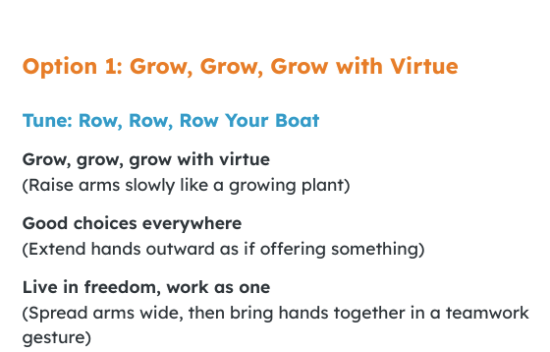
- Civic Virtue Songs
- Chart paper for creating an anchor chart
Student Materials
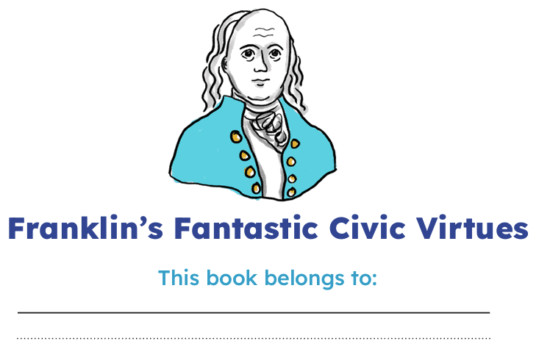
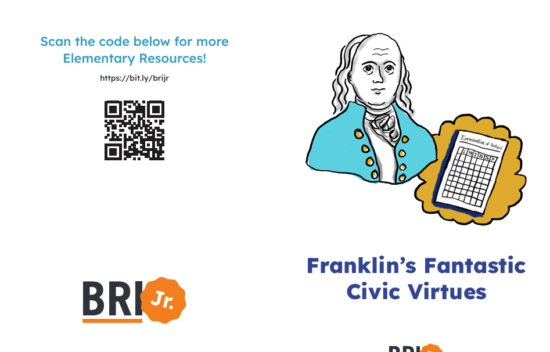
- Franklin’s Fantastic Civic Virtues Mini-book
- Two versions of the mini-book are available based on the lexile level of your learners.
- Option A (K-1)
- Print double-sided, along short edge. Fold along center line and staple to create a book.
- Print-Ready Option B (2-3)
- Print single-sided, staple on left side where indicated, then cut on the dotted line to create books.
- Digital Option B (2-3) – meant to be accessed via a device
- Option A (K-1)
- Two versions of the mini-book are available based on the lexile level of your learners.
- Group Assessment
- Two options of the assessment are available to choose from based on the needs of your learners.
Engage
Civic Virtue Song
- Tell students: “Today I am going to teach you a song called the Civic Virtue Song. It is going to help us remember some important ideas that we will be learning about.”
- Teach students the words and motions for the Civic Virtue Song, one line at a time.
- Sing the full song at least two times with students.
- You can repeat the song throughout the day singing with students during transitions, play time, or during periods of waiting.
Teacher note: There are two civic virtue songs available in the teacher resource. Choose the one that works best for your classroom.
Explore
Repeated Reading
- Transition: Distribute copies of the mini-book to students.
- Tell students: “We are going to read a book called Franklin’s Fantastic Civic Virtues. Based on our Civic Virtue Song, what do you think civic virtue is? Based on the title and the book cover, what do you think this book will be about?”
- Guide students to the idea that civic virtues are good habits that promote good character and that make good communities for everyone.
- Read the book with students twice.
- First, read the book aloud to students as they follow along with pointing to each word with a finger as you read. Model appropriate speed and expression as you read to your students.
- Pause and discuss the reading strategy Are you Understanding? before reading the story again.
Are you Understanding?
- Transition: Now that we have read the story, we can begin to consider what it is about. To figure out what a story is about, it can help to pay attention to words that you see again and again. On each page, notice what repeats. Then ask yourself, “Does this word tell me what the book is mostly about?”
- Pair students and supply them with pencils. Ask students to circle important words in their mini-book that repeat.
- Advise students that they can skip functional words like He, the, and it. They should focus on words that give the story meaning.
- Ask several students to share a word that they circled.
- Then call on one or more students to share what they think the main topic of the story is.
- Transition: Ask students to put their pencils down and return to the beginning of their mini-books to continue with the Repeated Reading.
- Next, read the book in a teacher think-aloud reading style.
- In a think-aloud, you will pause at strategic points to highlight important information, summarize, and model skilled thinking about reading for your students.
- For example, on page 15 of mini-book Option A the text says: “He also thought that practicing civic virtue was important for the new American colonies. He knew Americans would need to have good character to govern themselves.”
- A teacher could say: What do you think it means when it says govern themselves? How do we govern ourselves at school? Franklin believed that people needed to have good character to help their country. That makes me think about how today, we also need to be kind, honest, and responsible to make our communities better. For example, when people follow rules, or help others, they’re showing good character—just like Franklin wanted. I wonder what I can do to help my community today. Maybe I can pick up litter at the park or help a friend who needs something. That’s how I can show civic virtue too! When have you seen someone be kind or honest?
- This kind of connection helps students see how the ideas in the story relate to the real world and their own lives.
- Then ask students if the main topic seems right after their second read. Correct any misunderstandings as needed.
Scaffolding note: If reading with more advanced or older students, additional reading styles are available to choose from in our Modes of Reading Teacher Support Document.
Assess
Group Assessment
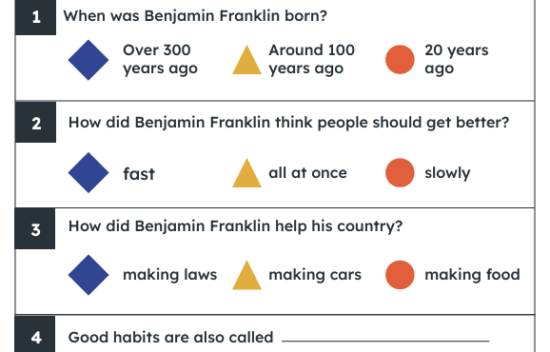
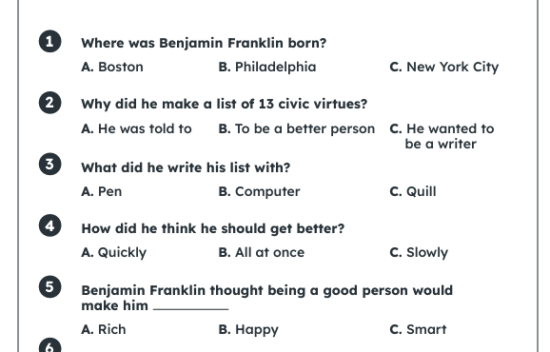
- Facilitate a whole group assessment. There are two options available based on the needs of your classroom.
- Option 1: For K-1
- 5 multiple choice questions, shapes distinguish options
- Option 2: For 2-3
- 10 multiple choice questions, letters distinguish options
- Option 1: For K-1
- To facilitate a whole-group assessment:
- Print a copy of your chosen assessment option for each student in the class and project a copy of the assessment if possible.
- Ask students to point to the number 1 on their page, then follow along as you read aloud. Perhaps pointing to each word as you read.
- Read the question, pointing to each word.
- Read each answer choice, pointing to the choice indicator (letter or shape)
- Repeat the question-and-answer choices if needed.
- Prompt students to choose their answer by circling their choice.
- Repeat for the following questions to complete the assessment.
Extend
Anchor Chart Creation
- Create an anchor chart with students that will hang in the classroom. The anchor chart should include:
- Civic virtue is the practice of a good quality—like kindness, honesty, or courage. It’s something you choose to do to be a better person.
- Practicing civic virtue builds character which is when you do good things again and again—until it becomes part of who you are.
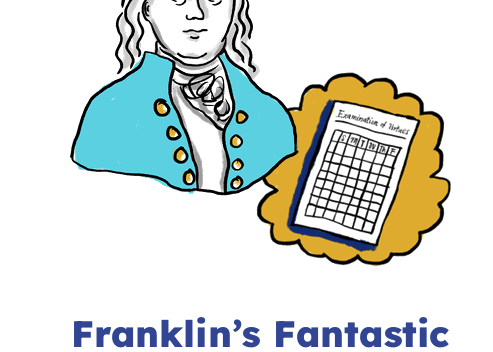
- Benjamin Franklin practiced civic virtue by making a list and working to use one virtue a week.
- Examples of Civic Virtues:
- Respect- Hands Shaking – treating all people equally, knowing that all humans deserve kindness no matter what
- Responsibility – Two hands on top of each other – making good decisions about what is right and wrong.
- Justice – scales – upholding what is fair and right.
- Courage – a lion – the ability to take helpful action in the face of fear or danger.
- Examples of civic virtue in action. This will vary based on your class. You could include helping in the community, listening, being kind, volunteering
- Send student mini-books home at the conclusion of the lesson to encourage family engagement. Families and students will benefit from shared understanding around classroom activities.
Scaffolding note: You could also extend this by choosing civic virtues students could practice at home and work each week. Students create their own civic virtue table modeled after Franklin’s, record their efforts daily, and compare their experiences at morning meeting or circle time.
