Lesson
Irma Grese and Self-Deception
How did self-deception play a role in the World War II Holocaust? How can ordinary men and women be indoctrinated to commit inhuman evil, and how can we guard against ideologies that lead to these behaviors?
Founding Principles
Civic Virtue, Equality, Individual Responsibility, Liberty, Majority Rule / Minority Rights
Guiding questions
Essential Question
- Why is self-deception destructive to a healthy civil society?
Guiding Questions
- How can a person become so deceived by ideas that lead them to commit horrific acts against others?
- How can one prevent themselves from being deceived by harmful ideas?
Learning Objectives
- Students will analyze the story of Irma Grese to identify the dangers of self-deception, and explain how self deception can lead to the endangerment of others.
- Students will identify skills they can practice to avoid conforming to an ideology rather than thinking for oneself.
- Students will reflect and plan how they can think critically to help prevent themselves from being deceived by harmful ideas.
Materials
Student Resources
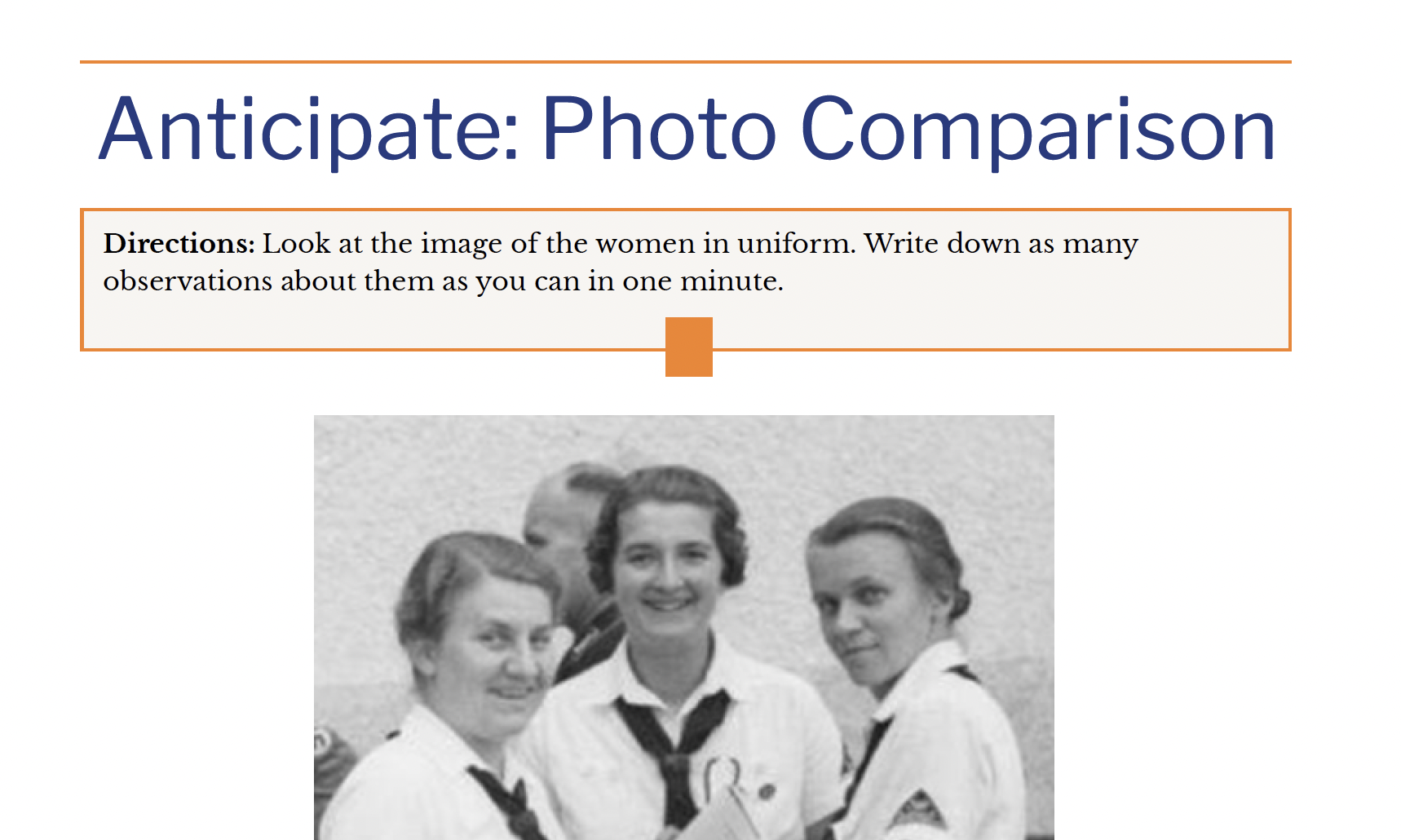
- Anticipate: Photo Comparison Handout
- Engage: Analyzing Primary Sources Handout
- Irma Grese and Self-Deception Narrative
Teacher Resources
- Analysis Questions
- Virtue in Action
- Journal Activity
- Sources for Further Reading
- Virtue Across the Curriculum
Lesson Components
Lesson plan
90 minClick a phase to open it
Key Terms
- Self-Deception
- Acting on a belief that a false idea or situation is true. Being deluded or deceived by ideas that endanger the humanity of others and movements that are unjust.
- Martial
- warlike
- Paramilitary
- a group that is organized to act as a military, but is not part of a country’s official armed forces.
- Fuhrer
- German word for “leader” that is strongly associated with Adolf Hitler.
- Cadre
- a group specially trained for a purpose
More Information
Procedures
- The following lesson asks students to consider the vice of self-deception and how it can cause us to endanger ourselves and others. As humans, we crave community and recognition within the group we belong. However, when we act on a belief that a false idea or situation is true, it can lead to unjust situations. Through activities, storytelling, and reflection, students will understand how to recognize self-deception and combat it with integrity.
- Grese was a young person who was swept up by Nazi ideology. She allowed that ideology to deceive her into thinking injustice was permissible, Jews were a dangerous threat to society, and violence and extermination were normalized. Grese is an example of how self-deception can lead a person to get caught up in conformity to an ideology rather than thinking for oneself about right and wrong.
- Students will engage with the story of Irma Grese as they consider the question: Why is self-deception destructive to a healthy civil society?
- The main activity in this lesson requires students to read and analyze a narrative that explores Irma Grese. Students may work individually, in pairs, or small groups as best fits your classroom. The analysis questions provided can be used to help students comprehend and think critically about the content. As the teacher, you can decide which questions best fit your students’ needs and time restraints.
- Lastly, the lesson includes sources used in this lesson for further reading and suggestions for cross-curricular connections.