Lesson
International Relations: United States Cooperating in UN, NATO, NAFTA, and USMCA
Guiding question
How do international organizations and agreements shape political and economic collaboration on a global scale?

Objectives
- Students will analyze the goals and roles of the United Nations (UN), North Atlantic Treaty Organization (NATO), North American Free Trade Agreement (NAFTA), and United States-Mexico-Canada Agreement (USMCA) within the context of international cooperation.
- Students will demonstrate their understanding of the origins and purposes of the UN, NATO, NAFTA, and USMCA by participating in collaborative research, brainstorming, and artistic expression to create a visual representation (mosaic).
- Students will compare how the United States and other member nations collaborate politically and economically within each framework.
- Students will reflect on their collaborative experience, discussing the challenges and successes encountered during the project and reflecting on the themes of cooperation depicted in the mosaics.
Materials
Materials
- Student Handout: Overview of UN, NATO, NAFTA, and USMCA (below)
- Art supplies (colored paper, markers, glue, scissors)
- Digital devices with internet access
- Access to video editing software (optional)
Overviews of International Organizations
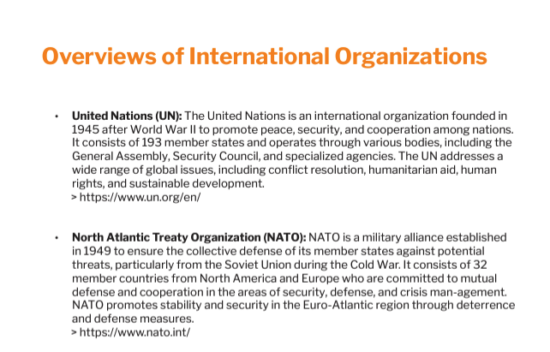
- United Nations (UN): The United Nations is an international organization founded in 1945 after World War II to promote peace, security, and cooperation among nations. It consists of 193 member states and operates through various bodies, including the General Assembly, Security Council, and specialized agencies. The UN addresses a wide range of global issues, including conflict resolution, humanitarian aid, human rights, and sustainable development.
- North Atlantic Treaty Organization (NATO): NATO is a military alliance established in 1949 to ensure the collective defense of its member states against potential threats, particularly from the Soviet Union during the Cold War. It consists of 32 member countries from North America and Europe who are committed to mutual defense and cooperation in the areas of security, defense, and crisis management. NATO promotes stability and security in the Euro-Atlantic region through deterrence and defense measures.
- North American Free Trade Agreement (NAFTA): NAFTA was a trade agreement signed in 1994 by the United States, Canada, and Mexico, aimed at eliminating tariffs and trade barriers among the three countries. It facilitated the flow of goods, services, and investments across borders, promoting economic growth and integration in North America. NAFTA was replaced by the United States-Mexico-Canada Agreement (USMCA) in 2020, which modernized and updated certain provisions of the original agreement.
- United States-Mexico-Canada Agreement (USMCA): USMCA is a trade agreement that replaced NAFTA in 2020. It governs trade relations among the United States, Mexico, and Canada and includes provisions related to intellectual property rights, digital trade, labor standards, environmental protections, and rules of origin for automobiles and agriculture products. USMCA aims to modernize and enhance North American trade while addressing concerns raised under NAFTA.
Lesson Components
ActivityStudent Handout: International Organizations
A student handout to introduce the international organizations that they will encounter in this lesson.
Lesson plan
90 minClick a phase to open it
More Information
Procedures
- In this lesson on international relations, students will explore how organizations and agreements such as the United Nations (UN), North Atlantic Treaty Organization (NATO), North American Free Trade Agreement (NAFTA), and United States-Mexico-Canada Agreement (USMCA) shape political and economic collaboration globally. They will conduct collaborative research and create mosaics to visually represent the goals, roles, and cooperation within these frameworks. The lesson involves a gallery walk to compare and contrast the different organizations, followed by a reflection session to discuss the themes of cooperation, diversity, and unity. Through this process, students will gain a deeper understanding of international cooperation and the role of the United States and other member nations in these organizations.