Lesson
Frederick Douglass and Responsibility
Dive-deep into the life of Frederick Douglass and explore how he demonstrate the virtue of responsibility.
Founding Principles
Virtues
Guiding questions
Essential Question
- How can one individual’s responsibility influence a community?
Guiding Questions
- What happens when one acts irresponsibly and “lets down” another?
- Is there any connection between being responsible and being trusted? Between being responsible and being respected?
Learning Objectives
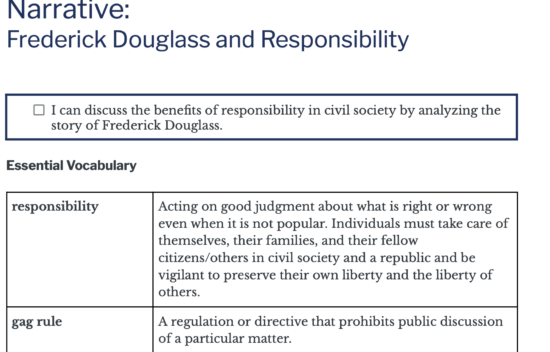
- Students will discuss the benefits of responsibility in civil society by analyzing the story of Frederick Douglass.
- Students will reflect on ways that they can be responsible for themselves and for their communities.
Materials
Student Resources
Teacher Resources
- Analysis Questions
- Virtue in Action
- Journal Activity
- Sources for Further Reading
Lesson Components
Lesson plan
60 minClick a phase to open it
Key Terms
- Responsibility
- Acting on good judgment about what is right or wrong even when it is not popular. Individuals must take care of themselves, their families, and their fellow citizens/others in civil society and a republic and be vigilant to preserve their own liberty and the liberty of others.
- Gag rule
- A regulation or directive that prohibits public discussion of a particular matter.
More Information
Procedures
- The following lesson introduces students to the civic virtue of responsibility. Acting responsibly for oneself and others is essential to the health of one’s community. Students will learn that responsibility is striving to know and do what is best, rather than what is most popular or expedient.
- Students will engage with the story of Frederick Douglass as they consider the question: How can one individual’s responsibility influence a community?
- The main activity of this lesson requires students to analyze the story and actions of Frederick Douglass. Students may work individually, in pairs, or in small groups as best fits your classroom. The analysis questions provided can be used to help students comprehend and think critically about the content. As the teacher, you can decide which questions best fit your students’ needs and time restraints.
- Lastly, the lesson includes sources used in this lesson for further reading and suggestions for cross-curricular connections.
Standards
Related materials


ActivityFrederick Douglass, Narrative of the Life of Frederick Douglass, 1845
Use this primary source text to explore key historical events.

VideoReading Frederick Douglass’ Letter to Thomas Auld | A Primary Source Close Read w/ BRI
Kirk Higgins is joined by David Bobb, President of the Bill of Rights Institute, to read Frederick Douglass’s 1848 letter to Thomas Auld, his former enslaver. Through the letter, they'll explore Douglass' incredible story and how he connected his horrific experiences as an enslaved man to a strong moral argument against slavery. How does Douglass define his own humanity and the natural rights of humankind?