(K-3) Week-long Lesson Plan – Eckford’s Epic Courage
Guiding Questions:
- What is the civic virtue of courage?
- How do people show courage?
- How did Elizabeth Eckford show courage in going to a new school?
Objectives
- Students will…
- Define and identify the civic virtue of courage.
- Describe how Elizabeth Eckford showed courage.
- Demonstrate understanding of courage and civic virtue through discussion, art, and roleplay.
Facilitation Notes
- This lesson is intended to be implemented over several days or class periods. 3-5 days are likely, flex the activities to fit your class time. For example:
- Day 1: Anticipate and Engage
- Day 2: Explore
- Day 3: Apply and Assess
- This lesson is intended to follow Franklin’s Fantastic Civic Virtues lesson. It can follow or precede any version of Armstrong’s Amazing Courage.
- Armstrong’s Amazing Courage also focuses on the civic virtue of courage. This is intentional to allow comparison of how two different people manifested courage in different situations. Scaffolding notes are included throughout the lesson to help you create these connections for students.
- This lesson is intended for younger learners, from kindergarten to 3rd grade. Several modifications, such as different levels of texts and scaffolding notes, are available to span this large range of ages and developments.
- This lesson requires advance preparation, including collecting and printing materials. See the Teacher and Student Materials list.
Resources
Teacher Materials
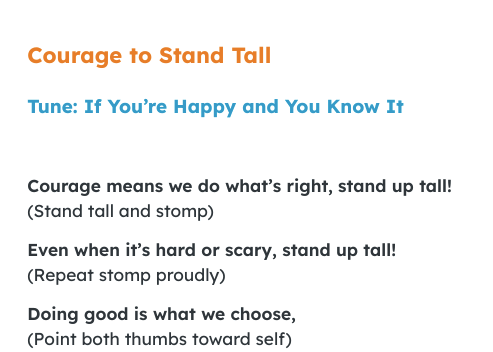
- Eckford’s Epic Courage Song Courage to Stand Tall
- Anchor Chart Materials
- Poster or chart paper, markers
- Stations Materials
- Station 1: Tough Situation Roleplay
- Materials: Role cards, situation cards, civic virtue cards, props like stuffed animals, dress up clothing, or name tags
- Station 2: Sequencing Handout
- Materials: Handouts (printed), scissors, glue, pencils
- Station 3: Read-to-Self
- Materials: Eckford’s Epic Courage Mini-books, Library center or selection of books at student reading levels
- Station 4: Primary Source Investigation
- Materials: Eckford’s Epic Courage Primary Source Set and Find It! Cards (printed, laminated, and cut), magnifying glasses, pencils
- Station 1: Tough Situation Roleplay
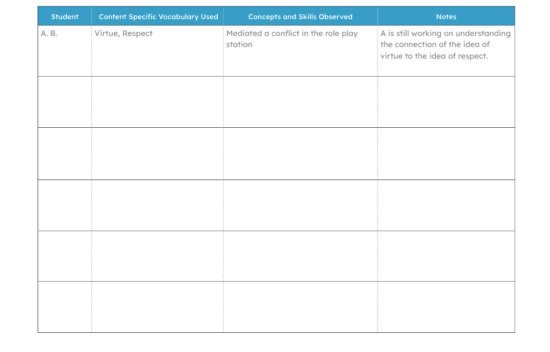
- Teacher Observation Sheet
- Collaborative Courage Timeline materials
- Butcher paper or sentence strips, printed/drawn images of Elizabeth Eckford, markers, crayons, glue
- Optional: Courage symbols for timeline decoration
- Optional: Teacher-created “moment cards” for timeline scaffolding
- Optional: Modes of Reading Teacher Support Document
Student Materials
- Eckford’s Epic Courage Mini-book
- Two versions of the mini-book are available based on the lexile level of your learners. Option A features clear, simple sentences, large easy‑to-read print, and a dedicated reflective writing page. With fewer total pages, it’s an ideal choice for younger learners or those who benefit from a streamlined, accessible format. Option B features more complex sentence structures and a longer page format. Skills boxes appear throughout to reinforce key literacy concepts including phonic spelling patterns (sounds), Fluency and Vocabulary practice words, and targeted phonemic awareness skills. This option offers a more robust challenge for developing readers who are ready for increased rigor.
- Option A (K-1)
- Print double-sided, along the short edge. Fold along center line and staple to create a book.
- Print-Ready Option B (2-3)
- Print single-sided, staple on left side where indicated, then cut on the dotted line to create books.
- Digital Option B (2-3) – meant to be accessed via a device
- Option A (K-1)
- Two versions of the mini-book are available based on the lexile level of your learners. Option A features clear, simple sentences, large easy‑to-read print, and a dedicated reflective writing page. With fewer total pages, it’s an ideal choice for younger learners or those who benefit from a streamlined, accessible format. Option B features more complex sentence structures and a longer page format. Skills boxes appear throughout to reinforce key literacy concepts including phonic spelling patterns (sounds), Fluency and Vocabulary practice words, and targeted phonemic awareness skills. This option offers a more robust challenge for developing readers who are ready for increased rigor.
- Group Assessment
- Two options of the assessment are available to choose from based on the needs of your learners.
Anticipate
Courage Song
- Tell students: “Today I am going to teach you a song called Courage to Stand Tall. It is going to help us learn and remember some important ideas that we will be learning about.”
- Teach students the words and motions for the song, one line at a time.
- Sing the full song at least two times with students.
- Repeat the song throughout the day, singing with students during transitions, play time, or during periods of waiting.
Scaffolding notes: This song compliments the song about Courage from Armstrong’s Amazing Courage. If students already know that song, discuss the differences between the songs and how courage can look different in different situations.
- For instance, it can be courageous to jump from a tall rock, and it can be courageous to speak in front of a large crowd.
Engage
Reading the Mini-book
- Transition: Distribute copies of the mini-book to students.
- Tell students: “We are going to read a book called Eckford’s Epic Courage. Based on our courage song, what do you think courage is?
- Guide students to the idea that courage is when you do good things, even if it is hard or scary. “How were they courageous?”
- Brainstorm with students: “Who are some people or characters that you think are courageous?”
- Student-friendly examples could include superheroes, community helpers, or sports players.
Scaffolding Note: If students have experienced the Armstong’s Amazing Courage lesson, this is a good time to bring back out the anchor chart from that lesson and activate student prior knowledge.
- Tell students: “Next, we will read a story about a girl in high school that had to be very courageous going to a new school. Her name was Elizabeth Eckford.”
- Read the book with students twice.
- First, read the book aloud to students as they follow along with pointing to each word with a finger as you read. Model appropriate speed and expression as you read to your students.
- Next, read the book in a teacher think-aloud reading style.
- In a think-aloud, you pause at strategic points to highlight important information, summarize, and model skilled thinking about reading for your students.
- Prepare these pause points before the lesson based on your students’ grade and skill level. You can also utilize the skills boxes in Mini-book Option B to inspire your pause points.
- For example, on page 2 of mini-book Option B the text says: “Some people did not want her at school. They did not like the new rule that let her go.”
- A teacher could say: It is important to know why people did not want Elizabeth to go to this school. In the 1950s, many schools were divided by skin color. This was called “separate but equal.” A new law said this was not fair. It said all kids should be able to go to the school closest to them. Some people were angry about this change. They wanted Elizabeth to stay at her old school instead of going to the school that had been for white students only.
- This kind of connection helps students fill gaps in their knowledge of the world or remind them of the history they may have forgotten.
- For success in the next part of the lesson, the students will need to discuss a few key details. You can also use or add to the anchor chart from Armstrong’s Amazing Courage with additional images of Eckford and examples of courage.
- Optional: Create an anchor chart with students that will hang in the classroom during the rest of the lesson.
- The anchor chart should include:
- Courage is doing good things even if it is hard or scary.
- Elizabeth Eckford showed this civic virtue by attending a new school, even though some people didn’t want her there.
- Courage icon:
- Courage – lion– the ability to take helpful action in the face of fear or danger.
- Examples of Courage in action:
- Add to the chart as student share examples. This will vary based on your class. You could include: trying something new, joining a new sports team even if you’ve never played before, speaking up in class to answer a question when you’re nervous, admitting you made a mistake instead of hiding it, returning a lost toy to its owner even if you wanted to keep it, going to the doctor even though you’re scared of shots or learning to ride a bike even after falling a few times.
- The anchor chart should include:
- Students will have the opportunity to read the book again on their own and/or with a partner during the stations activity in the Explore section of the lesson.
- Send student mini-books home at the conclusion of the lesson to encourage family engagement. Families and students will benefit from a shared understanding around classroom activities.
Scaffolding note: If reading with more advanced or older students, additional reading styles are available to choose from in our Modes of Reading Teacher Support Document. Check out “Choral Reading” or “Echo Reading” to support fluency.
Explore
Stations
- Transition: Prepare the stations in four distinct areas of the classroom with materials and instruction posters from the lesson stations materials.
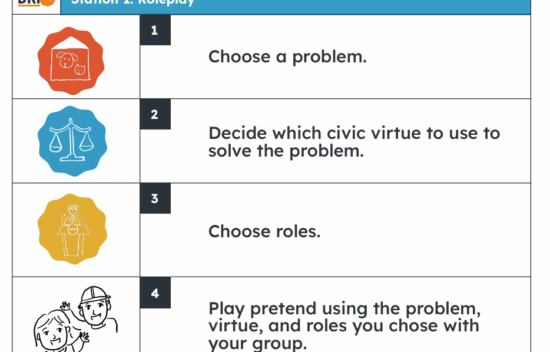
- Station 1: Tough Situation Roleplay
- Materials: Role cards, situation cards, civic virtue cards, props like stuffed animals, dress up clothing, or name tags
- Student Task Overview: Play pretend using the civic virtue of courage, situation and roles chosen by their group.
- Station 2: Sequencing Handout
- Materials: Handouts (printed), scissors, glue, pencils
- Student Task Overview: Cut images and glue in corresponding boxes to sequence Elizabeth’s story.
- Station 3: Read-to-Self
- Materials: Eckford’s Epic Courage Mini-books, classroom library center or selection of topical books or books at student reading levels
- Student Task Overview: Read their mini-book with a partner and then to themselves.
- Station 4: Primary Source Investigation
- Materials: Eckford’s Epic Courage Primary Source Set and Find It! Cards (printed, laminated, and cut), magnifying glasses, pencils
- Student Task Overview: Use magnifying glasses and Find it! cards to investigate primary sources and discuss with peers.
- Station 1: Tough Situation Roleplay
Teacher Note: Do not expect students to read any of the primary sources provided in the source set. These sources are for viewing as pieces of art, not for text analysis. Students may be able to distinguish letters or words.
- Before beginning the stations:
- Divide students into groups that will rotate every 7-10 minutes
- Overview the station materials and instructions (printable visual instructions are included in the stations materials to hang in the stations areas)
- Discuss appropriate behavior
- Discuss early finisher options
- As students are in stations:
- Actively observe and take notes using the Teacher Observation Sheet
- Stay aware of the students’ language and conversations, looking for student misconceptions and misunderstandings that can be addressed before the Apply section of the lesson.
Discussion and Reflection Questions
- Conclude the stations activity by holding a class discussion on the classroom rug or other gathering area. Choose 2-3 questions.
- What is courage? How is courage a civic virtue?
- Remind students that civic virtues are a good quality—like kindness, honesty, or courage. It’s something you choose to do to be a better person. Civic virtue builds character, which is when you do good things again and again—until it becomes part of who you are.
- Who was Elizabeth Eckford and how did she show courage?
- Identify a situation in your life, big or small, in which you could demonstrate courage.
- What challenges might you face in acting with courage?
- How could you overcome them?
- Think of a time you wish you had more courage. How might the situation be different if you had courage?
Scaffolding notes:
- Break up discussion by asking students to talk to a partner about the question before sharing answers with the group.
- Choose one question for students to write or draw in response to and add it as evidence to your students’ portfolios to show growth along with the Teacher Observation Sheet.
- If the station set up does not work for your group of learners, or you would like the lesson to take more instructional time, you can turn the stations into distinct activities that can be completed individually.
Assess
Choose one option or combine.
Option 1: Teacher Observation
- As students work in stations and in the Apply activity, use the Teacher Observation Sheet to record your observations of student behaviors.
Option 2: Group Assessment
- Facilitate a whole group assessment. There are two options available based on the needs of your classroom.
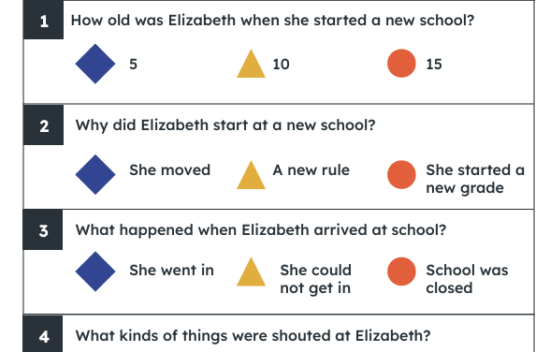
- Option 1: For K-1
- 5 multiple choice questions, shapes distinguish options
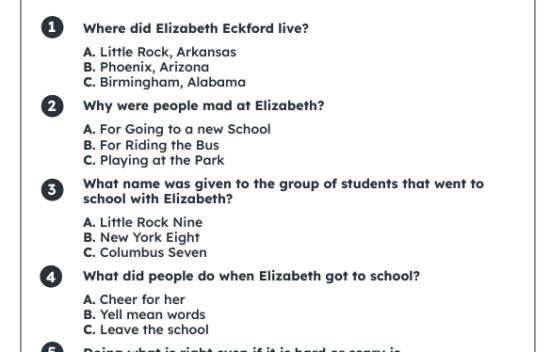
- Option 2: For 2-3
- 10 multiple choice questions, letters distinguish options
- Option 1: For K-1
- To facilitate a whole-group assessment:
- Print a copy of your chosen assessment option for each student in the class and project a copy of the assessment if possible.
- Ask students to point to the number 1 on their page, then follow along as you read aloud. Perhaps pointing to each word as you read.
- Read the question, pointing to each word.
- Read each answer choice, pointing to the choice indicator (letter or shape)
- Repeat the question-and-answer choices if needed.
- Prompt students to choose their answer by circling their choice.
- Repeat for the remaining questions to complete the assessment.
Extend
Collaborative Courage Timeline
- Transition: Organize students into groups of 2-3 students and provide them with materials for the collaborative timeline activity.
- Materials: Long strip of butcher paper or sentence strips (one per group), printed or drawn images of Elizabeth Eckford (from the stations primary source file, for example), markers, crayons, glue
- Optional: teacher-created pre-printed “moment cards” with short phrases (e.g., “Got dressed for school,” “Walked to the bus stop,” “Faced the crowd”) for scaffolding
- Tell students (Choose one or use all three):
- “We have learned a lot about Elizabeth Eckford and the civic virtue of Courage. Elizabeth had the courage to stand tall and do a good thing. She desegregated a school with her friends.”
- Pause to allow students to share what they remember, filling gaps and connecting ideas as needed.
- “We have learned about Elizabeth Eckford and the civic virtue of Courage. Elizabeth showed courage when she walked into a school where many people didn’t want her to be. Courage means doing something that is right, even when it is hard or scary. Today, we are going to make a timeline to show the steps Elizabeth took that required courage.”
- “Courage can seem like an intimidating task, but you do it in your lives more often than you realize. Asking someone to stop picking on someone else is a big example, but it can also be small actions. Sitting next to a new student or asking someone if they are feeling okay, trying out for a new team or club, most virtuous actions happen in the mix of our daily lives.”
- “We have learned a lot about Elizabeth Eckford and the civic virtue of Courage. Elizabeth had the courage to stand tall and do a good thing. She desegregated a school with her friends.”
- Lead students step by step through the activity, pausing as needed to give students time to draw or write and share student examples with the group.
- Explain the timeline:
- “A timeline shows events in the sequence or order they happened. We will make a timeline of Elizabeth’s day when she went to Central High School.”
- Draw the line for the timeline:
- Create a long horizontal line to create the collaborative timeline. Mark the start and end points.
- This could be a piece of string, a line on butcher or chart paper, tape on the floor, or another method of your choice.
- Add a title and Elizabeth’s image:
- Create a title and place or draw a picture of Elizabeth at the top of the timeline area or beginning of the timeline.
- A copy of the primary source images from the stations could be used for this.
- Brainstorm key moments:
- Ask students:
- “What happened first?” (Getting dressed for school)
- “What happened next?” (Walking to the bus stop)
- “What happened when she got to school?” (Facing the crowd, getting to the bus stop)
- Write these on the board as students share ideas.
- Student groups create events for the timeline:
- Students draw or glue pictures for each moment along the line. Encourage them to add details like facial expressions or background to show how hard it was.
- Timeline event examples:
- Getting dressed for school
- Walking to Little Rock Central High School
- Arriving at school alone
- Encountering the crowd for the first time
- Trying to get in the door
- Being unable to get in
- A kind woman helps her get to the bus stop
- Waiting for the bus
- Going home
- Returning to school with the rest of the Little Rock Nine
- Finishing the school year
- Ask students:
Scaffolding note: Add or remove events based on the mini-book that your students read and the primary sources that they encountered during the lesson.
- Decorate with courage symbols:
- Around the timeline event, students can add words or drawings that show courage (e.g., a heart, strong arms, the word “courage”).
- Share and explain:
- Each group shares their timeline event with the class. Ask:
- “Which part do you think was the hardest for Elizabeth? Why do you think that? What did you see or hear that made you think that?”
- “How did she show courage? How do you show courage? How can we show courage in our everyday lives?”
Scaffolding Notes:
- For younger students or those who need support, provide pre-printed event cards they can place in order.
- Use a think-aloud:
- “I remember Elizabeth walked alone through a big crowd. That was scary! I’m going to draw lots of people around her and make her look calm and strong.”
- If students struggle, brainstorm as a class before starting.