(K-3) Week-long Lesson Plan – Franklin’s Fantastic Civic Virtues
Lesson Components
Guiding Questions
- What are civic virtues?
- How did Benjamin Franklin practice civic virtues to improve himself, his community, and his country?
Objectives:
- Students will. . .
- Define and identify civic virtues.
- Describe how Benjamin Franklin practiced civic virtues.
- Demonstrate understanding of civic virtues through discussion, art, and roleplay.
Facilitation Notes
- This lesson is intended to be implemented over several days or class periods. 3-5 days is likely, flex the activities to fit your class time. For example:
- Day 1: Anticipate and Engage
- Day 2: Explore
- Day 3: Apply and Assess
- This lesson is intended for younger learners, from kindergarten to 3rd grade. Several modifications, such as different levels of texts and scaffolding notes, are available to span this large range of ages and developments.
- This lesson requires advance preparation, including collecting and printing materials. See the Teacher and Student Materials list.
- Virtue can be understood in many ways and often reflects individual and family values. While personal virtue shapes character, this lesson emphasizes civic virtue—the qualities and behaviors that support the common good. Civic virtue is best understood in relation to others within families, communities, schools, workplaces, and civic roles.
Teacher Materials
- Civic Virtue Songs
- Anchor Chart Materials
- Poster or chart paper, markers
- Franklin’s Fantastic Civic Virtues Stations Materials
- Station 1: Local Government Roleplay Cards
- Materials: Role cards, problem cards, civic virtue cards, props like stuffed animals, mayor sash, city worker uniforms, or name tags with the names of roles in civil society
- Station 2: Cut and Paste Handout
- Materials: Handouts (printed), scissors, glue, pencils
- Station 3: Read-to-Self
- Materials: Franklin’s Fantastic Civic Virtues Mini-books, Library center or selection of books at student reading levels
- Station 4: Primary Source Investigation
- Materials: Franklin’s Fantastic Civic Virtues Primary Source Set and Find It! Cards (printed, laminated, and cut), magnifying glasses, pencils
- Station 1: Local Government Roleplay Cards
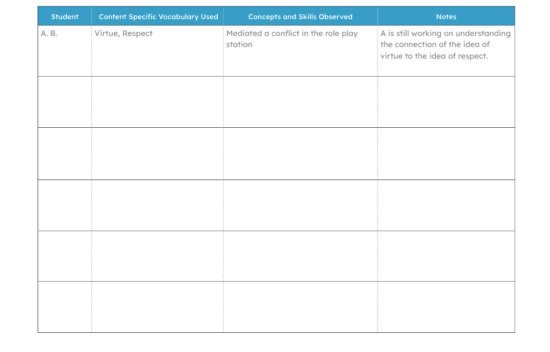
- Teacher Observation Sheet
Student Materials
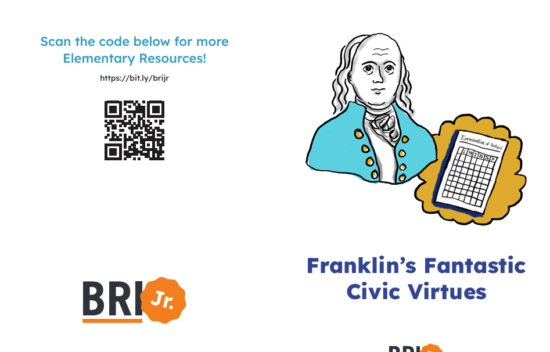
- Franklin’s Fantastic Civic Virtues Mini-book
- Two versions of the mini-book are available based on the lexile level of your learners.
- Option A (K-1)
- Print double-sided, along short edge. Fold along center line and staple to create a book.
- Print-Ready Option B (2-3)
- Print single-sided, staple on left side where indicated, then cut on the dotted line to create books.
- Digital Option B (2-3) – meant to be accessed via a device
- Option A (K-1)
- Two versions of the mini-book are available based on the lexile level of your learners.
- Group Assessment
- Two options of the assessment are available to choose from based on the needs of your learners.
Anticipate
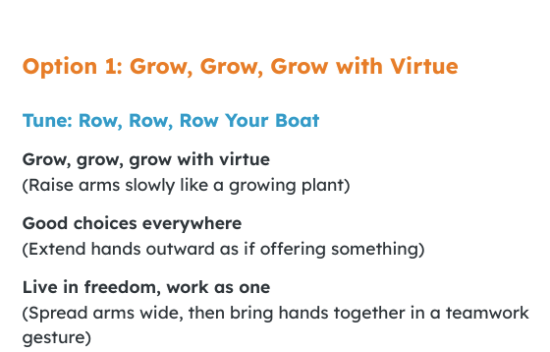
Civic Virtue Song
- Tell students: “Today I am going to teach you a song called the Civic Virtue Song. It is going to help us remember some important ideas that we will be learning about.”
- Teach students the words and motions for the Civic Virtue Song, one line at a time.
- Sing the full song at least two times with students.
- Repeat the song throughout the day, singing with students during transitions, play time, or during periods of waiting.
Teacher note: There are two virtue songs available in the teacher resource. Choose the one that works best for your classroom.
Engage
Reading the Mini-book
- Transition: Distribute copies of the mini-book to students.
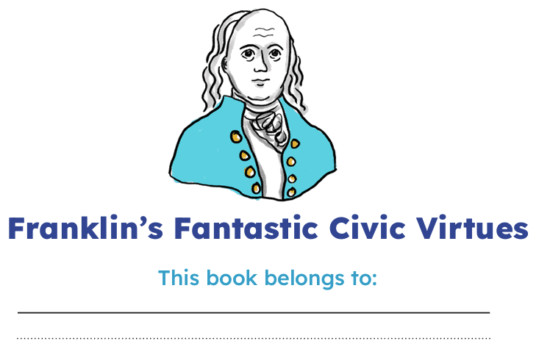
- Tell students: “We are going to read a book called Franklin’s Fantastic Civic Virtues. Based on our Civic Virtue Song, what do you think civic virtue is? Based on the title and the book cover, what do you think this book will be about?”
- Guide students to the idea that civic virtue is a good quality—like kindness, honesty, or courage. It’s something you choose to do to be a better person. Civic virtue builds to Character which is when you do good things again and again—until it becomes part of who you are.
- Deepen understanding by connecting concepts to real-world examples and modeling reflective thinking. After modeling, invite students to share their own observations. For instance, highlight civic or personal virtues demonstrated by characters in texts they have read or examples observed in the classroom. Prompt discussion with questions such as:
- When have you seen someone show kindness?
- When have you noticed honesty or courage in action?
- Read the book with students twice.
- First, read the book aloud to students as they follow along with pointing to each word with a finger as you read. Model appropriate speed and expression as you read to your students.
- Next, read the book in a teacher think-aloud reading style.
- In a think-aloud, you will pause at strategic points to highlight important information, summarize, and model skilled thinking about reading for your students.
- For example, on page 15 of mini-book Option A the text says: “He also thought that practicing civic virtue was important for the new American colonies. He knew Americans would need to have good character to govern themselves.”
- A teacher could say: What do you think it means when it says govern themselves? How do we govern ourselves at school? Franklin believed that people needed to have good character to help their country. That makes me think about how today, we also need to be kind, honest, and responsible to make our communities better. For example, when people follow rules, or help others, they’re showing good character—just like Franklin wanted. I wonder what I can do to help my community today. Maybe I can pick up litter at the park or help a friend who needs something. That’s how I can show civic virtue too! When have you seen someone be kind or honest?
- This kind of connection helps students see how the ideas in the story relate to the real world and their own lives.
- For success in the next part of the lesson, the students will need to discuss a few key details during this part of the lesson.
- Create an anchor chart with students that will hang in the classroom during the rest of the lesson. The anchor chart should include:
- Civic virtue is a good quality—like kindness, honesty, or courage. It’s something you choose to do to be a better person.
- Practicing Civic virtue builds character which is when you do good things again and again—until it becomes part of who you are.
- Benjamin Franklin practiced civic virtue by making a list and working to use one civic virtue a week.
- Examples of Civic Virtues:
- Respect- Hands Shaking – treating all people equally, knowing that all humans deserve kindness no matter what
- Responsibility – Two hands on top of each other – making good decisions about what is right and wrong.
- Justice – a lion – upholding what is fair and right.
- Courage – scales – the ability to take helpful action in the face of fear or danger.
- Examples of civic virtue in action. This will vary based on your class. You could include helping in the community, listening, being kind, or volunteering
- Students will have the opportunity to read the book again on their own and/or with a partner during the stations activity in the Explore section of the lesson.
- Send student mini-books home at the conclusion of the lesson to encourage family engagement. Families and students will benefit from a shared understanding around classroom activities.
Scaffolding note: If reading with more advanced or older students, additional reading styles are available to choose from in our Modes of Reading Teacher Support Document. Check out “Choral Reading” or “Echo Reading” to support fluency.
Explore
Stations
The following materials can be used either as learning stations or as individual knowledge-building activities, depending on your learners’ needs and available time. The instructions are designed for station-based implementation but also include discussion prompts and suggestions for facilitating whole-group activities.
- Transition: Prepare the stations in four distinct areas of the classroom.
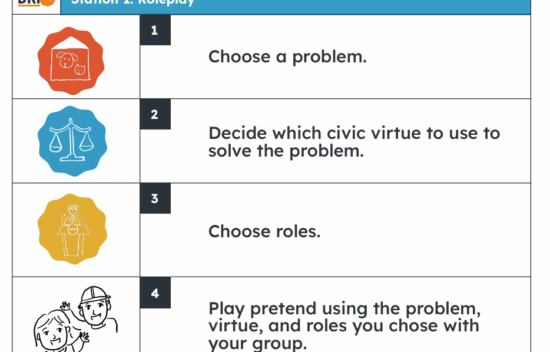
- Station 1: Local Government Roleplay
- Materials: Role cards, problem cards, civic virtue cards, props like stuffed animals, mayor sash, city worker uniforms, or name tags with the names of roles in civil society
- Student Task Overview: Play pretend using the civic virtue, problem and roles chosen by their group.
- Station 2: Cut and Paste Handout
- Materials: Handouts (printed), scissors, glue, pencils
- Student Task Overview: Cut images and glue in corresponding boxes to sort
- Station 3: Read-to-Self
- Materials: Franklin’s Fantastic Civic Virtues Mini-books, Library center or selection of books at student reading levels
- Student Task Overview: Read their mini-book with a partner and then to themselves.
- Station 4: Primary Source Investigation
- Materials: Franklin’s Fantastic Civic Virtues Primary Source Set and Find It! Cards (printed, laminated, and cut), magnifying glasses, pencils
- Student Task Overview: Use magnifying glasses and Find it! cards to investigate primary sources and discuss with peers.
Teacher Note: Do not expect students to read any of the primary sources provided in the source set. Students may be able to distinguish letters or words, but these sources are for viewing as pieces of art, not for text analysis.
- Before beginning the stations:
- Divide students into groups that will rotate every 7-10 minutes
- Overview the station materials and instructions (printable visual instructions are included in the stations materials)
- Discuss appropriate behavior
- Discuss early finisher options
- As students are in stations:
- Actively observe and take notes using the Teacher Observation Sheet
- Stay aware of the students’ language and conversation, looking for student misconceptions and misunderstandings that can be addressed before the Apply section of the lesson.
- (Optional) If conducting each activity as whole-group activities:
- For Local Government Roleplay:
- Discussion Questions:
- Why do you think each role is important in a community?
- How did your group solve the problem? What civic virtues helped you?
- Whole-Group Variation:
- Act out one scenario as a class, assigning roles to volunteers. Pause at key points to ask, “What should happen next?”
- Discussion Questions:
- For Cut and Paste Handout:
- Discussion Questions:
- Which image was hardest to place? Why?
- How do these actions show civic responsibility?
- Add partner discussion to the Cut and Paste Handout.
- Sentence Starters:
- This goes with how he helped his city because. . .
- I put this here because. . .
- This is important because. . .
- Whole-Group Variation:
- Use a large chart or interactive whiteboard to sort images together as a class. Invite students to justify their choices aloud.
- Discussion Questions:
- For Read-to-Self:
- Discussion Questions:
- Which civic virtue stood out to you most? Why?
- How do you think Franklin practiced this civic virtue in his life?
- Whole-Group Variation:
- Replace with a whole-group read aloud, stopping at strategic points to discuss images, add context, or answer questions.
- Discussion Questions:
- For Primary Source Investigation:
- Add discussion to the Find It! Task Cards:
- What do you think this teaches us about Benjamin Franklin?
- Why do you think this is important for us to know?
- Whole-Group Variation:
- Project one primary source on the board. As a class, use Find It! cards to locate features and discuss what they reveal about Benjamin Franklin or civic virtue.
- Add discussion to the Find It! Task Cards:
- For Local Government Roleplay:
Discussion and Reflection Questions
- Conclude the stations activity by holding a class discussion on the classroom rug or other gathering area. Choose 2-3 questions.
- What is civic virtue?
- Who was Benjamin Franklin and how did he practice civic virtue?
- Identify a situation in your life, big or small, in which you could demonstrate civic virtue.
- What challenges might you face in acting with civic virtue?
- How could you overcome them?
- How does acting with civic virtue affect others?
Scaffolding notes:
- Break up discussion by asking students to talk to a partner about the question before sharing answers with the group.
- Choose one question for students to write or draw in response to and add it as evidence to your students’ portfolios to show growth along with the Teacher Observation Sheet.
Assess
Option 1: Teacher Observation
- As students work in stations and in the Apply activity, use the Teacher Observation Sheet to record your observations of student behaviors.
Option 2: Group Assessment
- Facilitate a whole group assessment. There are two options available based on the needs of your classroom.
- Option 1: For K-1
- 5 multiple choice questions, shapes distinguish options
- Option 2: For 2-3
- 10 multiple choice questions, letters distinguish options
- Option 1: For K-1
- To facilitate a whole-group assessment:
- Print a copy of your chosen assessment option for each student in the class and project a copy of the assessment if possible.
- Ask students to point to the number 1 on their page, then follow along as you read aloud. Perhaps pointing to each word as you read.
- Read the question, pointing to each word.
- Read each answer choice, pointing to the choice indicator (letter or shape)
- Repeat the question-and-answer choices if needed.
- Prompt students to choose their answer by circling their choice.
- Repeat for the following questions to complete the assessment.
Extend
Body Biographies
- Transition: Organize students into groups of 2-3 students and provide them with materials for the body biography activity.
- Materials: large poster board or butcher paper (one per group of 3, cut to a length a few inches longer than the tallest student in your class), markers and crayons
- Tell students: “We have learned a lot about Benjamin Franklin and civic virtue. Benjamin Franklin improved himself by practicing civic virtue. Over time, he built good character. We can see that through the ways that he helped his community and country. Today, we will be creating life-sized versions of Franklin on paper to show what you know about how Franklin practiced civic virtue.”
- Lead students step by step through the activity, pausing as needed to give students time to draw or write and share student examples with the group.
- Choose one student from the group to lay on the paper. The other two students trace an outline of the student’s body.
- Students decorate the outline with clothing, hair, and a face to look like Benjamin Franklin. They can use their mini-book for reference.
- Groups may choose to create Benjamin Franklin as a young man, or later in his life.
- Last, students decorate the background with words and drawings to tell more about Franklin. The items they choose will give you insight into what students know, remember, and what they think is important about Benjamin Franklin.
- Groups may choose to surround Franklin with words like character, civic virtue, respect, or improve. They might draw a book, a library, or a quill. They can use their mini-book or discussion to prompt ideas.
- If students are able, have them label their drawings. Or ask students to verbally explain their drawing and add a label for them.
Scaffolding note: If students need support, use a think-aloud to prompt them. In a think aloud, the teacher discusses aloud their thinking as they process a question or task. For example, a teacher might say “I remember in our mini-book, Franklin wrote down a list of 13 civic virtues and practiced one every week. How can I represent that? Maybe a quill, a list, and a calendar! I’m going to add those around my Franklin figure.”
Scaffolding note: For younger students, or students that need more prompting, consider brainstorming ideas with students or providing choices of items that they can place around Franklin.
