Lesson
August Landmesser and Courage
How did August Landmesser display the virtue of courage? Explores the significance of courage in a society built on democratic principles.
Founding Principles
Virtues
Guiding questions
Essential Question
- Why does being courageous and standing up for yourself when others think and act differently matter?
Guiding Questions
- What are some possible consequences of doing nothing in the face of injustice?
- What are the risks of acting courageously?
- What are the elements required to act courageously?
Learning Objectives
- Students will identify the meaning of courage through the example of August Landmesser.
- Students will discuss the complexities of choosing to act courageously in their daily lives.
- Students will reflect on the importance of courage in a healthy civil society.
Materials
Student Resources
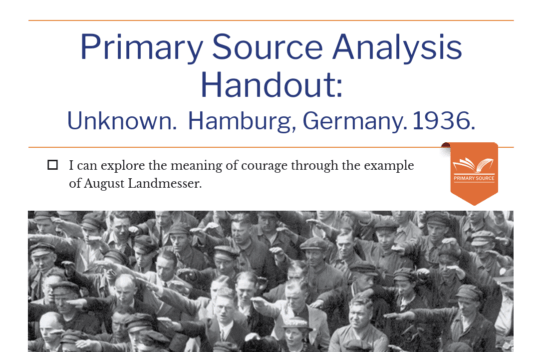
- Primary Source Analysis Handout: Unknown. Hamburg, Germany. 1936.
- Assess & Reflect: Structured Dialogue
Teacher Resources
- Analysis Questions
- Virtue in Action
- Journal Activity
- Sources for Further Reading
- Virtue Across the Curriculum
Lesson Components
ActivityStructured Dialogue
Lesson plan
45 minClick a phase to open it
Key Terms
- Courage
- The ability to take constructive action in the face of fear or danger. To stand firm as a person of character and do what is right, especially when it is unpopular or puts one at risk.
More Information
Procedures
- The following lesson introduces students to the civic virtue of courage. It is challenging to act courageously when faced with pressure from a group. Many people in history displayed cowardice to protect themselves and their interests. Students will learn courage is when one stands firm and does what is right, especially when it’s unpopular or puts one at risk.
- Students will engage with the story of August Landmesser as they consider the question: Why does being courageous and standing up for yourself when others think and act differently matter?
- The main activity of this lesson requires students to analyze a historic photograph of August Landmesser and learn his story. Students may work individually, in pairs, or small groups as best fits your classroom. The analysis questions provided can be used to help students comprehend and think critically about the content. As the teacher, you can decide which questions best fit your students’ needs and time restraints.
- Lastly, the lesson includes sources used in this lesson for further reading and suggestions for cross-curricular connections.
Standards
Related materials

LessonCourage Under Fire: The Selfless Decision of John Robert Fox
In this lesson, students will learn about the actions of John Robert Fox during the Italian campaign during World War II. Through his example, students will understand how they can act more selflessly in their own lives.

LessonWe are not Afraid and We Shall Overcome: The Freedom Rides and Courage
How did the Freedom Riders in the early days of the 1960s Civil Rights movement display courage? How can students act courageously in their own lives?