Lesson
Angusville Wins a Grant, Federalism Case Study

How does federalism enable local self-government to balance the needs of the common good, address viewpoint diversity, and promote civic virtues within a community?
Guiding Question:
- How does federalism enable local self-government to balance the needs of the common good, address viewpoint diversity, and promote civic virtues within a community?
Objectives:
- Students will simulate how local self-government and volunteer community organizations promote responsiveness to the common good and community needs.
- Students will explore the tension and need for compromise in building consensus within a community, given that community members will not always agree on issues.
- Students will reflect on the civic virtues necessary for engaging in community discussions and decision-making.
Materials
Student Resources:
- Student Handouts
- Simulation overview handout
- City council member handout
- Representative handout
- Press handout
- (Optional) Federalism essay
- (Optional) Principles and Virtues handout
Lesson Components
ActivityFederalism Case Study Simulation Directions and Student Handouts
How do local self-government and volunteer community organizations promote responsiveness to the common good and community needs?
Lesson plan
Click a phase to open it
Key Terms
- Block grant
- a fixed amount of money from the federal government given to state and local governments to assist them in addressing broad purposes, such as community development, social services, public health, or law enforcement. Block grants have been a part of the American federal system since 1966.
- City council
- an elected local governing body with legislative and administrative powers, such as passing laws and appropriating , or deciding how to spend, funds.
More Information
Facilitation Notes:
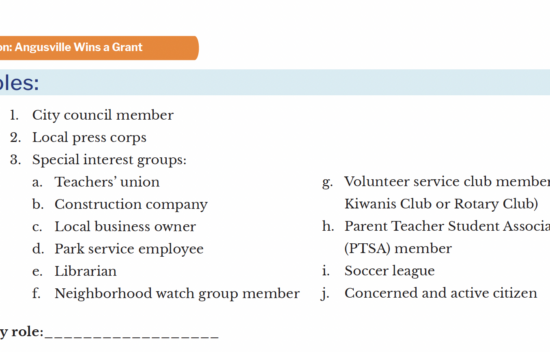
In this activity, students will simulate a city council decision on how to spend a $1 million block grant from the state government.