Video
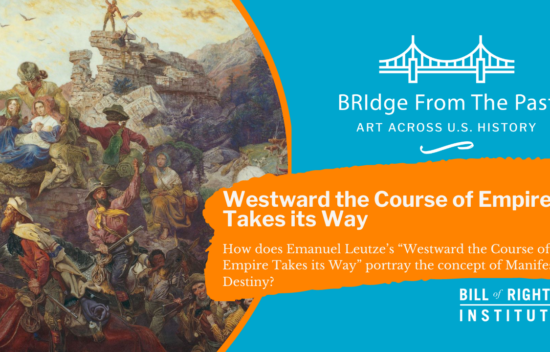
Westward the Course of Empire Takes its Way | BRIdge From The Past
Watch
Founding Principles
Virtues
About this video
How does Emanuel Leutze’s “Westward the Course of Empire Takes its Way” portray the concept of Manifest Destiny? In this episode of BRIdge From The Past, Mary explores the massive 1861 mural depicting westward United States expansion that hangs in the U.S. Capitol Building. Commissioned in 1831 and painted in the Capitol Building during the Civil War, the mural features several aspects of the United States' advancement into Western territories and attempts to visualize what is meant by the phrase ‘Manifest Destiny.’ How does each part of this mural work together to give us a glimpse of the complicated history behind Westward expansion and Manifest Destiny?
0:00 Hi, everyone. Welcome to Bridge from the Past. I’m your host, Mary, and this series is all about using images as a starting point to think about important topics in American history. Today, we’re looking at a mural entitled Westward the Course of Empire Takes its Way. What can this mural tell us about the concept of manifest destiny? Let’s jump in and see.
0:23 Here is our image, Westward the Course of Empire Takes its way. The artist is a German American named Emanuel Leutze, and you would find this mural in the house wing of the US Capitol in Washington, DC. This is a large mural, so it looks small on my screen, but it’s 20 by 30 feet. So if you saw it in person, it would be larger than life.
0:45 We’re trying to think about what this painting can tell us about manifest destiny. Manifest destiny. If something is destiny, it’s fate. If something is manifest, it’s clear, it’s obvious. This term manifest destiny comes from 1845, and it was coined in the context of annexing or bringing Texas into the United States Union.
1:08 That’s where the word comes from. It’s this idea that it’s manifest destiny. It’s the obvious fate of the United States the United States to spread across the entire continent, from the Atlantic to the Pacific. What does this image tell us about that idea? It’s important to start with some observations. Pause here if you’re using the handout that comes with this video and make some observations of your own.
1:31 Here are a few things that I notice. The first thing that I notice is that there’s a lot of people in the foreground, and I’m also really noticing the landscape. It’s beautiful. I have these beautiful mountains with snow on them to the right and this beautiful golden, open valley to the left. There’s a man up here atop this rocky formation.
1:53 The landscape is beautiful, and I can see there are a lot of people on this landscape. Many of them in Conestoga wagons. I can see a lot of livestock coming with these people. They’re pulling these heavy wagons. I see men, I see women. Here’s the man, here’s the woman. I see a young African American boy.
2:13 I’m also drawn to this figure right here, wearing a coonskin cap with a woman. Looks like she’s cradling a baby, and he’s gesturing to this beautiful open landscape. There’s another beautiful open landscape down here at the bottom of the painting. What does all this mean and how does it connect to manifest destiny?
2:33 Let’s start with the landscape. On the right, you have the Rocky Mountains, and the artist actually traveled to the Rocky Mountains to sketch them so he could portray them accurately in this mural. The people right here are actually on the continental divide. What that means is at this point to the left, all the water would flow into the Pacific Ocean, and to the right, all of the water, rivers, etc.
2:55 Would flow into the Atlantic Ocean. It’s really this important spot geographically, but also psychologically. So all of these settlers have reached the point where they’re heading out west. They’re going to settle in this beautiful landscape. There are a lot of immigrant families here. And there’s also, as I pointed out before, this African American child.
3:16 So this was painted. It was finished in 1862. In 1862, slaves in Washington, DC had recently been emancipated. And of course, in 1863, Abraham Lincoln will issue the Emancipation Proclamation, which will lead to the end of slavery in the Union. This is during the Civil War. The country is fighting each other.
3:37 And Leutze has put some images of national unity into this painting. The man up here atop the continental divide is waving the American flag. This woman right here, cradling the baby, is wearing red, white, and blue. And some people have referred to her as the American Madonna, a reference to Mary, the mother of Jesus of Nazareth.
3:58 So you can see Leutze is saying that this is a place of opportunity for immigrants, for recently freed African Americans. There’s this beautiful Western landscape that they can occupy. Of course, the West was not empty. Many Native American tribes called the West their own. These Native American tribes, of course, will be pushed out as this influx of American settlers comes into the West.
4:23 Up here, we have a symbol of the American Union and the wings of the Eagle, of course, the Eagle being the symbol of the American Union, are pushing aside to Native Americans, which is a very important part of the story of manifest destiny. It’s important to consider that that is a piece of the story that the American country needs to own as well.
4:44 We started by asking what Emanuel Leutze’s muralcould tell us about the concept of manifest destiny. We learned where the term comes from and how Leutze expands the concept to apply to African Americans and immigrants in his mural that hangs in the US Capitol in the house wing. But as always, there’s so much more to the story.
5:04 Now I’m going to turn it over to you. What’s the next question in our conversation? What do you want to learn more about? I’d love to know in the comments below. If you like this video, be sure to subscribe to our channel to be in the know about other resources and contests to help you throughout the school year. I’ll see you again soon. Until then, everybody, take care.
5:24 Wow, I didn’t know history was so relevant. Kind of makes you think. Think what? That you definitely have to subscribe to the Bill of Rights Institute’s YouTube channel. They have so many videos on American history, government, and civics. From primary source document breakdowns to historical image analysis, whether you’re studying for a test or just interested in learning more,
5:46 they’ve got something for you. Using this channel is the only way I know I can ace my test. Be sure to check out this video right here. And hit the subscribe button so we know you want more videos.
Standards
Related Resources

Did the positives outweigh the negatives as the concept of Manifest Destiny drove western expansion during the nineteenth century? A. James Fuller and Andrew Fisher debate this question.

If you lived in 1872, would this painting inspire you to pack up and move west? Mary is joined by Jotwan Daniels, 2019 BRI Teacher Council Member and high school teacher in Breckenridge, Colorado, as they explore John Gast's "American Progress" (1872) and America's rapid push westward following the civil war. What does this painting tell you about America's values at the time? Is it really documenting progress for everyone?