Video
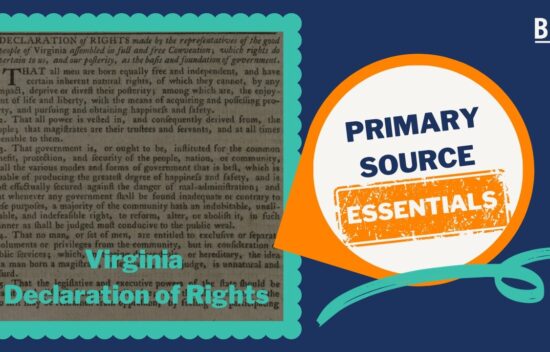
Virginia Declaration of Rights | Primary Source Essentials
Watch
Founding Principles
Virtues
About this video
In this episode of Primary Source Essentials, examine the Virginia Declaration of Rights and the founding principles it established during the American Revolution. Adopted in 1776, the document asserted that all people are born equally free and independent, possessing inherent rights including life, liberty, property, and the pursuit of happiness. It also embraced popular sovereignty, representative government, freedom of the press, religious liberty, and protections for the accused.
This episode explores how figures like George Mason and James Madison helped shape the document and how its ideas likely influenced Thomas Jefferson while drafting the Declaration of Independence. As one of the earliest statements of American rights and liberties, the Virginia Declaration of Rights became a foundational expression of the principles that would help define the new nation.
0:00 Welcome to Primary Source Essentials.
0:02 In this episode, we are going to briefly examine the founding
0:05 principles asserted in the Virginia Declaration of Rights
0:09 and how it helped shaped the Declaration of Independence.
0:13 In May 1776, the Second Continental Congress
0:17 recommended that colonial legislatures form new governments
0:22 and write new constitutions based upon popular consent.
0:27 To that end, the Virginia Convention met in May and June
0:31 and adopted a new constitution and a Declaration of rights.
0:36 The Virginia Declaration of Rights began by asserting that humans are born
0:41 equally free and independent, with certain inherent rights of life,
0:47 liberty, property, and the pursuit of happiness.
0:52 It embraced the principle of popular sovereignty that all power is derived
0:57 from the people, and that they can alter or abolish that government.
1:02 The document defined other founding principles as well,
1:05 including representative government, separation of powers, free elections,
1:11 freedom of the press, and the rights of the accused,
1:14 such as trial by jury and no cruel and unusual punishment.
1:20 It also stated
1:21 that civic virtue is necessary for self-government
1:24 and to secure the blessings of liberty, which cannot be preserved to any people,
1:30 but by a firm adherence to justice, moderation, temperance, frugality,
1:36 and virtue, and by frequent recurrence to fundamental principles.
1:42 After George Mason proposed the right of religious toleration
1:45 to protect religious minorities, a young James
1:49 Madison went further and stated that it was a natural right.
1:54 All men are equally entitled to the free exercise of religion
1:58 according to the dictates of conscience.
2:02 The Virginia Declaration of Rights was published in the Pennsylvania Gazette
2:06 in Philadelphia,
2:07 where Thomas Jefferson was drafting the Declaration of Independence.
2:12 It was likely one of the sources that helped influence
2:15 his writing of that founding document.
2:18 Thanks for watching and check out the other videos in Primary Source Essentials.
Standards
Related Resources

On June 7, 1776, Richard Henry Lee brought what came to be called the Lee Resolution before the Continental Congress. This resolution stated “these United Colonies are, and of right ought to be, free and independent states ...” Congress debated independence for several days.

Mason’s ideas helped to shape the Founding documents of the United States, but few Americans remember him today. The words he used when writing the Virginia Declaration of Rights and the Virginia Constitution of 1776.