Video
Uncle Abe’s Valentine | BRIdge From The Past
Watch
About this video
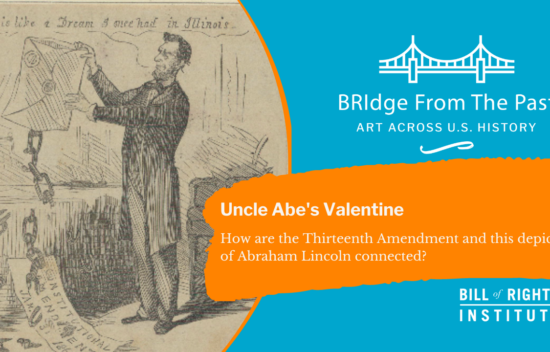
How are the Thirteenth Amendment and a depiction of Abraham Lincoln connected? In this episode of BRIdge from the Past, Mary explores 'Uncle Abe's valentine sent by Columbia; an envelope full of broken chains' published in Frank Leslie's Illustrated Newspaper in 1865. What was Lincoln’s role in supporting the Thirteenth Amendment? How was the Thirteenth Amendment a culmination of what he wanted for the United States?
0:00 Hi everybody. Welcome to another episode of Bridge From the Past. I’m your host, Mary, and this series is all about using primary source images as a starting point to think about important topics in American history. Today, we’re looking at a political cartoon of Abraham Lincoln that connects to the 13th amendment. What’s the connection between our 16th President and this 13th amendment? Let’s jump in and see.
0:25 Here’s our image. It’s entitled Uncle Abe’s Valentine sent by Columbia. It was published in Frank Leslie’s illustrated newspaper, which was published in New York in 1865. This source comes from the Library of Congress. Whenever you have a primary source image, it’s important to just make some observations with the information in front of you before you can go any further.
0:45 Here are a few things that I notice. If you’re using the handout that goes with this video, pause here and make some of your own observations. Starting with this source line, you actually get a fair amount of information. I know that Uncle Abe, who appears to be Abraham Lincoln, he’s got the distinctive facial features of Abraham Lincoln, was sent a valentine, which I can see he’s holding, by someone named Columbia.
1:08 I don’t see anyone else in the image. It’s just Abraham Lincoln holding this rather large valentine. There’s also some words here that are giving me some clues. It says, This is the dream I had in Illinois. That’s what Abraham Lincoln is saying. Down here, we have the title again, Uncle Abe’s Valentine sent by Columbia. Underneath, it says, An envelope full of broken Chains.
1:30 I can see these broken chains coming out of the envelope as well as a slip of paper. The slip of paper reads, Constitutional Amendment, January 31, 1865. There’s actually a lot to work with here. I’ve got Abraham Lincoln having something to do with a constitutional amendment in 1865.
1:51 In 1865, the Civil War is still going on, but it’s coming to a close. So something’s happening very important to the Constitution during this time period. I’ve made some observations. I have some initial questions. Now it’s time to jump into my analysis. One of my first questions is, who is Columbia? Columbia sent aid this Valentine.
2:12 Columbia is not pictured here on the screen, but Columbia is a representation of the United States of America, like Uncle Sam or the Statue of Liberty. The United States, a representation of the United States, has sent this Valentine of broken chains to Abraham Lincoln in 1865. It’s a constitutional amendment. This is what will become the 13th
2:33 amendment that bans slavery in the United States. The 13th amendment actually passed Congress on January 31, 1865, and Abraham Lincoln would sign it the very next day and send it out to the states for ratification. Unfortunately, Abraham Lincoln was assassinated before he saw the 13th amendment become ratified,
2:55 become part of the constitution, and before he saw the end of the Civil War. But in December of 1865, slavery was officially banned from the United States. 13th amendment was ratified and it was put into the constitution. Abraham Lincoln strongly supported the passage of this amendment. This line up here, this is a dream I had in Illinois.
3:16 Lincoln made passing this amendment part of his reelection campaign in 1864. He is basically officially saying, If you elect me as President, I’m going to make sure that this amendment goes through. He put his full support behind it. He wanted to see an end to slavery in the United States, what he called in the Gettysburg Address, a new birth of freedom.
3:38 We started by asking, what was Abraham Lincoln’s role in supporting the 13th amendment? We learned that he really put his support behind this amendment. He wanted to see an end to slavery. He issued the Emancipation Proclamation in 1863. He had spoken out against slavery in his political career prior to becoming President. This was in a lot of ways a culmination
3:59 of what Lincoln really wanted for the United States. But as always, there’s so much more to this story, so I challenge you to ask more questions and keep the conversation going. If you learned something, be sure to like this video and subscribe to our channel to be in the know about other resources to help you throughout the school year and beyond any homework or tests that you may have.
4:20 I’ll be back soon with another primary source image to help us think about important topics in American history. Until then, everybody, take care. Oh no. The video’s over. Oh, come on. Don’t be so sad. Don’t you know that the Bill of Rights Institute has tons of videos on American history, government, and civics? From primary source document breakdowns to historical image analysis, whether you’re studying for a test or just
4:43 interested in learning more, they’ve got something for you. Oh, well, in that case, I better check out this video. And don’t forget to subscribe so you aren’t so sad again.
Standards
Related Resources


President Andrew Johnson saw himself as a protector of the United States Constitution during and after the Civil War. In his efforts to preserve and restore the Union, he supported the Thirteenth Amendment ending slavery. The same motive led him to oppose the Fourteenth Amendment because he believed it would infringe on the legitimate powers of the states. In this lesson, students analyze Johnson’s leadership with respect to Reconstruction, and specifically his response to the passage of the Thirteenth and Fourteenth Amendments.

What can the details of a portrait tell us about the sixteenth president? In this episode of BRIdge from the Past, Mary examines W.F.K’s portrait of Abraham Lincoln, which went on display recently at the National Portrait Gallery in Washington, DC. The massive portrait is 9 feet tall and contains numerous details that hint at specific parts of Lincoln’s life and his time as president. What image of Lincoln does this portrait attempt to convey?