Video
This Land Is Your Land: Exploring the Great Outdoors Through Images | BRIdge from the Past
Watch
Founding Principles
Virtues
About this video
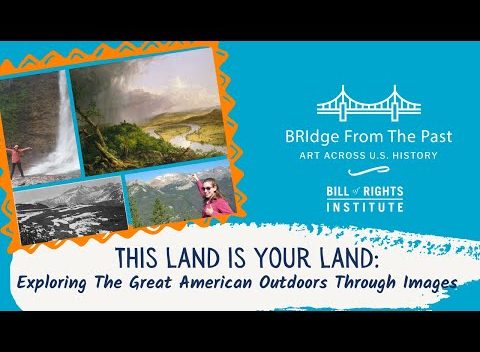
"From the mountains, to the prairies, to the oceans white with foam," America has some of the most diverse and beautiful landscapes in the world. Join Mary as she explores images of our landscape from the past to the present. How can images inspire us to go outside and recharge?
0:01 Hi everybody. Welcome back to another episode of Bridge from the Past art Across US history. I’m your host, Mary, and I hope I’m not the first person to wish you a happy summer. One of my favorite things to do during the summer is to recharge. And one of my favorite ways to do this is to go outside. It turns out I’m not alone. Artists have been fascinated
0:22 by the diversity of American landscapes for a long time time. In honor of summer, I thought it would be fun to take a look at just a few of these works of art. Let’s jump in and meet our artists. Here are the artists whose works we’re going to be taking a look at.
0:43 So I’ll start over here on the left. So this man right here is the artist Thomas Cole. And next to him is Samuel Coleman. And these two guys were part of the Hudson River School. If we’re talking about American art, the Hudson River School is a good definitely a good thing to know. Before the Hudson River School, most American artists copied Europe. They went to Europe to study they copied European subject matter.
1:06 Artists in the Hudson River School named because, well, they were based in New York City, but often ventured into the Hudson River Valley. We’re like, we’re not going to do that. We’re going to stay here in the United States, and we’re going to paint the beauty that we see around us. This man in the middle here is Albert Bierstadt. So his name is German, but he spent most of his life being in painting in the United States.
1:28 He’s also considered part of the Hudson River School, really sort of the second generation and sometimes called the Rocky Mountain School. So again, focusing on American subjects, particularly those further west, moving into the 20th century. This man here with this great hat and his camera is famous photographer Ansel Adams. So he was an environmentalist, and his black and white images of national
1:50 parks out west in particular are very well known. So we’ll take a peek at those. And over all the way over here on the right is not quite an artist because she has no formal training in any sort of photography or art. But I do like to go outside, as I said, so I’ll share some of my pictures of American landscapes with you as well. So that’s enough about the artists.
2:11 Now let’s go ahead and look at the paintings. So our first image is from Thomas Cole. So again, he’s one of the founders of the Hudson River School. He’s painting an American landscape. So that’s not quite a straight line, but you can see that we are in Northampton, Massachusetts, and the date here is 1836.
2:32 So this is before the Civil War, and he’s in New England. So New England at that time is starting to industrialize a little bit more than what had emerged before. And in this painting here, I’m sort of struck by there’s almost this divide between natural wilderness over here on the left and on the right, I see it’s much lighter and the landscape
2:57 is much more orderly, for lack of a better term. So it’s almost like he is showing this division between nature and what man does to nature. So if I closely here, you can see a field. This is a very ordered plot of land that’s been plowed. I can see smoke coming from chimneys.
3:18 So someone obviously lives here, or maybe it’s an early factory. It is along the river. Early factories are going to be powered by water and most of them are going to be in New England. So he definitely is commenting on what he sees around him, this sort of tension between nature and man. You can see that tension again in this painting by Samuel Coleman.
3:40 Again. An American scene. We’re on the Hudson River and we also see this split, so to speak, between industry. I have the same ship over here with the smoke coming out, and you have the sailboats over here and the mountains, and you have an aero boat here. So things are definitely changing. And if you look at the date here, 1866,
4:02 there’s definitely more industry, more things being powered by steam. So Coleman is sort of commenting on that again. And you can also see, just like in the previous picture, the light is really interesting. There’s definitely a darker and a lighter side to the painting. So what might the artists have meant by that is a really fun question to speculate on that.
4:24 Now we’re moving on into the second generation of the Hudson River School, which is sometimes called the Rocky Mountain School. And this painting right here by Albert Bierstadt kind of gives you a hint as to why we’ve moved further west. And I can see the Rockies. So if you’ve never seen the Rockies, so I’m here on the East Coast, and we don’t have mountains like this on the East Coast.
4:44 It is quite a sight to behold. And Bierstadt felt exactly the same way when he traveled out west. So if you note the date here, 1863. So this is before the transcontinental railroad. So to travel this far west was quite an undertaking. And it’s also we’re right smack in the middle of the Civil War. So that especially makes this landscape
5:06 really interesting because it’s almost like sort of this untouched wilderness. And you can see here in the foreground, Bierstadt has depicted a Shoshone village, and you can see there’s waterfalls and there’s mountains and there’s this beautiful scenery. And you have these Native Americans who live here, who have lived here or camped here or traveled here for generations.
5:28 So it’s really interesting to consider is this untouched wilderness. Is he saying Americans haven’t gotten here yet or we should get here? This idea of Manifest destiny. So these are things the more you look at the image, the more it’s kind of the more questions you can start to ask, not just about the painting, but about the bigger, you know, historical themes as well.
5:51 So here’s another painting by Bierstadt, the Valley of Yosemite from the following year, 1864. So again, the Civil War is still going on. So this really horrific conflict. But this painting is just there’s absolutely no indication that some sort of terrible conflict is raging in the country. It’s beautiful, really.
6:12 It’s pristine. When Bierstadt saw the Valley of the Yosemite this is in California, he compared it to the Garden of Eden and Eden. Excuse me. And he described it as paradise. And it really does look like paradise. You have these elk here, and it’s by the river, and it’s absolutely stunning and pristine.
6:32 And the light here is especially interesting. So the Hudson River school and the Rocky Mountain school made good use of light. Kind of seen that in all of these paintings. And the light, I think, is most striking here as it’s sort of shining down the valley. So when people saw paintings like this, they would say, this is beautiful.
6:54 And there was a lot more interest in the lands out west. And it actually is going to lead Abraham Lincoln to make Yosemite a park in 1864, which, again, I didn’t even know that. And it’s kind of remarkable considering the Civil War was going on. And he really had a lot on his plate, so to speak. Now we’re moving into the 20th century.
7:14 You have the photographs of Ansel Adams. So again, he is photographing Montana. So this is Glacier National Park. So this land is protected wilderness in the 20th century. And again, you have these striking mountains, these beautiful tall trees. It’s really quite jaw dropping. And again, you have Rocky Mountains
7:34 in Colorado with the snow and the pine trees. So they’re really iconic landscapes. So Ansel Adams was an environmentalist and a conservationist. So his photographs were a tool to convince people these lands are beautiful and they’re pristine. And it’s our responsibility and his point of view to take care of them.
7:55 And his photographs will help him do that. So now, again, not exactly the work of a trained artist, but like I said, I love to go outside. I love to see all the various landscapes across the United States. And I didn’t grow up doing things like this. I had to sort of make it happen for myself. So I would encourage you to get out there
8:16 and explore and travel and see all these amazing places within your community and within the large United States, because there’s a lot to see here. So this is in the North Cascades in Washington State, as well as this waterfall here, the Alamo. And my coonskin cap. Yes, I really have a coonskin cap. I bought it at the Alamo. And I’m wearing my coonskin cap here.
8:36 Pretending to be Lewis and Clark in the Columbia River Gorge between we’re sort of straddling Oregon and Washington State. So before I leave you, I want to share with you this quote by the first artist that we looked at, the Hudson River school artist Thomas Cole, in his essay on American scenery from 1836.
8:57 Whether an American beholds the Hudson explores the central wilds of this vast continent or stands on the margin of the distant Oregon, he is still in the midst of American scenery. It is his own land. Its beauty, its magnificence, its sublimity are all his. And how undeserving of such a birthright if he can turn towards it in unobserving eye and unaffected heart.
9:23 In other words, go outside. Where are you going to go? To enjoy the great American outdoors this summer. I hope you do go somewhere, and I hope if you take any good pictures, be sure to share them with us. You can tag them at BRI students on our Instagram account and I’ll be sure to check them out along with everybody else who’s following us and who’s on our staff.
9:47 That’s all we have time for today. We’ll be back with more regular episodes of Bridge from the Past in the fall, but over the summer we’ll be releasing other videos and things to keep you engaged with all things history and civics. So until we see you again, stay safe, have fun, take care.
Standards
Related Resources

BRIdge from the Past: Art Across U.S. History is a new YouTube series for students that explores an important historic image every episode to gain insights into the culture, politics, and society of a particular time in U.S. history. Host Mary Patterson will explain how each primary source is its own “window to the past,” revealing new areas for contemplation and discussion.

Use this primary source imagery to analyze major events in history.