Video
The Third Amendment | BRI’s Homework Help

Watch
Founding Principles
About this video
Why did the Founders believe so strongly that troops should not be quartered in the homes of citizens that they enshrined this protection in the Bill of Rights? The Third Amendment is rarely talked about, but studying its origins and purposes is important in order to understand our system of the relationship between civilians and the military. Learn more about the story of the Third Amendment with this Homework Help video.
0:00 For many Americans, a home is the most important piece of property that they own. In fact, the constitution recognizes the importance of the home by placing explicit protection for it in the Bill of Rights, the Third Amendment. The Constitution reads, quote, no soldier shall in time of peace be quartered in any house without the consent
0:20 of the owner, nor in time of war, but in a manner to be prescribed by law. The founders of the United States included this because they believed that an individual’s property rights needed to be protected from government intrusion. So what are the origins of the Third Amendment? And why did the founders believe that housing soldiers in homes pose such a great threat to individual liberty
0:44 that they enshrined protections against it in the Bill of Rights? This is the story of the Third Amendment. The Anglo-American tradition has a long history of opposing the government’s
1:05 ability to use an individual’s property to house soldiers. For example, in 1628, the English parliament sent a list of grievances against King Charles I in a document known as the Petition of Rights. In it, Parliament criticized Charles for forcing individuals to quarter soldiers in their homes against their will. In general, English rulers respected
1:27 the precedent that individuals should only need to quarter troops if military barracks were full and the citizen had voluntarily agreed to take on the burden. However, this changed over time. During the French and Indian war from 1754 to 1763, for example, Great Britain quartered soldiers in colonists’ private property at the expense of colonial legislatures,
1:50 sometimes without the consent of the owner. American colonists despised this change in precedent and believed their rights as Englishmen were not being respected. In the aftermath of the war, Great Britain gained huge amounts of territory in North America that needed to be protected. During the 1760s and 1770s, the British believed that a permanent
2:11 armed force was necessary in the colonies for defense purposes. However, because they were expensive to maintain, the British government often required individuals to quarter soldiers on their property during this time. Parliament passed the quartering act of 1765, which allowed soldiers to continue to be quartered on private property like inns and uninhabited homes
2:34 even though the war was over. It also required the colonists to pay for the food and supplies of these soldiers with their own tax dollars. This peacetime quartering of troops was one of the many issues that fueled the split between the American colonies and Great Britain. In 1774, the First Continental Congress released its declaration and resolve,
2:56 which deemed the Quartering Act to be a violation of the colonists’ rights. A few years later, in 1776, the declaration of independence accused King George III of, quote, quartering large bodies of armed troops among us. In that same year, the Delaware Declaration of Rights stated, quote, that no soldiers ought to be
3:17 quartered in any house in time of peace, without the consent of the owner, and in time of war in such manner only as the legislature shall direct. After the Revolutionary War, Americans debated the best way to protect themselves against the government excessively quartering soldiers on individuals private property. This was raised during the debate over the ratification of the Constitution.
3:39 Patrick Henry, a prominent Anti-Federalist, attacked the proposed Constitution, stating, quote one of our first complaints under the former government was the quartering of troops among us. This was one of the principal reasons for dissolving the connection with Great Britain. Here we may have troops in time of peace. They may be billeted in any manner to tyranny, oppress, and crush us.
4:00 Ultimately, James Madison brokered a compromise under which the Anti Federalists agreed to ratify the Constitution, and the Federalists promised to pass a Bill of Rights during the first session of the new Congress. The Federalists upheld their promise and submitted a series of amendments for Congress to consider, including one calling for the prohibition of the quartering of troops during peacetime.
4:22 In 1791, the Third Amendment was ratified by the states. The Third Amendment has been the least litigated amendment of the Bill of Rights. In fact, the Supreme Court has never even heard a case concerning it. It has, however, referenced the amendment in other cases. For example, in his opinion on the case of Griswold v.
4:42 Connecticut, Justice William Douglas wrote that the Third Amendment implied that individuals should have their homes be entirely free from agents of the state. And in the case of Youngstown Sheep and Tube Company v. Sawyer, which concerned the question of whether the President could seize private property during wartime, justice Robert Jackson wrote,
5:02 quote The Third Amendment says, even in wartime, seizure of needed military housing must be authorized by Congress. Lower courts have also rarely heard cases concerning the Third Amendment. In the most prominent case, Engblom v. Carey, workers in the New York State Department of Corrections went on strike to demand better pay in 1979.
5:22 The Governor of New York sent in the National Guard to keep prisons under control, who were cornered in an administrative building that served as a home to two corrections officers in southern New York. The officers sued, claiming that the governor’s actions violated the Third Amendment. The case reached the Court of Appeals in the Second Circuit, which incorporated the Third Amendment to apply to New York, Connecticut,
5:46 and Vermont, which were the states within its jurisdiction. Therefore, the corrections officers residency was protected under the Third Amendment from seizure and occupancy by the National Guard. Fortunately, there haven’t been cases serious enough to require the Supreme Court to invoke the Third Amendment. Even during the Civil War, our government has respected the limits it
6:08 places on its ability to house soldiers in Americans homes. Even though the Third Amendment is rarely talked about, it is still an important part of our constitutional system as it protects property rights. Will any new cases be litigated concerning this amendment? This has been the story of the Third Amendment. Thanks so much for watching.
6:29 Please like this video. And for more American history and civics, be sure to subscribe.
Standards
Related Resources

Answer key for Third Amendment Homework Help viewing guide.

Why did the Founders see the need to create a Bill of Rights in addition to the US Constitution? What historical documents and events influenced them as they drafted it? The Virginia Declaration of Rights written by James Madison, the Magna Carta, the Petition of Rights, the English Bill of Rights, and the Massachusetts Body of Liberties. The Founders included both concepts of democracy and republic in the blueprint for American government. Democracy protected majority rule whereas the idea of a republic protected individual citizens. The Bill of Rights was an important addition to the Constitution because it helped to guarantee individual rights. As a fluid document, inclusions to the Bill of Rights like the 14th Amendment brought the idea of incorporation, the process of states being held liable to uphold the Bill of Rights on the state level. This latest installment in our Homework Help series explores these important constitutional questions.
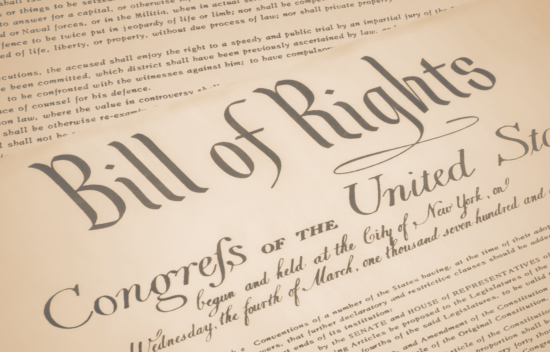
The first 10 amendments to the Constitution make up the Bill of Rights. James Madison wrote the amendments, which list specific prohibitions on governmental power, in response to calls from several states for greater constitutional protection for individual liberties.