Video
The Schechter Brothers and Integrity: Heroes & Villains

Watch
About this video
Why is it important in a healthy civil society for individuals to act with integrity? Explore the story of the Schechter Brothers in this video feature of BRI's Heroes and Villains Curriculum to help determine how they exhibited the virtue of integrity.
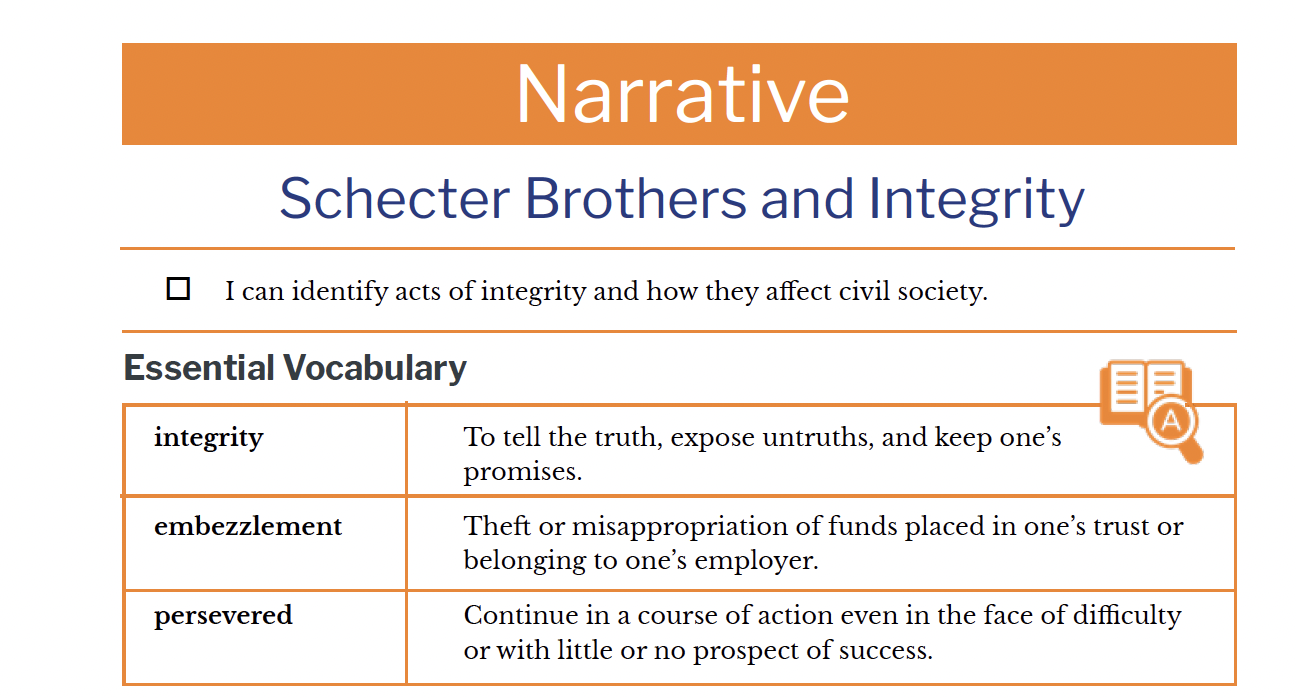
0:08 Integrity. It’s a dedication to being honest, standing up for what’s right, and keeping your word. And it’s the cornerstone of a healthy democracy. Meet the four Schechter Brothers, Jewish butchers, who in the 1930s were true to their faith and customers, even when it was against the law. Their story takes place during the Great Depression,
0:29 a global economic crisis that plunged millions of Americans into poverty. In Brooklyn, New York, which has a large Jewish population, the Schechter Brothers, Joseph, Martin, Alex, and Aaron ran two poultry markets according to their Jewish faith. Like many practicing Jews, the Schechters only wanted to sell kosher meat from healthy animals that had been killed humanely.
0:52 They allowed their customers to inspect their chickens before purchasing them in accordance with the long held tradition of kashrut. For the Schechters, integrity was a core virtue that protected the interests of their customers. But in 1933, the New Deal’s National Recovery Administration passed new government regulations prohibiting consumers from inspecting food products.
1:14 The Schechters stuck to their principles and tried to operate as normal, much to the relief of their customers. But inspectors from the National Recovery Administration had them arrested for violating the regulations. They were found guilty and sent to prison. Rather than accept that they had done anything wrong, the brothers appealed to the U.S. Supreme Court.
1:37 In a unanimous decision, the court ruled that the law was unconstitutional because Congress did not have authority to regulate trade within a state or give too much of its lawmaking authority to the executive branch. The Schechters were deemed innocent and their integrity as business owners in the community was upheld. In a constitutional republic, it takes integrity
1:58 to lead with moral character, even when it presents a personal risk in order to preserve the rights of every citizen. How to standing up for your rights with integrity benefit a civil society?
Standards
Related Resources

By the end of this section, you will explain how the Great Depression and the New Deal impacted American political, social, and economic life over time.