Video
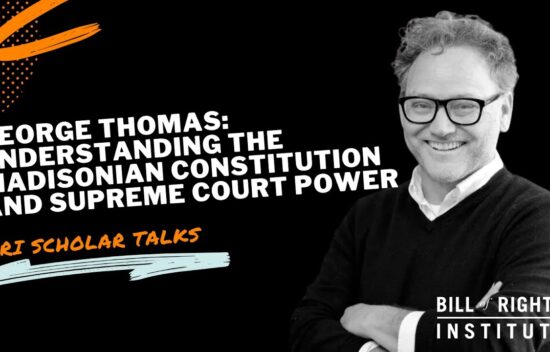
The Madisonian Constitution and Supreme Court Power with George Thomas | BRI Scholar Talks
Watch
Founding Principles
Separation of Powers, Due Process, Natural/Inalienable Rights, Justice
Virtues
About this video
Is the Supreme Court the final word on the meaning of the Constitution? In this episode of Scholar Talks, Tony Williams, Senior Fellow at the Bill of Rights Institute, is joined by George Thomas, Bernadette C. Wofford Professor of American Political Institutions at Claremont McKenna College, to explore insights from Thomas’s acclaimed book, The Madisonian Constitution.
This episode delves into the foundational principles of the Madisonian system, emphasizing the separation of powers and the shared responsibility of all branches of government in interpreting the Constitution. Through compelling historical case studies, the discussion examines debates over judicial supremacy, Congress's enforcement of the 14th Amendment, and the Progressive Era's challenges to constitutional structure. Thomas also highlights lessons from figures like Abraham Lincoln and Franklin D. Roosevelt, demonstrating how constitutional interpretation has evolved through political and legal conflict.
0:06 In this episode of Scholar Talks. The guiding question is, is the Supreme Court the final word on the meaning of the Constitution? So our guest, George Thomas, is the Bernadette C Wofford Professor of American Political Institutions at Claremont McKenna College, where he teaches constitutional law and American political thought.
0:26 And he’s the author of The Madisonian Constitution, which is the subject of today’s discussion. I am Tony Williams, senior fellow at the Bill of Rights Institute, and I want to welcome you to another episode of Scholar Talks in the America 250 series. George, I want to thank you very much for joining us. Oh, thanks so much for having me.
0:47 Sure. I mean, I really love the book. Some some great, a great examination of the American Constitution as Madison originally, intended it, the the relationship of the separation of powers and and how each branch interprets the Constitution, as well as some really great case studies to illustrate the point to me.
1:10 So we’ll start with a big question. But in a nutshell, what is the MadisonianConstitution, and why is it relevant to the understanding of judicial review? Okay. Well, first, thank you so much for the praise of the book. And for having me, you know, it’s delight. Especially first book. It’s been a little bit,
1:31 so I’ve written to for, you know, people to rediscover it, I suppose. So, the maybe the easiest way to start in thinking about the Madisonian Constitution is to really take conventional wisdom. And conventional wisdom that’s probably dominant, certainly among, the political class and most representatives, and has been for half a century, maybe more.
1:53 And that’s that. When we think of the Constitution, we think of it as fundamental law, but fundamental law like ordinary law, and that the primary mechanism of enforced ment is the courts. And so judicial review in that understanding really becomes the central way of enforcing the Constitution and the courts then
2:15 is, seen to be the final and authoritative interpreter of constitutional meaning. So to start from a Madisonian perspective, which I don’t, I think Madison, is sort of the central and key figure in fully articulating this view, but is, you know, we’ll get to I think it’s been picked up.
2:36 By an awful lot of political thinkers, over the years and was, I think probably pervasive, among many, leading, political actors, political thinkers from the founding generation. And the first place to start, really is to think of the Constitution in much more political terms and to start with the separate institutions, the notion of separated powers
2:59 and the separation of powers is not really just about checks and balances. It is about checks and balances, but it’s first about constituting these institutions in a manner that they can then best carry out their constitutional duties and responsibilities. And so, for instance, you have a divided
3:19 Congress not just to make things difficult. It does make it more difficult. But you want really, serious representation among a wide swath of the population that’s more immediately connected to them in the House, say, but in the Senate, you have, longer terms. You get, a voice from the States, and it’s these different institutions
3:40 that are going to bring out, different versions of representation and popular government, different interests, but they’re going to then be forced to think and deliberate and construct good public policy. And that’s what you want from a legislature in the same way. Right? You have a court that is, somewhat independent. I mean, very independent.
4:01 And it’s carrying out its responsibilities and deciding cases. And then you have an executive, you know, singular executive who, not just administers the law but can act quickly and decisively in particular instances. But but the Madisonian point, then, is that these institutions are structured in a way that requires them in carrying out
4:22 constitutional duties and responsibilities to also discern and think about constitutional meaning in that process. And so, the the way that’s, I think, different than how we ordinarily conceive the Constitution is we should expect Congress to be thinking about the Constitution. We should expect the president to be thinking about the Constitution.
4:46 And, in the Madisonian, scenario, no one institution is given responsibility for finally interpreting the Constitution. There’s a real skepticism from the Madisonian perspective of reposing trust in any one particular branch and say, okay, you’re the kind of constitutional branch of government.
5:07 The result of that is that constitutional, interpretation is often get it, involve some conflict over constitutional meaning. The branches could have different understandings or readings, at different times. But that’s an ordinary feature for Madison of, constitutional government. And that means that we should be more ready
5:30 inclined to accept some kind of constitutional conflict and know we’re going to have some debates over constitutions, meaning and that they’re likely to be worked out, as part of the overall political process, over time. So very quickly, just in contrast, judicial supremacy, the idea would be that while the court decides
5:53 and now all the branches, have to follow what the court said about the Constitution, not just the case before it. For from the Madisonian view, there’s real skepticism of that. And judicial review still plays an important part in the constitutional scheme. The court hears cases and it decides cases, and the parties to the cases go before it and often,
6:14 have constitutional questions that they’re engaging. And so the court resolves those constitutional questions, and those, decisions are binding on the parties to the case. That’s so that’s judicial review, right? Judicial review might find that there’s an act of Congress that’s unconstitutional or an act of the executive that’s unconstitutional. The Madisonian Framework accepts that.
6:36 But in the process of deciding that particular case, the court also renders a judgment on what is the Constitution mean, that that refines that. And then the question is, okay, so when you go back to the executive carrying out his or her duties or members of Congress deliberating on constitutional issues, are they bound by that
6:58 understanding that the court handed down, or can they read the Constitution, on their own and say, well, we think the court got it wrong in this case. And so, in in terms of the broad constitutional question, and so we’re going to, follow our own understanding of the Constitution. And the Madisonian framework invites the branches to do that.
7:20 Correct. Thank you. I mean, that’s really nicely laid out. And, you know, it’s it strikes me as pretty funny that it it seems novel that we would have each branch of the government interpreting and following the Constitution, because that’s where we are with, you know, the idea of judicial supremacy, as you mentioned. So, Yeah, look at it.
7:41 Right? Is if is if somehow like Congress is not supposed to look at the Constitution when they’re, deciding, you know, these legislative questions or thinking about their power, right? They’re supposed to just turn to Supreme Court opinions, not the Constitution, which is a little bit of. Right right right. Okay. So so jumping into your case studies to really illustrate these points,
8:03 which I think is is a great part of the book. So, so after the Civil War, you show that Congress and the court struggled over the meaning of the especially the 14th amendment. So what was the nature of that struggle between these branches? Yeah. I mean, start with, just in thinking about the history, the fact that you have, the, the Republican Congress at the time,
8:28 after the Civil War, forging the 14th amendment and amending the Constitution and in part, at least amending the Constitution to really kind of settle some constitutional questions that had been disputed, prior to the Civil War. Let me just take one really clear instance of it, that you get by a Supreme Court opinion, in the years just before the Civil War,
8:52 that’s the famous or infamous Dred Scott case, which says that blacks free or slaves can’t be citizens of the United States. It also, you know, reads the rights of citizens far more narrowly. And so the, reconstruction Congress wants to solidify its understanding in the kind of Lincoln and Republican understanding
9:15 of the Constitution by way of constitutional amendment. And that not only makes, blacks. Of course, there’s obviously, the, the, abolition of slavery in the 13th amendment. But then you make blacks are all persons born in the United States, citizens of the United States. And you, entitle those citizens to the privileges or immunities
9:36 of citizenship you command that states, respect their rights by way of due process clause and, guarantee equal protection by way of the 14th amendment. And I mean, just one of the things that’s interesting, I think, for, especially, you know, people who don’t have a lot of background in constitutional history to look at is when you go back to,
9:57 the, Reconstruction Congress and after, you have this, you know, these, these extraordinary political actors in thinking, engaged in these great constitutional debates. I mean, they’re incredibly smart constitutional debates. They’re thinking deeply about constitutional questions. And we tend to think, as you said earlier, right, that like, oh, well, Congress thinking about the Constitution seems sort of novel.
10:19 And yet, you know, the the debates from that era are in the engagement with the constitutional questions are really, profound. But so the court in a series of decisions over the course of the latter half of the 19th century, really sort of narrows, the, the meaning of the 14th amendment.
10:40 It does so by really reading out of the Constitution the Privileges or Immunities Clause. And so when you think of, you know, we view the Constitution through the lens of the court. And so we tend actually not to talk much about the privileges or immunities of citizenship. And yet that was really key, to the Reconstruction Congress. And, you know, it was
11:00 it was maybe, you know, one of the most important features of the 14th amendment. And so that period for me is just interesting because you have, I mean, to, to maybe simplify things, but you have, a really interesting dynamic of the Congress, attempting to enforce the 14th amendment. And incidentally, it you know, the amendment gives Congress the power in section five.
11:23 I meant to enforce the terms of the amendment. Right. So, you see, right there that they don’t want to just trust in the courts to say, okay, don’t we’ve now amended the Constitution. The courts will tell us what this means. Congress says, no, we’re actually going to have an active part in enforcing the terms of this amendment. And as they do so, the court really narrowly reads, the terms of the amendment or culminating,
11:44 for listeners that would be more familiar with it. In the case of Plessy v Ferguson, where, the courts are a separate, separate, separate facilities and racial segregation are okay. They’re part of equal protection, almost certainly at odds with a lot of the understandings articulated by, the, the Reconstruction Congress that, you know, framed
12:06 and ratified the 14th Amendment and those understandings immediately after. So it’s a it’s a great example also, of seeing Congress actively engaged in protecting constitutional rights in a robust way when we tend to think, oh, well, legislatures don’t care about rights, courts do. And our history is just a lot more complex than that. Right? Right. Not.
12:28 I yeah, there’s so much to dig around in. But but we’ll move forward. So so if years after that few decades, how did the progress of seek to change American constitutionalism? And did the courts agree in that case? Yes. So the the progressives, in ways in I mean, especially in the,
12:50 you know, most visible figure of Woodrow, Woodrow Wilson, but hardly just Wilson, the progressives really were skeptical of, the separation of powers. And so if we think of sort of the key features of the Constitution, it’s really rooted in this idea of the political dynamic, of the separation of powers. Which reflects, for Madison, a popular government.
13:13 The idea is that the government still its deeply, you know, smaller, Republican and popular and should ultimately be responsible to the people. And yet there’s also a kind of skepticism of the people in the same way that there’s a skepticism that any one institution, should be, the enforcer of the Constitution, because the people too can be, ignorant.
13:35 They can be misled, they can simply not have enough time to consider things. So part of the job of the separation of powers and representative institutions in terms of Madisonian design, is to, in fact, both articulate popular understandings, but also, to educate and correct those understandings at times to force a kind of deliberation. And progressives are,
13:57 deeply skeptical of the separation of powers. And so far as, it often works, what they understand is popular mandates. It makes government somewhat more complex because, you know, you’re elected, but then you can’t immediately kind of act on why you think you were elected because, you know, a progressive understanding sort of introduced this idea of that,
14:20 those representatives who are elected have a mandate from the people. And so they should be able to act on that quickly and, separation of powers, in a more antagonistic kind of Estonian sense thwarts that. So or potentially thwarts, it and so the progressives prefer I, you know, I think an understanding
14:41 of popular government that’s that’s far more in accord with something like direct democracy channeled through, especially, a presidency, a kind of plebiscite, airy presidency in ways. And so, Wilson and others are trying to think about ways to use both, especially the presidency and political parties, to overcome what they view as the defects
15:04 of separation of powers and checks and balances. The the court at the time, is more skeptical of this popular understanding that just because, the people you know, passed legislation or wanted legislation doesn’t necessarily mean it’s constitutional. And, you know, again, I don’t want to get too involved in the complexity.
15:26 I mean, there are all kinds of questions. Was the court acting, outside the bounds of the Constitution? Was it narrowing federal power in ways? I mean, those are all, I think, really interesting and fascinating questions. But in the end. Right. I mean, you get this. I think the two things that are interesting to, to, pull out briefly are the, progressive kind of skepticism of,
15:49 separation of powers. But it’s also interesting because they, at the same time, are kind of championing that the other branches of government should be actively involved in constitutional interpretation and potentially against the courts. I mean, Teddy Roosevelt, is especially insistent on that point. And you and and you end up even, you know, with some skepticism of the Madison system.
16:09 You end up with a pretty Madisonian dynamic between the court and the branches of government, where the court kind of forces, the other branches to articulate their constitutional understandings, envision then you and you get a bit of that, especially from a William Howard Taft in a, in a Teddy Roosevelt. You know, seem like you’re you’re honing in, also on the,
16:32 you know, arguments of Roosevelt, of Wilson, thinking that the court sort of impeding the creation of this regulatory state that these, you know, if you just put the Constitution sort of in the presidency, as you said, and and especially in the sort of the experts in the administrative state that they could sort of create this sort of perfect social order
16:53 of, of efficiency and order and everything would be more harmonious. Yeah. And FDR really, draws on that understanding, in fact. I mean, FDR is a, you know, a really interesting figure because, I mean, on the one hand, he seems to embrace very much,
17:16 you know, Madisonian understandings where as president, he thinks the court is reading, national power to narrowly, he’s skeptical of their understandings. And so he wants to challenge the court and the court’s, seeming monopoly on constitutional interpretation. And he has these great lines like,
17:36 you know, the Americans should read the Constitution, like they should read the Bible. It should be something that, every citizen knows. And that part of it, I think, is deeply made Estonian. And this idea of engagement with the Constitution, not just among the people, but by, the Congress and the presidency at the same time,
17:58 he has these lines where in his famous court packing plan or what becomes known as the court packing plan, he, of course, didn’t call it that. But he has these lines where he wants to say the separation of powers is this three horse team all plowing for the people and the courts, sort of leading us astray over here, and it needs to get in line and plow.
18:19 And that very much represents more of the progressive vision you’re talking about that it’s like, okay, the government is going to be unified, around a particular political party or understanding it. All the three branches should then move in lockstep, which is, I mean, you know, think very much at odds with the Madisonian,
18:39 dynamic because you’re trying to bring one branch on and say, okay, you, you now go along with us. But what if that branch is like, but what we think you’re doing is constitutionally problematic. I mean, and then the the final part of FDR that I think is, is, interesting. There is he also resorts to and I think this becomes more familiar, even though he’s articulating a vision, saying, Read the Constitution
19:01 like you read the Bible and articulating a vision against the court. He ultimately resorts to a kind of court packing. Like how he’s going to achieve his constitutional understandings is to put more justices on the court who will then follow his interpretation and understanding of the Constitution, and that I think, in the end, leads to a much more legalized view of the Constitution.
19:24 Right. What you see, I mean, you saw that in recent years where if you don’t like court opinions, rather than arguing with them and thinking about them and the duties before you, you’re like, well, let’s just put more justices on the court and we’ll work through the courts. And that, I think, lends itself far more to, a legalistic understanding where you’re you’re kind of accepting, a form of judicial supremacy.
19:47 The court will decide things. You’re just wanting to, you know, put your, your, justices on the court. So that’ll be your understanding, articulated by them that that triumphs right then. And, and you talk a lot about the struggle over, over the Commerce clause. Right. That the, the, the core seemed to put a break on, on the, national, industrial Recovery Act and on the Agricultural Adjustment Act,
20:11 on all these things he wanted to do, FDR wanted to do for for recovery and reform and, and yet, you know, he eventually gets it. And we sort of have this governing through the Commerce Clause. Can you just briefly. Yeah. And, and and it’s and, you know, it’s it’s it’s interesting at the time too, because, you know,
20:32 some of the Commerce Clause cases where FDR is pushing national power are decided by, the, you know, progressives on the court where they’re kind of skeptical of some of the national overreach. And so there’s there’s, I mean, right, both with some of the, figures on the court that think but you’re but you are pushing national power
20:53 maybe farther than it goes. And then in his own party, even also is like, hey, you can’t engage in packing the court. That seems to be problematic. So those they’re, you know, they’re those Madisonian elements of the Constitution institutionally are still there. But, I mean, the struggle over the Commerce Clause, it in the end,
21:14 as FDR puts more justices on in time, you know, really shapes out his way. And, you know, you have a kind of middle period where you get the the court saying, okay, there’s pretty robust national power, but it’s still within the system of dual federalism. And there are limits. And the court has a constitutional obligation to police,
21:35 those limits, even while upholding, subsequent New Deal legislation, which actually was changed and reformed based upon the court striking down some of the first rounds. But then you ultimately get with, with feeders, justices, having a majority on the court, you ultimately get the court simply retreating from any notion that it would really engage
21:59 in policing the limits of Congress’s Commerce Clause power. And so you get a retreat saying that, you know, that’s really something that will be settled, totally by the political process where the court, by and large, won’t have, a role in it. And that really kind of, you know, carries out through much of the second half of the 20th century
22:19 until I think you get Reagan, you know, playing FDR in some sense in reverse. Right. And great segue into my, my, my one of my last questions here is that, you know, Reagan attempts to restore the Madisonian Constitution through originalism. So, you know, was he successful in achieving that?
22:40 I, I’d say yes and no. And Reagan is, he’s the he’s the first president since FDR to embrace, clearly embrace and articulate, this understanding that the president and the Congress is and the other branches of government have a role
23:00 in constitutional interpretation and to reject clearly the idea of judicial supremacy that the court is not just, authoritative again, in deciding the cases before it. Right. The Madisonian understanding accepts that they resolve the cases. That’s what they do. But again, do they resolve the broader constitutional question
23:21 when it comes before another branch of government? And to Reagan’s, you know, the the first president to really clearly articulate that since FDR and and just just kind of as a side, you know, we should pause just to think that, you know, Americans engage in this kind of ranking of presidents. And it’s it’s almost certainly not a coincidence that when we think of, you know, post
23:42 George Washington, the, the presidents that, you know, make the ranking, they’re all, engaged in constitutional interpretation in their own right. They’re all what, what the under the Reagan era. And then, you know, today we would call the mentalist presidents or depart mentalism. And that is the idea that each branch of government, in carrying out its own duties and duties before it,
24:06 each department gets to interpret the Constitution, and its duties. That doesn’t mean the other branches have to accept it, right? I mean, that’s part of the clash. But. So Reagan, I think, clearly brings that back. And that part is powerful. At the same time, the way Reagan, I think achieves
24:27 many of his outcomes in the end, because he for him, he says this should coincide with a jurisprudence of original intent and. Right. That’s the idea, at least for Reagan, that the court should be or we should be deciding constitutional questions based upon, the intent of the founding generation, that subsequently gets refined, especially by Reagan’s justices,
24:50 to, become what’s now called original meaning originalism. And that’s the idea that, we should decide cases. We should decide constitutional meaning based upon how the people who ratified the Constitution understood it. And Reagan is absolutely, successful insofar as he brings originalism out,
25:13 as a way we should think about the Constitution and obviously, right, that’s been, become, increasingly dominant to the degree to which, you know, you could argue that, it’s, you know, maybe the dominant mode of thinking about the Constitution these days with some questions and certainly, on the contemporary court,
25:35 you have a, a clear majority who’s, you know, and Chief Justice Roberts is sort of they’re sort of not, who adhere to originalism in some way or another. So on, on, you know, at that level, Reagan was very successful, I think, with some irony. At the same time, it’s, again, much like FDR did most of, Reagan’s
25:56 constitutional achievements in that way actually came through court decisions. And so there’s, you know, a, a legalistic take to that. And originalism in those terms is, and, and, you know, I don’t want to overstate it because most originalist scholars would say they’re departmental lists
26:17 of some sort or another. Not all, but but most all the original jurists, on on not just the Supreme Court but elsewhere insist upon a kind of judicial supremacy. And I would say, that’s really become post Reagan. That’s been true of most presidents and most members of Congress. Right? I mean, they’re to when they engage in constitutional debate,
26:40 they’re kind of working through the courts in the court system and trying to achieve their constitutional goals, by way of courts and, and give primary, deference to the courts on constitutional questions. And you see, you know, liberals, progressives accept that too.
27:01 And their, their, their solution was sort of court packing. Right? So when you had constitutional conflicts, that’s how, they were going to sort them out. Great. So I my final question goes back to our guiding question and a very simple, straightforward question. So is the Supreme Court the final word on the meaning of the Constitution?
27:24 And I say that tongue in cheek, of course. Yeah, yeah, I would, I would say no, and I think we’d be better as a constitutional republic, a polity, if the political branches and the people attended more carefully and more thoughtfully to constitutional questions, and that would on occasion mean,
27:45 you know, and really serious issues disputing the, the court’s reading and not just disputing it in newspapers and op eds, but disputing it in terms of how the executive acts or how the legislature acts. Now, again, just to be exquisitely clear on the point, that doesn’t mean not following
28:07 court decisions, especially Supreme Court decisions, as they resolve the dispute to the parties to the case, those should be viewed as binding. That’s what courts do. They resolve legal disputes that sometimes are constitutional disputes. And so just maybe to go back to wrap it up, when the Supreme Court handed down the Dred Scott decision,
28:31 the, parties to the case have to go with that decision. So when Abraham Lincoln becomes president four years later, he doesn’t get to go say, oh, no, no, Dred Scott is a free person because that’s how the courts should have settled that question. He he doesn’t get to challenge the court in that way. How he gets to challenge the court is,
28:53 in the course of making its decision, chief Justice Roger Tani also said, but blacks can’t be citizens of the United States. And Lincoln says, I think you’re wrong on that score. So when it comes to the State Department issuing passports to free blacks, can the president can the State Department say, well,
29:14 we think free blacks can in fact be citizens. And so we’re not bound by the broader constitutional understanding of the Dred Scott decision. And so we’re going to proceed to issue free blacks passports because we think they can, in fact, contrary to Dred Scott, be citizens of the United States. And I think that’s the kind of, constitutional government constitutional framework that’s more comfortable with constitutional disputes and,
29:38 and having these constitutional questions play out as part of, constitutional politics. That’s more in accord with the kind of constitutional self-government that Madison thought would be, the central feature of our constitutional system. Fantastic. George, I want to thank you very much
29:58 for joining me, on this very important and relevant topic. Great. Thank you so much for having me. It was a pleasure. And thank you all for joining us on this episode of Scholar Talks. Please check out the other episodes in our America 250 series.