Video
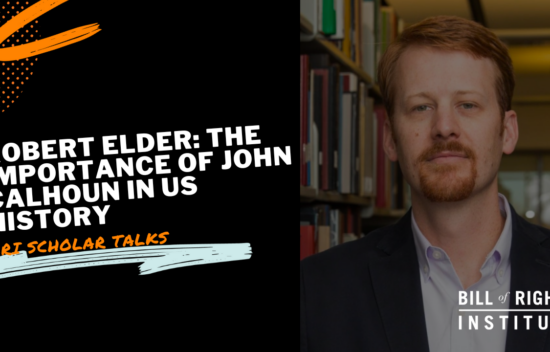
The Importance of John Calhoun in U.S. History with Robert Elder | BRI Scholar Talks
Watch
Founding Principles
Majority Rule/Minority Rights, Natural/Inalienable Rights, Liberty
About this video
Why is John Calhoun an important figure to study in United States history? In this episode of Scholar Talks, BRI Senior Fellow Tony Williams is joined by Dr. Robert Elder, Professor of History at Baylor University, to talk about his new book ‘John Calhoun: An American Heretic.’ Together, they discuss Calhoun’s shifting views, controversial ideas, and role as an influential figure in American history.
0:01 [Music] foreign for this episode of scholar talks The Guiding question is why is John Calhoun an important figure in U.S history Our Guest today is Dr Robert Elder who is a professor of history at Baylor University he focuses on the cultural intellectual and religious history of
0:21 the American South during the 19th century his prize-winning biography John Calhoun an American heretic is his second book I am Tony Williams Senior fellow at Bri and I am pleased to bring you another episode of scholar talks in our series topics in American history Bob I want to thank you very much for
0:43 joining us thanks for having me Tony love the book um you know I found it highly readable it’s extremely informative about a wide range of really important events and I’m going to probably embarrass you a little bit here by saying I’m going to dare to call it magisterial uh you know I think it’s just one of those biographies that
1:05 you’re just swept in uh and it’s pushing what uh a little over 500 pages but it’s just so readable and really draws you in I will take that complimental technique um I mean one of the challenges of the book obviously is uh it is a long book and how to maintain a sort of narrative
1:25 over that length and to keep people interested was uh was really something that we had to work on really hard in my editor and I and um I’m glad that people have found it readable that took a lot of work well you succeeded uh with a home run I’m gonna go ahead and call it the the definitive biography for many years to come so uh but I I know I’m
1:48 embarrassing so uh so so the first question um so whatever the controversy surrounding him and and we’ll get to those what made John Calhoun such a towering Statesman in the mid-19th century yeah I mean one way that I that I usually talk about this is to say that if you had asked people in
2:09 the first uh well let’s say the middle three decades of the 19th century the 1820s 1830s 1840s for their list of sort of the top five American political figures who had not yet been president but but would be Calhoun would have been on most of those lists um he was somebody that everybody
2:29 would have put at the very Pinnacle of American politics he was right in the rank with uh people like Andrew Jackson you know Henry Clay Daniel Webster those sorts of figures um and part of that was just his in his incredible influence at the very top levels of American politics
2:49 for all of those three decades I mean he he uh he’s elected to congress during right before the war of 1812. he is then the Secretary of War under James Monroe from 1817 to 1824 he’s a key figure in kind of
3:10 forging the modern war department um he’s vice president under two different presidents uh John Quincy Adams and Andrew Jackson and then of course he’s most famous for for his role as a son senator from South Carolina for most of the rest of his career although there’s a brief one-year period near the end of his life when he’s actually back
3:31 in the executive branch as a Secretary of State under John Tyler for a year so he was just omnipresent and uh took part in most of the major political battles in the first half of the 19th century right and so let’s talk about some of those uh Calhoun’s views I think changed quite a bit over the course of his
3:52 political career can you explain some of those views and and some of those events that you were just mentioning and and maybe why his views might have changed yeah so you think the typical view of Calhoun and this is somewhat the view of his critics both at the time and and now I think is that there’s this dramatic
4:13 shift in Calhoun’s approach to politics that he starts out as a strong nationalist uh during the War of 1812 and really all the way up until he he resigns as Andrew Jackson’s uh vice president in 1832 during the Nullification Crisis which is sort of this hinge point where he becomes a a
4:37 more sectional figure associated with South Carolina and states rights and those sorts of things um and one way of narrating that is is simply um that he has this shift in his interests right that he becomes more cynical about the American project more interested in defending slavery as he
5:00 sees looming threats to that and I think part of that is just accurate Calhoun never really faced up to the to to just how nationalist he was in his early career but uh Calhoun would have narrated it differently the way he did that in an 1843 campaign biography was he said look at the beginning of my career in the War
5:21 of 1812 and all the way into the into the 18 1920s the main threat was foreign it was a it was an invasion of Britain like we were we had to guard against that and so centralized power and authority was actually really important and the main threats were external after 1828 let’s say when the the Tariff has
5:42 passed um and Andrew Jackson comes to power he said the main threats to American um uh to the American experiment are internal uh right they’re they’re the threat of of tyranny in the executive branch in the form of Andrew Jackson of uh over the overreach of congressional powers
6:03 and from Calhoun’s perspective uh the threat of an anti-slavery movement that he viewed as unconstitutional and and dangerous to the fabric of the of the union and so he that his shift you know he would have narrated it differently um but there there is a there is a shift
6:25 and as for those more controversial views we mentioned uh what role did he play in The Nullification Crisis of the 1830s yeah so um so as I mentioned uh Calhoun the nullification crisis at the heart of it right is the Tariff of 1828 the so-called Tariff of Abominations which uh which Calhoun and South Carolina
6:47 oppose um Calhoun’s role in The Nullification Crisis is really you know that’s the key shift in his career he still wants to be president in the 1820s but South Carolina is slowly becoming because of the Tariff much more radical in its opposition to the to the federal
7:07 government including many people in South Carolina there were actual secessionists in South Carolina um and Calhoun’s role was to sort of thread the needle between actual secession and uh somehow finding a way this to to oppose the Tariff within the
7:28 Constitutional system uh that he still believed in and nullification was his way of doing that and of course nullification it’s not a new idea Thomas Jefferson and James Madison in different ways had raised the idea that a state could interpose its Authority between its citizens and the federal government
7:48 but Calhoun is the one who really puts a theoretical bones or or meat on those bones he works out an actual process constitutional process by which nullification could uh could work and South Carolina puts it into practice In 1832 nullifies they they hold a
8:09 constitutional convention which Calvin says is the only way you can do this because that’s the original creating power of the Constitution so it has to be uh you know that’s what ratified the Constitution so you have to go back to that to nullify a law and uh almost provokes a war between South Carolina and uh and Andrew Jackson
8:32 but his ideas about nullification are not widely accepted at the time I’m not that’s what’s so controversial about it right some people even people who believed in secession thought that nullification was kind of a crazy idea trying to have it both ways and true nationalists like Andrew Jackson also thought this was a crazy idea because it
8:53 would allow one state to kind of interpret the Constitution for itself uh so even more controversial perhaps were Calhoun’s Embrace of the quote unquote positive good of slavery and also his ideas about what was called the concurrent majority can you explain some of these hardening
9:14 views towards the end of his life and and maybe what impact they had Calhoun’s I mean arguably he’s most famous in American history for this 1837 speech in the Senate where he argues that slavery is not a necessary evil it’s a positive good and this uh the Calhoun had really avoided
9:36 slavery for most of his career because he wanted to be president and it was a divisive issue he’s a good politician but in the 1830s as the as the um as the Abolitionist Movement is growing in strength and there’s a discernible sort of anti-slavery movement uh developing alongside it Calhoun comes to the belief
9:59 that the old defense of slavery with the traditional defense which was the necessary evil defense this is what Thomas Jefferson would have argued Jefferson would have said it this is a contradiction of the American idea um but we can’t get rid of it and Calhoun realized that um that argument
10:20 was too susceptible to attack and compromise that it it admitted too much in his view to be uh to be a useful tool against this new anti-slavery and so he gathers a lot of arguments that were floating around for a couple decades and really molds them into a potent
10:40 political ideology where he says uh look slavery is good um politically uh because it establishes a um a subjugated class that makes every white person equal essentially it his argument is essentially that slavery allows white democracy it allows white
11:02 equality that that there’s always going to be a subjugated class in any society um and that uh if we just admit that that’s the case uh then slaves can be that in American society and this will allow a sort of equality among white
11:24 people so politically uh it’s good he says economically it it’s good he says that uh there’s this conflict between labor and capital that’s developing in the industrialized World we’re already seeing it in places like Manchester England uh and in in the New England industrial societies and this is going
11:44 to be the defining conflict of the modern world and slavery he says solves this problem because it takes the it takes the political power away from the working class so it you know eliminates them as a political danger according to Calhoun but he says and it also kind of
12:04 unifies the interests of Labor and capital in the person of the slave owner because his interests are also you know he has an interest in the slaves well-being as well as his own well-being because he owns his the the the labor right and uh this is why Calhoun has
12:25 been fascinating to generations of marxist Scholars beginning with people like Eugene Genovese because um Calhoun basically says look capitalism as it is emerging in these industrial societies is exploiting a working class they are exploiting a
12:45 working class and we’re just being more honest about it and because we’re being more honest about it it obligates us to take care of our workers and so the fact that Calhoun is so instrumental in sort of spreading it this becomes more or less the majority position for many white slaveholders by the time of the Civil War and that makes it much harder
13:08 I think to compromise on on slavery than it would have been if they were still operating on the old necessary evil uh argument right and he makes arguments about concurrent majority I I know that can get a little complicated as a as a political philosophy but can you tell us a little bit about that yeah I mean this this really the concurrent majority shows up most strongly in Calhoun’s
13:31 posthumous essays on government he writes two essays on government there or published the year after his death he dies in 1850. and these are really the sort of summation of ideas that run all the way back to the Nullification Crisis because at the heart of the Nullification Crisis was the for Calhoun was the issue of how
13:52 do you protect minority rights in a majority uh you know majoritarian democracy right at the time it was how do you protect South Carolina within the larger constitutional framework of federalism um but he elaborates that further by the end of his life it’s really spurred by
14:13 his um by the position of slaveholders within American democracy by 1850 where he saw them as a as a sort of minority interest that eventually would be outweighed by by the majority but but Calhoun is also just interested he is a he’s interested in the Constitutional
14:35 thought of that or the problem that that represents as well um he’s not only interested he is interested in protecting slave holders interests within the union but no other major politician of his generation wrote anything like these essays they they are still studied today by political
14:55 scientists uh Jon Stewart and Mill called Calhoun the um you know the greatest American political thinker since the founding generation and that was mainly because of these these essays and Calhoun’s idea of the concurrent majority is he says that um it’s a mistake to found
15:16 governments on the idea of a pure majority that instead what the Constitution actually and this is controversial this is his interpretation of the con of the Constitution the American Constitution that what the Constitution actually is working towards is consensus that what it wants to put
15:37 the power of the federal government into action the founders wanted as much consensus as possible and so they established all these different uh checks and balances so that you actually have to get to a very between the you know between Congress and the president and the way that we do elections and the way that laws are passed it actually
15:58 requires a fairly High consensus a degree of consensus to make a decision and Calhoun’s argument essentially was that they hadn’t gone far enough uh that uh that you needed there needed to be even more consensus in order for government to operate
16:19 and um so the concurrent majority is really the consensus majority and his idea was that every major um every major part of American society uh should have veto power over uh over any major legislation and he never defines exactly what he means by every
16:41 major group or interest but you could imagine this being States you could imagine it being slave holders uh Merchants uh workers you know you can imagine the groups in a lot of different ways but he believed that somehow uh each of these groups should have a veto power over major legislation
17:03 so that essentially you would need consensus for any major piece of legislation uh and you know I just I was just thinking as you’re talking about nullification and and criticisms of capitalism that boy these some of these debates are maybe still with us so uh it goes to the enduring relevance of of the topic of your book for sure
17:26 um but my last question is you know comes back to our uh original question why is John Calhoun such an important figure in American history yeah I think I think that Calhoun uh the way that I express it at the end of the book I mean I called the book American heretic which you know kind of captures I think how he
17:48 operates in our National imagination today uh and I actually Drew on an argument that John Stewart Mill made um in his famous essay on Liberty where he made the case for why we should allow Heretics ideological religious political Heretics in our societies and Mill said
18:10 these people are important um because they make us confront uh any weaknesses in our own beliefs they make us actually like think through what we believe right and the stronger their arguments are the stronger our arguments have to be and the more sure we can believe be that what we believe is
18:31 actually true um but without that testing without those people pushing us we can’t be sure um all the time that what we believe is true and so for me um Calhoun is a really important figure because he’s probably one of the best and sure you know smartest most
18:52 insightful critics and Calhoun serves a vital role because he can still make us think through some of those beliefs and and make sure that what we you know that what we believe will will stand up to scrutiny and criticism Bob Elder uh author of John Calhoun American heretic I want to thank
19:14 you very much for joining us thanks so much Tony it’s been great and thank you all for joining us on this episode of scholar talks please check out our other interviews in the topics in American history series on our Channel
Standards
Related Resources

This eLesson was written by Shannon Jones, a member of BRI's Teacher Council. Introduction: In the midst of the 1830s, Congress was not only stymied by the ongoing tariff debate and the sectional division created by this debate, but it also began to see a rise in anti-slavery petitions from abolitionists.

BRI Senior Teaching Fellow Tony Williams sits down with political scientist James H. Read to discuss his essay on John C. Calhoun in BRI's new digital history textbook, "Life, Liberty, and the Pursuit of Happiness." Dr. Read tells the provocative story of how Calhoun’s political philosophy broke with the Founders’ view of majority rule in a republic. Calhoun developed the idea of a “concurrent majority” to protect “states’ rights” before the Civil War. What is the proper role of majority rule and consent in a republican form of government? What is the nature of the relationship between the federal and state governments according to the principle of federalism?
Use this primary source text to explore key historical events.