Video
The Evolution of Justice Doors at the Supreme Court | BRIdge From The Past
Watch
Founding Principles
About this video
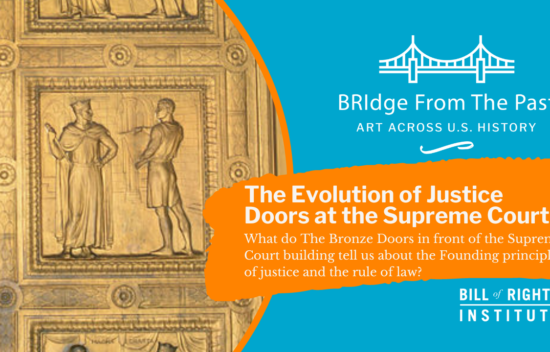
What do The Bronze Doors in front of the Supreme Court building tell us about the Founding principles of justice and the rule of law? In this episode of BRIdge From The Past, Mary explores Gilbert and John Donnelly Sr.’s Justice Panels displayed in front of the Supreme Court building in bronze. Finished in 1935, these panels depict in chronological order the evolution of justice according to Western tradition. Why do you think the artist chose these specific events to be enshrined forever? What event depicting justice would you add to the doors?
0:00 Hi everybody. Welcome to an episode of Bridge from the Past. I’m your host Mary, and this series is all about using images as a starting point to think about important topics in American history and civics. Today, we’re once again returning to the Supreme Court building in Washington, DC. The entrance to the Supreme Court is marked by this massive bronze door.
0:20 What can the symbolism on this door tell us about founding principles of justice, justice and the rule of law? Let’s jump in and see. Once again, we’re thinking about how the bronze doors at the entrance of the Supreme Court building can tell us something about the founding principles of justice and rule of law.
0:42 Here’s our starting point. So you can see I’ve given you the big entrance to the Supreme Court building in Washington, DC. And the bronze doors are up here at the top of the steps behind these columns. So I’m not zooming in on those doors yet. That will come in just a minute, because I think it’s important to look at where the doors are in context to make some initial observations.
1:04 Whenever you’re looking at an image, it’s important to just make some observations before you go anywhere with your analysis. If you’re using the handout that accompanies this video, go ahead and pause here and make some observations of your own. Some of my initial observations are that this building looks like a temple. It’s white. It looks like it’s made of marble.
1:25 It is made of marble. I have these columns. There’s a pediment. You have these wonderful statues out front. You have the contemplation of justice and the authority of law, both of which we explored in another Bridge from the Past video, if you want to check those out. But if you go up the stairs sort of up high, your eye is drawn up to these doors.
1:47 So they’re bronze, they’re shining. It kind of catches the eye. It must be important. So let’s go a little bit more in depth. Now I’ve zoomed in more closely on these wonderful bronze doors at the entrance of the Supreme Court. So these doors were made by the artist Gilbert and John Donnelly, Sr. So it was a father and son, and they were made in 1935,
2:08 and that’s actually they were made for this new Supreme Court building. Fun fact, the Supreme Court didn’t have its own building until former President and Chief Justice William Howard Taft strongly lobbied for the Court to have its own building. The Supreme Court is the highest court in the nation. It’s the final arbiter of the law. And Taft thought it was extremely important that the Court have its own building.
2:30 Previously, it had been meeting in the Capitol, and Tas thought this was completely inappropriate. With this whole idea of checks and balances, the Court really needed to stand on its own. So we have a new court building. We have this magnificent doorway designed for this building and what’s going on here. It’s hard to get a sense of the scale just from this picture. But these doors are massive.
2:51 So they’re 17ft high, 9 and a half feet wide, and they weigh 17 tons. And on the door, you have eight panels depicting important scenes in the evolution of justice, going back to ancient times, going back to ancient Greece. So I won’t go through every single panel. I’ll just give you some of the highlights. So this first panel right here depicts a scene from Homer’s Iliad.
3:15 So in this scene, Achilles, who is a major character in Homer’s Iliad, presents his shield to two elders who aren’t actually depicted on the scene here, but they each pass judgment. So again, it’s this idea of having a dispute and having someone else weigh in on that issue and respecting their decision. If we go all the way up here to panel four.
3:37 So these are in chronological order, and they’re going this way. This fourth panel represents Justinian’s code. So Justinian was a Roman or Byzantine emperor, and it’s thought that this was the first codification or the first writing down consolidation of standardization of Roman law. So all of these panels are representing
3:58 something going again from ancient Greece, ancient Rome, important stepping stones and showing the importance of the law, of respecting the law, of writing the law down, of the idea that if the law is written down, it’s going to apply fairly to other people down here. This panel right here is Magna Carta. So Magna Carta kind of a big deal.
4:19 This is actually the only panel that the artist signed. You’re just going to have to trust me here. If I zoom in, you still won’t be able to see it. But the artist signed his name down here in the Magna Carta panel. And Magna Carta from 1215 was the first document to put in writing the principle that the king is not above the law, and the law is a power into itself.
4:44 So really hugely important documents. Again, we’re going up through time. This panel right here depicts a scene of King James I of England who was actually barred from going into the king’s court. So this idea that the court has to be separate from the executive. And the final panel right here depicts
5:05 Chief Justice John Marshall and Associate Justice Joseph Story discussing the Marbury versus Madison decision. Marbury versus Madison, a hugely important court case where the principle of judicial review is established. Now, Justice Joseph story wasn’t actually on the court at the time that Marbury versus Madison was issued in 1803, but John Marshall was.
5:29 So again, just this idea of the court. This is the home of the court. It’s the entrance of the court, the highest court of the land, the US. Supreme Court. And you have all of these scenes that show the power of law, the importance of law and law being separate from other parts of the government. Now, this is from 1935, and our last panel here is a scene from 1803.
5:54 My question is if we could put another panel here, panel number nine, to illustrate the importance of justice and the rule of law, what would you put here? I’d love to hear what you would come up with in the comments below. We started by asking what we could learn about founding principles of justice and the rule of law by looking at the entrance, the bronze door to the US.
6:15 Supreme Court building. And we learned that the door is filled with symbolism and important steps in this idea of the development of justice. But there’s so much more to this story. What do you want to know more about? What’s the next question in our discussion? Let me know in the comments below if you learned something. Be sure to like this video and subscribe to our channel to be in the know about
6:37 other videos, resources and contests to help you through the school year. I’ll be back soon with a new image to help us think about the complex stories that make up our nation’s history and government. Until then, everybody, whenever you see an image, keep asking questions. Take care. So, did you learn something new? Do you know the Bill of Rights Institute has many more
6:59 videos on American history, government and civics? From primary source document breakdown to historical image analysis. Whether you’re preparing for a test or just interested in learning more, they’ve got you covered. And bonus on Trivia Night, everyone will want you on their team. Check out this video here and be. Sure to subscribe so you never miss out on a new video.
Standards
Related Resources

What do the sculptures outside of the Supreme Court building tell us about the Founding principles of justice and the rule of law? In this episode of BRIdge from the Past, Mary examines the front steps of the Supreme Court and James Earle Fraser’s accompanying sculptures. The sculptures followed the opening of the Supreme Court building in 1935 and aimed to be more than just purely decorative. What were Fraser’s goals when designing these sculptures? How did he accomplish these through the symbolism and detail of each?

Read summaries of the majority ruling in landmark Supreme Court cases that have had an impact on our rights as citizens.

The American Founders believed that justice needed to be protected. They wrote the Declaration of Independence to demonstrate to the British king and Parliament that this natural right was not being protected in the colonies. When forming the United States, the Founders protected justice in the Constitution and Bill of Rights. Over time, more groups of people like African Americans and women began to reap the benefits of the protections of justice.