Video
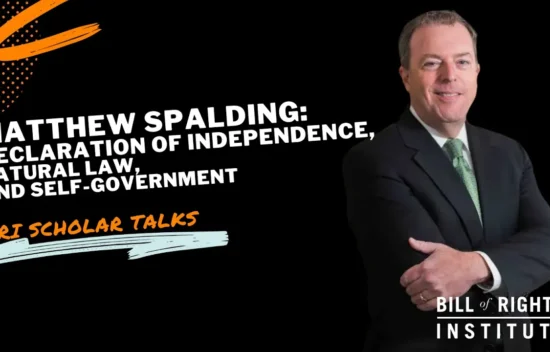
Declaration of Independence and Self-Government with Matthew Spalding | BRI Scholar Talk
Watch
Founding Principles
Natural/Inalienable Rights, Liberty, Consent of the Governed
About this video
In this episode of BRI Scholar Talks, Matthew Spalding, professor at Hillsdale College and dean of the Van Andel Graduate School of Government, joins host Tony Williams to examine the principles, structure, and enduring meaning of the Declaration of Independence. Drawing from his book The Making of the American Mind, Spalding explains how the Declaration tells a unified story of America’s founding by weaving together historical events, political debate, and philosophical argument into a coherent statement of national purpose.
The discussion examines the Declaration as a deliberate political and legal document shaped by debate within the Continental Congress. Spalding highlights its foundation in natural law, the five self-evident truths of the second paragraph, and the often-overlooked list of grievances that forms the core argument against British tyranny.
0:05 For this episode
0:06 of Scholar Talks, we will be discussing the principles
0:09 and meaning of the Declaration of Independence.
0:13 Our guest, Matthew Spalding, is a Kirby professor of government at Hillsdale
0:16 College, and it’s dean of the Van Andel School
0:20 of Government in Washington, D.C.
0:23 he is the author and editor of several books on the American founding.
0:26 Excellent books, I might add, including we still hold these Truths,
0:31 also a Sacred Union of Citizen Washington’s Farewell Address
0:36 and The American Character, and his newest book,
0:39 The Making of the American Mind The Story of Our Declaration of Independence,
0:45 which is, of course, the topic of today’s discussion.
0:48 I am Tony Williams, senior fellow at the Bill of Rights Institute,
0:51 and I want to welcome you to another episode of Scholar Talks
0:54 in our America 250 series.
0:57 Matt, I want to thank you very much for joining me.
1:00 Great to be with you, Tony.
1:02 You’re great.
1:02 You know, I really loved the book.
1:05 What a great combination of telling a really great story,
1:11 but then also understanding the meaning, the principles,
1:15 the ideas that went into the making of the Declaration of Independence
1:19 and I might add, you know, maybe,
1:20 maybe, just, just maybe why it’s still important today
1:24 and still has a great deal of relevance, going forward now.
1:28 Well, what I wanted to do something different.
1:30 I on the assumption they were going to be a lots of books out on the 250th.
1:35 I wanted to let the declaration, if you will, tell its own story.
1:39 Yeah.
1:40 We often study the document by, just studying Jefferson
1:44 or just studying a particular thing, or looking at what aspect of it.
1:49 I basically wanted it to kind of lay out a whole a full story
1:52 of how it came into being and then walk through it, very carefully.
1:56 I mean, as you know,
1:58 as you know, we oftentimes focus on the, on the most on the famous,
2:02 very important parts of the declaration, but we oftentimes ignore the rest of it.
2:06 And so I wanted to do an overarching treatment,
2:09 if you will, looking at the declaration, kind of treating it as,
2:14 you know, a symphony of different parts, but all in all, in harmony,
2:18 so that I would can draw the reader in with, with the story.
2:22 It’s actually a very fascinating, dynamic story.
2:26 But then once they get into it, start seeing, and,
2:29 and working through the declaration, its components, and explain them,
2:33 because these were all live questions, they were all debated at great length.
2:38 This is what they were arguing about in all their pamphlets.
2:40 This is not some sort of, invention out of some philosophical mind.
2:45 This is what,
2:47 as Jefferson said, which I, which which the title of the book comes from,
2:51 he said it was meant to be an expression of the American mind.
2:55 And that’s how I that’s how I approach it.
2:58 Very well.
2:59 Objectives achieved.
3:00 So let’s dive in and talk about it.
3:02 So, so can you provide a little bit of historical background, set the stage.
3:07 Some of the events that led to the, to American independence?
3:13 Yeah.
3:13 Without necessarily going into too much detail that everybody is,
3:17 is hearing, a lot about, I would, I would note a few things that make us
3:22 make the set of the declaration, perhaps, a little bit differently than we,
3:27 might look at, because I’m trying to center my narrative on,
3:30 Independence Hall in, in Philadelphia in the Continental Congress.
3:34 Congress had already met once, in 1774,
3:38 and they had already issued their, grievances to the King of England.
3:42 There are other various documents that done so.
3:44 But then the Continental Congress comes together for the first time
3:47 as a Congress, which is a unique use of that term.
3:52 And they decide that, well, if nothing happens, we will meet again.
3:55 Well, nothing did happen, but but something,
3:59 unfortunate or bad or tragic happened, I suppose.
4:02 Which was right before the Second Continental Congress.
4:06 General Gage in Boston sent troops out
4:09 to look for stores of of hidden munitions.
4:13 And we had Lexington, Concord just a few weeks before the
4:17 Second Continental Congress.
4:18 So that was kind of the immediate precursor.
4:21 The Continental Congress comes together there.
4:24 There’s a very intense debate what to do.
4:27 You know, sometimes we we forget and we have in hindsight,
4:30 since we know what happened, we don’t quite think about it this way.
4:33 But, you try to put yourself in their shoes.
4:37 Are we going to war or not?
4:39 Do we want to go to war?
4:41 We really don’t know what’s going to happen here.
4:43 We we really do not know.
4:45 Election Concord.
4:47 Triggers, a overall,
4:50 continental defense mechanism to start the in the place.
4:55 But then, come June of 17,
4:59 75, once they decide
5:03 we’re going to have to defend ourselves
5:07 and we we will recognize this army around Boston.
5:10 These are these, militias around Boston as a Continental Army.
5:13 And then they appoint
5:13 George Washington as a general, which itself is an act of war.
5:17 At that point, you had Bunker Hill, and once you have Bunker Hill,
5:21 you’ve got a war.
5:22 So it happens very rapidly, moves very rapidly.
5:26 And to some extent, I put the the declaration in the context of the,
5:30 the events.
5:31 You know, often we study the declaration as a, a separate document by itself,
5:37 as opposed to recognizing that it was it was actually a political document.
5:40 It was a piece of legislation passed by the Continental Congress,
5:44 and proclaimed by the kind
5:45 of Congress it had a committee, subcommittee.
5:49 It was heavily edited by the committee.
5:50 And then it was heavily edited again by the Continental Congress.
5:54 And so the kind of the legislative dynamic of that debate
5:58 about independence and then separately, about the declaration self is is,
6:03 a lot of the, the set up, if you will, the circumstances in the book.
6:09 Sure. Great.
6:10 So and you also, besides this confluence of events,
6:14 you also describe a confluence of ideas as well.
6:17 So you explain the different influences on the founders.
6:20 So how did it how do ancient thinkers and the English tradition
6:24 and the enlightenment Protestant Christianity, all of these
6:28 different strains of thought, all these different influences
6:31 and, influence the Declaration of Independence? Yes.
6:35 Just just a short, brief question. Yeah.
6:37 Just just in a nutshell.
6:40 Yeah.
6:40 Well, I mean, I would generally say by, by again,
6:44 backing it up and, and and looking at it more broadly, oftentimes
6:48 we think of the declaration, well,
6:49 that means we should just study Jefferson and Jefferson is important.
6:52 Don’t get me wrong.
6:53 But the colonial Congress
6:55 as a whole really debated and edited and shaped this thing.
6:59 So the question is, what were the influences on the the overall Congress?
7:04 And so I actually spent a lot of time in the book,
7:08 placing it in its historical context, you know, the cotton, the which begins
7:13 when in the course of human events, which is a historical reference.
7:17 How do they understand history?
7:19 And they really understood in a very traditional way,
7:22 but that also place them within a history.
7:25 And, and they very much understood that.
7:27 So I look at those, those influences, if you will, to try to draw out,
7:32 those influences and in ways that others have talked about.
7:36 But I’ve, I’ve tried to kind of, pull it together very tightly.
7:42 And in putting the book together,
7:43 one thing I did come to the conclusion even more that I proved
7:46 you thought was the influence of, say, Cicero in particular.
7:50 But the, the, the Romans and the classical thinking,
7:54 the classical education was the dominant form at the time.
7:58 They had clearly been influenced by that.
8:01 Cicero tended to be what they read when they learned Latin.
8:05 And the, the teachers, which were largely from Scottish,
8:09 Presbyterians, came over and, and, ran that ran the schools
8:12 where these guys were taught were largely classical scholars.
8:16 The, the the British tradition is extremely important.
8:19 The common law tradition.
8:21 And I talk about that at great length.
8:23 Blackstone and Cork in particular.
8:26 But of course, then broadly, the whole Christian tradition, again,
8:29 something I always thought was very important,
8:31 but even more so, I think, you know, as in spend some time in thinking this through
8:34 is how the Christian tradition, for all intents purposes, becomes the,
8:40 the bridge, if you will.
8:41 That brings the classical tradition, meaning the thinking about nature
8:45 and the kind of philosophical groundings of of what what man is,
8:50 the Christian tradition shapes that, but also then brings it into the modern era
8:55 and brings it in and greatly shapes the American founders,
8:58 especially through the thinkers like hooker, and others.
9:03 So the point is, there’s all of these sayings.
9:05 Again, don’t think of the declaration out of context.
9:09 All of these things are percolating up in all of their pamphlets,
9:12 all of their writings. It’s been quoted.
9:13 It’s been talked about at great length,
9:15 and it’s being debated in the Continental Congress.
9:19 So when Jefferson writes the declaration, he’s pulling it all together.
9:22 You know, there’s a famous letter, which I know you’re
9:25 familiar with, where he refers to the declaration being,
9:28 grounded in what Aristotle, Cicero, Sydney and Locke, etc.
9:33 of course, that, etc.
9:33 is very important, but generally speaking, he
9:36 he was thinking in those philosophical terms in terms of what he was doing.
9:39 But it wasn’t Jefferson inserting those that was the coin of the day.
9:44 They were debating these things.
9:46 Yeah.
9:47 And now I’m just going to say one I love
9:49 is that, you know, you talked about them not being abstract theories, right?
9:52 They weren’t.
9:53 And professors, is sitting around in a seminar room with graduate students.
9:57 I mean, they were practical statesmen.
9:59 I love that you brought that out there.
10:00 They’re part of the statesman deploying these, this this harmonizing
10:05 sentiments of the day, all these ideas into their arguments
10:08 for liberty and self-government.
10:10 Right? Right.
10:11 No, I think that’s that’s very important.
10:14 You know, we we we look for philosophical consistency
10:18 and a result we tend to emphasize, outside philosophical thinkers.
10:22 You, Locke, is the greatest example of that.
10:25 Locke was important.
10:26 I don’t I don’t downplay Locke,
10:28 but I don’t think it’s right to then say they were quote unquote Locke ians.
10:31 There’s they weren’t
10:33 they weren’t, kind of they weren’t political philosophy students.
10:36 They use what they had at hand, and they had all of these influences.
10:41 And Jefferson pulls it together very, very wonderfully,
10:43 beautifully in his, in his writing, these harmonizing sentiments.
10:47 But they harmonize and that’s very important.
10:50 Yeah.
10:51 One of the things I emphasize in the, in the book, in the
10:53 in the middle of the declaration, there’s a long conversation about prudence.
10:57 And prudence is the virtue of of is political virtue.
11:00 It’s a virtue of the statesman
11:02 which relates, abstract principles to practical circumstances.
11:06 That’s clearly what they were that were doing.
11:10 Right.
11:11 And so speaking of, of one of those, abstract principles.
11:14 So, so you talk a lot about natural law.
11:16 So, what is natural law and,
11:18 and how does it shape the Declaration of Independence.
11:23 Yeah, that’s that’s an important, question.
11:26 Right.
11:26 It really goes back to the kind of the tradition shaping,
11:30 their thinking coming in to the declaration, if you will.
11:33 Although there’s some immediate references in the declaration
11:35 itself, the laws of nature, of nature’s God, for instance.
11:38 But, part of it is to understand the tradition, if you will.
11:42 I mean, the, the Greeks, begin discussions about nature.
11:48 The Romans
11:49 and Cicero, you get the beginnings of what is actually called natural law.
11:53 So it really is pre-Christian, for that matter.
11:56 But then, especially in the Christian tradition, Aquinas in particular,
12:00 and others, you get this development of, this concept of natural law.
12:05 Now, don’t think it is some kind of crazy academic add on,
12:10 but this was the way to think about man and creation and, and,
12:14 the political world around him, which say there’s a nature of things.
12:18 Man has a has reason and can understand it.
12:22 And because of that, understand certain principles, certain, with the declaration
12:28 called self-evident truths, and and reason from that to conclusions
12:34 and, the phrasing they used for those, those truths by nature was natural law.
12:40 Those were laws.
12:41 Now, you can think about it
12:42 in a Christian sense, that those laws were laws or promulgated by God.
12:47 And we understand them by, either
12:50 formal revelation or general revelation, which is through a reason,
12:53 or you can understand it in a, in a, a classical Greek
12:58 or Roman sense, just rational thinking about the nature of things.
13:02 But but that language is, is just throughout their education.
13:06 And more importantly, it’s throughout their pamphlets
13:08 and it’s very clear they’re drawing that in.
13:11 And this, of course, gets us to the Locke question.
13:13 Locke again, is very significant, as is Algernon Sydney, by the way.
13:16 Both of them talk about natural law.
13:20 They also talk about natural. Right.
13:22 There’s there’s is some different, language, additions in the modern era.
13:26 That’s I recognize that.
13:28 But the question then is my in my mind is not what is not what John Locke thought.
13:33 Oh, that’s a very important interesting question.
13:35 It’s what did the American founders think of John Locke?
13:38 How do they use John Locke?
13:39 What do they where do they put John Locke in their pantheon, if you will?
13:43 And I argue that they understood John Locke and Sydney, for that matter.
13:48 In the longer tradition, which was a natural law tradition,
13:51 go back to the Greeks and Romans, also heavily influenced by by Christianity.
13:56 It’s it’s no coincidence, for instance, that the vast majority of the references
14:00 to lock the American founding era are found in sermons.
14:04 They were they they essentially read
14:07 the Christian Locke, the surface Locke, the two treatises.
14:10 Locke.
14:10 They didn’t read the philosophical Locke because they’re not philosophers.
14:13 They’re not political philosophers.
14:14 They’re practical statesmen. They’re trying to build a regime.
14:19 Right.
14:19 So, so you mentioned self-evident truths and how that that flows from
14:23 from the natural law.
14:24 So, you say that the declaration has five self-evident truths.
14:27 I love the way you framed that up.
14:29 Really lays it out nicely. So.
14:31 So what are those five self-evident truths and why are they significant?
14:36 Well, the the general flow of the document is very significant.
14:41 There’s the famous second paragraph, that begins,
14:44 we hold these truths to be self-evident.
14:46 I always like to point out, by the way, that they didn’t say,
14:49 we have some opinions we’d like to share with you.
14:52 They actually start talking about truths, which is very important.
14:57 And truths that are self-evident. Now,
15:00 we also have to think of self-evident that that comes at being a modern idea.
15:04 And it’s used in modern thinking.
15:06 But the most famous, the most famous real,
15:10 use of the concept of self-evident is in Thomas Aquinas.
15:14 And it really goes back to, to Aristotle,
15:17 who, who got it from, kind of logical mathematicians.
15:21 So it’s an older idea which you can understand.
15:23 The mind can understand things.
15:25 And so it is this kind of connects back to his natural law tradition.
15:29 But then I map out
15:30 in the, in the, in the book the five, truths
15:34 because it’s, it’s Jefferson is is is is a student of rhetoric.
15:39 So he’s very good at this we all these truths yourself and even that
15:43 and the word that signals
15:45 that all men are created equal, that they’re endowed by their creator
15:48 with certain animal rights, that among these are life, liberty, and pursuit
15:52 of happiness, that governments are based on consent
15:56 of the governed, and that,
15:59 if if government does not secure these rights, the people,
16:03 have a right to alter, abolish it and institute new government.
16:06 So I just if you look at the document, the way it’s written
16:09 and look at it closely and how it’s structured, he’s very careful with words.
16:13 There’s lots of signaling as to how it’s how it’s organized
16:17 in terms of a, a legal brief, if you will.
16:21 I mean, if the state’s principles,
16:23 then we go through prudence to figure out what to do,
16:25 and then it comes to a conclusion, the end.
16:29 Actually, you know, you just make it so easy to understand,
16:32 you know, for, for, you know, the average American citizen.
16:35 So, so, so I love it.
16:36 So, so you just we just talked about the self-evident truths.
16:42 We hold these truths to be self-evident.
16:44 All men are created equal, like we, most of us, or at least we should,
16:49 but we do know, that the second paragraph of the declaration.
16:53 But we often forget, the list of grievances.
16:56 And you spend, spend a good amount of time there, and I love that.
16:59 So what’s important about this often neglected list of grievances?
17:05 Against the king?
17:06 Yeah.
17:07 Well, I first of all, it’s extremely important.
17:09 It’s it’s it’s the longest section of the whole document, for sure.
17:13 It was the one that was most, amended and debated at the Continental Congress,
17:18 and it was the one that the, the British, especially the the the the king’s men,
17:24 if you will, and the loyalists in America spent most of their time responding to
17:29 so at the time it was the crucial piece, the,
17:32 the famous second paragraph, which we now all know.
17:36 It was it was, a core statement of, of,
17:41 their, their beliefs, and, and had that philosophical
17:46 meaning at the beginning it was always there, but at the time
17:50 it was somewhat, taken for granted is too hard of a phrase, I guess.
17:53 But it was all but it was kind of that was part of them.
17:55 And they had assumed that.
17:56 And so the focus was on the grievances.
18:00 And if you think about it as a legal case, they’ve said, here’s
18:02 what we believe, here’s what we’ve kind of stated our principles.
18:07 And they’re going to conclude later that the king is a tyrant.
18:10 But really, as you would expect in a courtroom where
18:12 what’s what’s the meat of the argument is going through your evidence.
18:15 That’s what the grievances are.
18:17 So, I do spend a lot of time on that.
18:19 And what I do is I try to find this.
18:21 Is this actually probably the longest part of my my research
18:25 because as with, you know, all of us, right?
18:27 We don’t study that stuff as as much.
18:30 What do they mean?
18:31 There are a whole bunch of them.
18:32 There are 20, some 27 or.
18:34 I can’t here the number.
18:35 They don’t seem to be in a pattern.
18:38 There’s not an obvious references.
18:41 There’s no dating.
18:42 They they don’t seem to be in a particular order.
18:47 And so I spent a lot of time trying to figure out what each one of them
18:49 meant and where each one of them came from.
18:51 And then what was the pattern?
18:53 And what I came up with was that it actually does follow a pattern.
18:56 If you break it down into its sections, meaning how it’s based on
19:00 how it’s written, which is the first part is about the king’s abuses of power.
19:05 What was what was the king doing to abuse his own power, against the Americans?
19:11 And then
19:11 the section on the King’s usurpations,
19:14 which is the stuff
19:15 we might more famously recognize, because this is where the King has,
19:19 usurped Americans power
19:21 by allowing Parliament to rule us.
19:25 And so here are references to basically all the laws
19:28 that passed that we object to.
19:31 And then the last part of the, the grievances is about the,
19:35 the King’s, out and out
19:38 violations of, kind of the use of power
19:41 to, to destroy the Americans, to go to war with his own people,
19:45 which famously talks about the Hessians and and, impressing,
19:49 Americans in the, in the, in the British Navy, culminating in the fact
19:53 that he’s a tyrant and he’s, Anyway, so, so I think there is a pattern.
19:57 And if you look at it, and see how it was constructed
20:01 and debated, it’s extremely important.
20:04 It really is the meat of the matter.
20:06 And it also shows you very nicely their practical statesmen
20:09 like thinking about, the particulars, because how you understand the particulars
20:14 and how they tie back to violations of the principles, is extremely important.
20:19 Yeah yeah.
20:20 It’s magnificent.
20:22 I just I’m just thinking, you know, I read it.
20:24 I don’t know how many times in my life, but.
20:26 And taught it and and and thought about it
20:28 and written about it for better I and my books and and yet,
20:32 you know, you’ve given me a new way to look at it, so.
20:36 Well, they’ve said I’ve done my job.
20:38 Yeah. So, Yeah.
20:40 So so you call the final part of the declaration it’s closing argument.
20:44 And this is what I really love.
20:45 And it’s basically a quote that the colonists saw themselves as a people,
20:50 as a nation, and as fellow citizens.
20:53 So I thought that was really magnificent way to put it.
20:55 Can you please explain, your understanding of that?
20:58 Yeah.
20:59 Well, part of that is, you know, I’m going through the declaration.
21:02 There’s been this long section on grievances, and then the last
21:06 the very last paragraph is, is actually pretty straightforward.
21:09 We we there for the representatives.
21:11 It’s the formal statement of, of their independence, at the end
21:16 of which they famously, pledge each other the lives, their fortunes, sacred honor.
21:20 Very beautiful price of the most beautiful line in the declaration.
21:23 But it took me a while to figure out there’s there’s this short paragraph
21:26 in between there.
21:27 It I couldn’t do for a while.
21:29 Figure out why was it there?
21:31 Jefferson doesn’t waste words.
21:33 The Congress cut it back by 25
21:36 to 30% to their, you know, the the worthless words are not there.
21:41 They were. It’s always been.
21:43 Why was that section there?
21:44 It famously talks about our British brethren.
21:47 Right.
21:47 And what it what it’s,
21:50 I concluded is that it was not actually intended
21:54 to be about the British per se, but it was actually intended to be about about us.
21:58 And the the declaration begins by we’re in the course of human events.
22:02 What people
22:05 is interesting as well, because the declaration assumes
22:08 we are already a people.
22:11 It it’s already there.
22:13 And so at the end of the declaration, they then come back to this question
22:16 of a people, the British are brethren which say we’re related to them.
22:21 Where there are ancestors, there are,
22:25 literally our brethren, our, our fathers, our uncles, we are related to them
22:29 that will continue, enemies in war, you know, in
22:33 in peace, friends.
22:36 But the British are not referred to as a people.
22:40 The Americans are a people.
22:42 And that that struck me as very important.
22:45 And I dug into that and found that throughout their writings,
22:49 throughout the writings of Congress, the Americans are always a people,
22:52 and the British are not a people.
22:53 They’re subjects of their brethren.
22:56 But it’s something different.
22:58 So you have to understand the extent to which the declaration
23:01 assumes an argument about what it means to be a people.
23:04 It has some do with place.
23:05 It has something to do with circumstances and common sufferings.
23:09 As Jay says in Federalist two.
23:11 But it ultimately has something to do with what are the what are the things,
23:15 we hold in common, and around which we are going to build our regime?
23:22 And and that’s actually what the,
23:23 the declaration is, is a statement of those things
23:27 by which we are a people
23:29 and by extension, those things, meaning that the British
23:33 are not a people in that sense, because they’re subjects indeed.
23:38 The declaration says they are death.
23:40 They are death to our claim of rights
23:44 because they don’t understand them, because they are not self-governing.
23:48 Individuals.
23:50 So I think the people and the people then becoming citizens.
23:54 And that term really begins in the declaration’s idea of citizen.
23:57 But of course, that’s not formalized until later once we get,
24:01 your constant state constitutions are formed,
24:05 and then and then eventually the federal constitution.
24:09 Right. Excellent.
24:10 So as we wrap up here, early in the book, you described
24:14 the declaration as a severance in the relationship of Great Britain.
24:17 I mean, it’s declaring independence, but you say it’s much more than that.
24:21 So more importantly, you call it the,
24:23 quote, the defining statement of America’s meaning and purpose.
24:27 So as we wrap up, in a nutshell, what is that mean?
24:34 Nothing’s in a nutshell.
24:35 Right right.
24:36 Well,
24:38 one thing is it always struck me again, you know, in going through the declaration
24:41 and I encourage everything to read it again.
24:43 We write millions of times.
24:44 Read it again, carefully and slowly.
24:47 Throughout the declaration, there are 3 or 4 places
24:50 where they talk about, their independence.
24:54 But it’s always presented in a twofold way, which is out there.
24:58 They are severing themselves from the British and creating a new government.
25:02 They have a right to alter, abolish and begin a new government.
25:07 There’s it’s always a two fold expression.
25:09 It’s never merely a breaking down.
25:11 It’s not revolutionary in that sense.
25:13 So there’s always other side.
25:16 And which is why I, by the way, I like to refer to it as the American
25:19 founding, as opposed to the American Revolution,
25:23 although it was a revolution in its in its own way.
25:25 But it goes to this other question about what were they ultimately trying to do,
25:29 and they all trying to to lay the groundwork for a much larger
25:34 and, bigger, a nation, a country, a regime.
25:40 But it was a regime based on a new way of thinking, a new set of principles,
25:44 which is why it’s radical in the sense of going back to the root.
25:47 And those new principles would be the ground for a future government,
25:50 which they didn’t have yet, which later takes us to the Constitution.
25:55 And that sense and it’s very clear, especially if you read,
25:57 you know, Hancock, said this to when he sent a letter out to the,
26:01 all the other colonies about the declaration.
26:05 It’s meant to be the thing around which we are going to build a nation.
26:08 So it’s in that it’s it’s a statement of principle.
26:12 And then if you start thinking of that so it doesn’t.
26:14 So when we say we hold these truths
26:15 to be self-evident, that all men are created equal,
26:17 that’s not just the grounds upon which we’re going
26:20 to sever ourselves from England, because they denied our rights.
26:23 It’s saying we’re going to build a nation
26:27 on those principles,
26:29 that all men are created equal, they’re endowed with rights.
26:32 And among these are life, liberty through consent,
26:34 so that those, those then become the principles
26:37 upon which American government is going to be built.
26:41 And so the declaration of the Constitution
26:43 are kind of two sides of the same coin.
26:45 They always have to be.
26:46 They always were historically, and they always have to be going forward.
26:51 You can’t have a constitution unless you have the
26:52 the precursor ideas behind it.
26:56 And,
26:57 you know, that is extremely, extremely important
27:01 in ancient thinking and, and Plato’s Laws and in particular,
27:05 you know, there’s a reference to you before the law.
27:09 You have to have the, the precursors law a, a, a prior
27:14 to a philosophical statement behind the law.
27:18 And I think that’s what the declaration is like.
27:20 That’s what they understood it to be.
27:21 It’s the place that you said, here, here I agree.
27:24 So, Matt, delightful conversation.
27:27 Thank you so much. Thank you.
27:29 Thank you for joining me to discuss the Declaration of Independence.
27:32 So important, so relevant today as we celebrate America 250.
27:37 It always has been very important in our American creed,
27:40 but also, hopefully for the next 250 years.
27:43 No, thank you for that. Thank you for the conversation.
27:46 Thank you for your nice words about the book.
27:48 And, thank you for all your work, by the way, as well.
27:51 Well, thank you.
27:51 We’re we’re doing a few good things that are very to.
27:54 So that’s great. Thanks.
27:55 All right.
27:55 So, thank you all for joining us as well.
27:58 On this episode of Scholar Talks.
28:00 Please check out the other episodes.
28:03 Scholar talks in the America 250 series on our channel and click subscribe.
28:09 Thanks.
Standards
Related Resources
How does the Declaration of Independence support the principles of individual liberty and self-government? In this rapid-fire episode of BRI’s Primary Source Essentials and Declaration of Independence summary, learn the arguments made by the American colonists as they sought to free themselves of British control.

What was the Continental Congress's argument for Independence? Join Kirk Higgins, as he takes a line by line look at the the Declaration of Independence.
Get ready to travel back in time to the early days of America and discover the thrilling events that led to the American Revolution! In this elementary lesson, we explore the key moments that paved the road to independence—from the end of the French and Indian War to the fiery debates over "taxation without representation." Our elementary lessons are primary source-based that focus on content-area literacy instruction and performance-based assessments. Designed for grades 3-5, these lessons use a modular approach for all learners and are ideal for helping elementary students explore American history and citizenship.
In this middle school history lesson, students explore the growing tension between Britain and the American colonies in the decades leading up to the American Revolution. Using four key documents, the Stamp Act Resolves, the Declaratory Act, The Patriot, and the Declaration of Independence, students investigate how different perspectives on taxation and representation fueled a foundational debate about self-governance. How did British and colonial perspectives on self-governance compare in the decades leading up to the American Revolution? Through guided analysis and color-coded document comparison, students uncover the themes that shaped this revolutionary moment. They’ll practice crafting a thesis supported by evidence, essential skills for completing the unit’s scaffolded Document-Based Question (DBQ) assessment.