Video
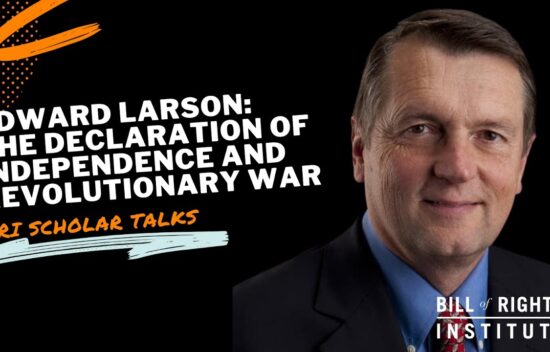
The Declaration of Independence and Revolutionary War with Edward Larson | BRI Scholar Talks
Watch
Founding Principles
Natural/Inalienable Rights, Liberty, Consent of the Governed, Democracy
About this video
In this episode of BRI Scholar Talks, Pulitzer Prize winning historian Edward J. Larson, author of Summer for the Gods and American Independence, joins host Tony Williams to explore why 1776 became the defining year of the American Revolution. Drawing on extensive research into newspapers, soldiers’ letters, state constitutions, and congressional debates, Larson explains how Americans shifted from protesting taxation to embracing republican self-government, popular sovereignty, and a complete break from monarchy. He traces how events such as the King’s speech, the burning of Norfolk, and the explosive reception of Thomas Paine’s Common Sense transformed colonial resistance into a united movement for independence.
The discussion highlights the powerful relationship between battlefield action and revolutionary ideas. Larson shows how soldiers demanded a cause worth fighting for, how John Adams pushed for new state constitutions, and how Thomas Jefferson shaped the Declaration by drawing from state charters, political pamphlets, and Enlightenment ideals. Together, the conversation reveals how inspiring words and courageous deeds shaped the American republic and why the spirit of 1776 became a touchstone for generations, from Lincoln and Frederick Douglass to the present day.
0:06 For this episode of Scholar Talks, the
0:08 guiding question is, what was the
0:09 relationship between Revolutionary War
0:12 battlefield deeds and the inspiring
0:15 words and principles of the Declaration
0:17 of Independence?
0:19 Our guest Edward Larson is a professor
0:22 of law and history at Pepperdine
0:24 University. He is the Pulitzer
0:26 Prizewinning author of Summer for the
0:28 Gods, which is on the Scopes trial, and
0:31 several books on the American founding
0:34 including The Return of George
0:35 Washington, Liberty and Slavery in the
0:38 Birth of a Nation, and his latest book
0:41 today’s topic, Declaring Independence:
0:44 Why 1776
0:46 Matters. I am Tony Williams, senior
0:49 fellow at the Bill of Rights Institute.
0:50 And I I want to welcome you to another
0:53 episode of Scholar Talks in the America
0:56 250 series. Ed, I want to thank you very
0:58 much for joining us.
1:00 >> Thank, you, for, having, me, on.
1:01 >> Great., I, I, love, your, your, newest, book.
1:04 Um and I I love to you so many people
1:08 talk about the declaration and its
1:10 principles uh sort of um you know
1:12 intellectually, abstractly. Other people
1:15 focus on the war. you’re it’s one one of
1:18 the few books I’ve ever read that that
1:20 bring those two strains together. You
1:22 you definitely really weave those
1:24 together., Uh, so, so, I’m, I’m I’m, eager, to
1:27 talk the about the book. It’s it’s
1:29 really excellent.
1:30 >> Well,, thank, you., Yeah,, that’s, exactly
1:32 what I was trying to do because my
1:36 question there are other great books. No
1:38 doubt about it. Um think of this recent
1:41 television series by Ken Burns. Think
1:43 about Rich Atkinson’s great books on the
1:45 war. Um, but they’re looking at the
1:48 Revolutionary War, what happened in the
1:50 battlefield. Um, McCullum did the same
1:52 thing in 1796. It’s all about battles.
1:55 Um, what I tried to do was people always
1:58 talk about even then they talk about the
2:01 spirit of 1776. You hear it now, you
2:04 don’t talk about the spirit of the
2:05 American Revolution. They talk about the
2:07 spirit of 1776. And as a longtime
2:10 history professor who would teach that
2:12 era,
2:13 my curiosity as we approached the 250th
2:16 anniversary was why does 1776, I know
2:20 why the revolution matters, but why does
2:22 1776 matter? Indeed, it did at the time.
2:26 Adams, Jefferson, they talked about the
2:28 spirit of 1776. Indeed, if you look at
2:31 the seal of the United States, which was
2:33 created in 1777
2:37 by Charles Thompson, the the secretary
2:40 of the uh Continental Congress, you can
2:43 see it on the back of your $1 bill, the
2:46 great seal. And it says in Latin
2:48 something new under the sun. It’s got
2:50 that pyramid with the eye. Um but then
2:53 it says at bottom it says 1776
2:57 in Norman. 1776, Lincoln talked about
3:00 1776, later Frederick Douglas, you name
3:04 it, Franklin Delaner Roosevelt during
3:06 World War II. So why did that year
3:10 matter was my question as opposed to the
3:13 Revolution. And so to do that what I did
3:16 was I just
3:19 looked at basically all the newspapers
3:23 and read them for the year and I looked
3:26 at um the letters from the founders but
3:29 also from the troops in the field.
3:30 They’re they’re ava generally available
3:33 but I read them for the year to see what
3:36 was what was happening in that year that
3:39 made that year important. It doesn’t
3:41 mean that 1775 wasn’t important or 1781
3:45 with the Battle of Yorktown. They’re
3:46 important, too. But why does 1776
3:49 matter? And that became my challenge.
3:51 And when doing so, I ended up right
3:53 where you said. It turns out it’s an
3:56 interplay of words inspiring deeds and
4:00 actions actions inspiring ideals. It’s a
4:04 mixture of the two. It is not
4:06 exclusively one or the other.
4:09 >> Great., So,, so, jumping, into, the, book., So,
4:12 so how did the resistance against Great
4:14 Britain and the pamphlet war in the
4:17 1760s, 1770s represent American
4:20 arguments for for rights and
4:22 self-government, government by consent.
4:27 The you go back really to in a major way
4:31 to 1765.
4:34 You have Otis’ pamphlet, magnificent
4:36 pamphlet, other ones by Hopkins
4:38 Delaney. These various pamphlets that go
4:41 back to the Stamp Act crisis where the
4:44 issue was taxation without
4:46 representation
4:48 and Americans fearful for their property
4:54 argued against what Parliament was
4:56 doing. It wasn’t just the taxation
4:59 without representation. Was also the
5:01 Quebec act and the proclamation of 17 um
5:04 63 taking the west and it was also the
5:08 declaratory act and the then the towns
5:12 and tariffs the tea act. Uh but those
5:14 were all directed against parliament and
5:19 were really rooted in econ economics.
5:23 And what changed in 1776
5:27 was a new conception of what the problem
5:30 was.
5:31 They realized in 1776
5:35 that the problem was not taxation
5:37 without representation.
5:40 That was simply a symptom of the real
5:44 problem was authoritarian rule. The real
5:47 problem was the monarch. You know, you
5:50 only have to go back to the mo probably
5:52 the most important document of 1775, the
5:55 declaration of causes and necessity for
5:57 taking up arms. You talk about battles
5:59 were already taken happening. You had
6:01 Lexington and Concord. You had 20,000 um
6:06 patriot militia forces from New England
6:08 surrounding the 4,000 British on that
6:12 island like Boston. And we were in the
6:15 middle of war. They had appointed
6:17 Congress had adopted this army as the
6:19 Continental Army. They had named George
6:22 Washington as a leader and he was on
6:24 their way up. And yet in the declaration
6:27 explaining all this, it says
6:30 we are reduced to the alternative
6:32 choosing between unconditional
6:33 submission to the tyranny of
6:35 parliamentary ministers or resistance by
6:38 force. And then it stresses, we have not
6:41 raised armies with the ambitious design
6:43 of separating from Great Britain, but in
6:46 defense of the freedom that is our
6:49 birthright as subjects of the king. They
6:53 still view themselves as part of the
6:54 empire. They still view themselves as
6:57 British, not Americans. And we’re not
7:01 fighting for separation. What changed?
7:05 Whereas you go all the way up to
7:07 December, you read all these letters
7:09 hardly anyone was arguing for ind among
7:12 the patriots, hardly anyone was arguing
7:15 for independence. Not Adams, not even
7:17 Payne, not Washington. What changed
7:20 during 1776 is mostly in the first half
7:24 of the era, but certainly by the end is
7:26 that virtually all the patriots except
7:29 some outliers like John Dickinson had
7:32 come around that
7:35 independence was needed. That the
7:36 problem wasn’t merely we want lower
7:40 taxes. The problem was authoritarian
7:43 rule. What we want is something new
7:45 under the sun.
7:48 Representative government, republican
7:50 government. We want rule of law. We
7:53 don’t want rule of king. As Payne said
7:56 in common sense
7:58 the will of the king is as much of the
8:01 law of the land in Britain as it is in
8:02 France. In America, the law is king. For
8:05 in an absolute government, the king is
8:07 law. So in free countries, the law ought
8:10 to become king. And that swept the
8:13 country and is captured in the
8:15 Declaration of Independence. This was
8:18 what was something new under the sun and
8:20 how pain could write. The sun never
8:22 shined on a cause of greater worth. The
8:24 cause of America is in great measure the
8:27 cause of all mankind. Well, revolutions
8:30 were nothing new. Countries had
8:32 splintered off empires since the time of
8:35 Rome and Greece and Carthage. And before
8:37 that, what was new was the idea that
8:40 these this breaking off to have the
8:44 people as sovereign. And as a result
8:48 during that year, the states all wrote
8:50 new constitutions, the first written
8:52 constitutions in the history of mankind.
8:56 >> Right., So,, you, bring, up, a, really
8:59 interesting uh point u that I’d really
9:01 love to to dial in even more is that I
9:04 I’ve always found it so anomalous that
9:06 here we are at war. Lexington and
9:09 Concord, Bunker Hill, these major
9:11 battles, the British are burning Nofak
9:14 and Falmouth and and and other other
9:16 towns.
9:17 >> Charles, Town.
9:18 >> Yeah., Yeah., and, and, and, and, yet, we’re, at
9:23 war and yet we’re we don’t declare
9:26 independence, right? I it’s what almost
9:28 a year and a quarter almost a year and a
9:30 half. I mean, how do you explain that
9:32 anomaly?
9:33 >> Well,, they, were, blaming, if, you, look, at
9:35 all the petitions, all the petitions
9:38 being written by the states, there were
9:41 many, many of them. all the letters
9:43 being written and of course the olive
9:46 branch petition, they were always
9:49 blaming Parliament. Parliament was
9:51 viewed as this foreign entity that was
9:54 adopted by um what um a small electorate
9:58 in England about 144,000 people. And
10:02 Jefferson in his great treatise of 1774
10:07 his pamphlet summary view he says we
10:10 don’t want to be um have tyranny of
10:13 144,000 people over us because they were
10:16 they had the polit they were politically
10:18 responsive to a small electorate in
10:20 England and to a unelected king and
10:23 house of lords. What they realized was
10:27 and I think Norfolk was a big part of
10:29 it. If you look at what happened in
10:32 January,
10:34 three things coincided and I think they
10:36 were all critical.
10:39 One was, if you read the newspapers
10:42 that’s when Americans first receive
10:46 the king’s speech from the throne.
10:49 That’s like the state of the union
10:50 message where the king goes before
10:53 parliament on the throne and reads
10:56 official policy. It took place in the
10:58 end of a October 1775, but it didn’t
11:01 reach the colonies uh for the most part
11:03 except for one exception. It didn’t
11:05 reach the col you don’t see it in the
11:06 newspapers until January. And in that
11:09 the king, not Parliament, the king
11:11 declares
11:12 that the colonies are he revokes his
11:16 protection of the colonies. Before this
11:19 all the petitions asked for the king.
11:22 They viewed themselves, the people in
11:24 America, the settlers in America viewed
11:26 themselves as British citizens. We are
11:29 as British as somebody in in London.
11:32 They would write that and they expected
11:35 the king to protect them. Now they read
11:38 he declares them out of his protection.
11:40 He announces that he’s going to send the
11:44 largest British overseas army in the
11:46 history of the world against them
11:49 assemble troops from throughout the
11:51 empire, and worse yet hire German
11:55 mercenaries
11:57 um who were viewed as like ruthless
12:00 barbarians. German mercenaries were
12:03 going to come over by the 10,000 and in
12:06 addition the largest navy in the history
12:08 of of Britain to subdue the colonies
12:13 announce that they read that
12:16 and at the same time they get word of
12:18 the burning the British official policy
12:22 burning of Norfolk. Norfolk then was the
12:24 second most important city in the
12:26 American South and they it was leveled
12:29 and the way it’s reported in the
12:31 newspapers it happens on January 1 but
12:34 the word spreads during January. You
12:37 read it in the newspapers and the way
12:38 it’s described it was completely a
12:40 British atrocity an unexcusable British
12:43 policy that unlike Falmouth was the
12:46 direct result of British policy. And
12:48 then right at the same time in the same
12:52 newspapers out comes Common Sense. And
12:55 Common Sense in the middle of January
12:58 becomes the most widely read pamphlet in
13:00 the history of America. The percentage
13:02 of Americans reading it, no book has
13:04 equal ever since then, except maybe the
13:06 Bible, of course. And it’s read
13:09 everywhere. It’s republished everywhere.
13:12 And within two weeks, everybody’s read
13:15 it or heard it. They read it aloud as
13:18 well. Um 100,000 copies and it makes it
13:23 all make sense. It says the problem is
13:26 not Harlem. The problem is the king.
13:32 Of more worth is one honest man to
13:35 society. Payne writes
13:37 of more worth is one honest man to
13:39 society and in the sight of God than all
13:43 the crowned ruffians that ever lived.
13:46 That applies to any tyrant, any absolute
13:48 government, any authoritarian
13:50 government. No, what we want if we
13:53 design
13:55 and nobody had it, it was something new.
13:57 Now granted, the idea was around from
13:59 Rouso and from um Lock’s second treatis
14:02 on government that you know you form
14:05 representative governments. Payne works
14:08 it out in detail an idea of we can have
14:11 representative government, the people
14:13 shall be sovereign. We will choose our
14:16 own representatives through free, fair
14:19 and frequent elections.
14:22 That’s what he’s saying. He writes right
14:24 in this in January. We have it in our
14:28 power to begin the world over again. Not
14:32 since the day of Noah have people had
14:36 this opportunity. That electricity
14:39 coupled with the reading the king’s
14:42 speech from the throne and the the
14:45 atrocity and action, the atrocity of the
14:48 British at Norfolk that combined to
14:51 literally like turn everybody around for
14:55 independence because the solution now
14:57 became not lower taxes, taxation without
15:01 representation. The solution now became
15:04 representative government, republican
15:06 rule, rule of law.
15:08 And that spirit was the spirit that
15:12 transformed my Washington of course has
15:14 common sense read to the troops
15:17 besieging Boston. It boosted their
15:19 morale. And he writes after seeing the
15:22 response, he says these battles
15:25 thinking of Norfolk, he just received
15:27 also news of Norfolk. These battles
15:29 coupled with the irrefutable
15:32 arguments of the pamphlet common sense
15:35 will lead nobody not supporting
15:37 independence. You can see it in the
15:38 writings of Abigail Adams, her letters
15:40 to her husband. You can see it in John
15:42 Adams own writing. You can see it in um
15:45 you could go on and on. Um uh uh
15:49 um Mercy Warren, Otis Warren, you can
15:53 see it in her writings. It just changes
15:56 the way people think. From South
15:58 Carolina, North Carolina, the word comes
16:01 out. Now
16:03 these words of pain made what was
16:07 happening to them on the battlefield
16:11 and in the actions
16:14 that made it gave it a whole new
16:16 understanding and light. And so
16:19 um the result was a conviction for
16:22 independence.
16:24 >> Great., Yeah., So, that, really, explains
16:28 well uh the s significance of of Thomas
16:31 Payne’s common sense just just how
16:33 important it was to to move that that
16:35 tie towards independence. There’s there
16:37 was another person who was also very
16:39 important. Uh so what was uh John Adams
16:42 role? Uh he certainly believed he had a
16:44 very big role and he did uh in driving
16:47 momentum for independence in the second
16:49 continental congress. You know, I’m
16:51 thinking about his his May 15th preamble
16:53 to this May 10th resolution. Uh, but
16:55 just the the behi behind the scenes
16:58 politicking and and so forth. So, so
17:01 tell us about Adams’s role.
17:03 >> John, Adams,, this, is, the, John, Adams., I
17:05 love the John Adams from 1776.
17:08 Um,
17:10 he becomes pulled over to the cause of
17:13 revolution. He wasn’t for, by his own
17:15 description, he was not necessarily for
17:17 independence. He was for reconciliation
17:19 up through the end of 1775.
17:22 But he becomes convinced that only
17:24 independence and if you see his private
17:27 letters which I’ve tried to follow very
17:29 closely and summarize in the book um he
17:33 says what is independence? Well
17:35 independence for him was a new state
17:38 constitution in every one of the
17:40 colonies. That is the colonies had been
17:44 formed with charters from the king and
17:47 those charters the king was sovereign
17:50 and so you had a charter for Virginia or
17:52 you had a charter for Pennsylvania
17:54 charter for Massachusetts. Some set up
17:56 proprietorship colonies but really the
17:59 proprietor like the Penn family were
18:01 based in England and under the king.
18:02 Some were directly royal colonies. In
18:05 all cases, the king was sovereign. And
18:07 he thought what independence was in his
18:10 mind was breaking with the king. And he
18:14 viewed each state, each colony as a
18:17 separate entity. And so he believed that
18:20 each needed a new a new republican
18:23 representative
18:26 constitution that created a republic.
18:28 And so he um pushed that through. And he
18:32 said, he repeatedly said, "What is
18:34 independence?" Well, he was right.
18:36 Independence was a new constitution, a
18:38 Republican constitution in every state.
18:41 Um, recognition by some other states
18:43 like France and, um, uh, getting those
18:48 things done. Um, and, uh, ultimately
18:52 um,
18:54 driving the British out. So he his first
18:58 cause becomes these um new
19:01 constitutions. So some of them
19:03 anticipating all his writing because
19:05 he’s writing and others are writing and
19:06 having the same thinking. Um some states
19:09 have rushed ahead like South Carolina
19:11 and and and New Hampshire earlier in
19:14 1775. Um but Payne opposed by John
19:18 Dickinson who still wants reconciliation
19:20 and know this will be a big break. He
19:23 doesn’t need unonymity. you need
19:25 unonymity for a for a declaration of
19:28 independence, but you only need a
19:29 majority vote uh for a resolution on
19:32 independent governments. and he gets he
19:34 writes it he gets it passed and he
19:36 writes a fiery preamble um calling on
19:40 every state to adopt a new constitution
19:44 to use quoting directly from it best
19:47 conducive to the happiness and safety of
19:50 their constituents in particular and
19:53 America in general and then he writes a
19:56 his most important pamphlet ever
19:58 thoughts on government it’s a great
19:59 pamphlet um that comes out in May um
20:04 where he tries to describe the sort of
20:07 government that everybody should adop
20:08 that should be adopted and it becomes a
20:10 model for North Carolina, New Jersey
20:14 Maryland, Delaware directly. Um, and in
20:18 it he asks, "When," this is what he
20:21 writes, he puts an exclamation point
20:23 after that, "when had a people a full
20:26 power and fair opportunity to form and
20:28 establish the wisest and happiest
20:31 government that human wisdom can
20:34 contrive, adding that republican
20:36 governments
20:39 are such a government." that republics
20:41 are governments to his words of law not
20:45 of men. Now this echoes common sense
20:49 though the governmenty designs are
20:51 different in common sense it’s proposing
20:54 government’s basically a onehouse
20:56 legislature
20:57 um uh Adams has two house balanced
21:01 government still a very weak executive
21:04 power is in the elected representatives
21:06 and both of them call for annual
21:08 elections that are free fair and and
21:11 frequent but the point is um
21:16 they’re both use these terms. We the end
21:19 of government, they write the end of
21:21 government is security
21:25 liberty,
21:27 and the goal is great, as Payne puts it
21:32 the greatest happiness at the least
21:33 expense. Um, that now compare that with
21:37 everything before. Could you imagine
21:40 George III or any English monarch or any
21:43 monarch in Europe saying his purpose was
21:46 to secure the liberty and happiness of
21:50 the people? No, he got Henry the You’ve
21:52 got uh Louis the 14th declaring the
21:55 state is me. Christian IVth in Denmark
21:59 the other great absolute monarch of that
22:01 uh decade was saying similar things. The
22:04 purpose of the state is to help is to
22:07 back me. crime solver. Um, no, no
22:11 you’re not. It’s saying, and this is
22:14 captured in all the state constitutions
22:16 but my favorite probably in this respect
22:19 is the North Carolina constitution of
22:21 1776, which was directly inspired by
22:24 Adam’s thoughts on government. And the
22:27 opening line of that constitution is all
22:31 political power is vested in and derived
22:34 from the people only. Now in a world
22:40 where kings are sovereign and you speak
22:43 of divine rights to say that all
22:46 political power is vested and derived
22:48 from the people only that indeed is
22:51 revolutionary something new under the
22:53 sun and Adams is at the heart of that
22:56 argument.
23:01 >> Right., Right., and, and, and, and, I, was
23:03 going to ask you which is a great segue
23:04 to say you know there’s this
23:06 relationship between the constitution
23:09 making on the state level and then you
23:11 know we had Virginia and other states um
23:13 they’re they’re declaring their rights
23:15 they’re they’re shaping new
23:16 constitutions republican constitutions
23:18 as you say so there’s that direct
23:20 relationship with declaring independence
23:23 and what’s happening in in the
23:25 declaration maybe you can look into that
23:27 relationship a just a little bit more
23:29 closely
23:30 >> absolutely, the, the, declaration, falls
23:33 directly follows directly from that. Um
23:36 now remember Adams thought what was
23:38 important were new state constitutions
23:40 and that if you have a state
23:41 constitution declaring the people
23:43 sovereign and the king not sovereign u
23:45 and including grievances against the
23:47 king. You look through the state
23:48 constitutions they take a very similar
23:51 format. They they have a bill of rights
23:53 declaring the rights of the people. They
23:55 have the grievances against the king.
23:57 the order of the two move around and
23:59 then they have the structure typically a
24:02 very representative structure broad
24:05 voting rights for people maybe a two
24:07 house legislature maybe one if two
24:10 higher property rights for the other um
24:13 various requirements to discourage
24:15 gerrymandering and to encourage
24:18 legislation that the public knows about
24:21 and can respond to very similar But
24:27 at the same time
24:29 and it doesn’t come from Adams, the
24:31 thinking comes
24:34 from these various states as they’re
24:36 drafting their constitutions.
24:38 >> And, Virginia, is, the, critical, example,
24:40 but it’s true from all of them.
24:43 They say, "Well, yes, we’re declaring
24:47 our independence through our state
24:48 constitution, but we need to
24:50 collectively declare our independence
24:52 too." So the Virginia legislature which
24:54 is working on its new constitution
24:57 sends a resolution up and the resolution
25:01 this was the idea of the governor. It
25:03 was actually others didn’t push it.
25:06 Patrick Henry did not push this but the
25:08 governor gets through that we think that
25:12 Congress should also declare the
25:15 independence of the whole as well as
25:17 we’re declaring independence of each
25:18 state. So they send up their resolution.
25:21 is carried out by Richard Henry Lee. Um
25:23 it arrives in June and um says that
25:28 these colonies are and of rights should
25:30 be free and independent states and ask
25:32 Congress to adopt it. Well, as soon as
25:34 they get it, they realize we need an
25:36 explanation justifying it. Just like all
25:38 the state constitutions are drafting a
25:41 list of grievances against the king um
25:44 that justify they’re declaring
25:46 independence under this notion of
25:49 popular sovereignty and right to rebel
25:52 that then appears in the Declaration of
25:54 Independence. And so they assign the
25:56 task to a committee. Thomas Jefferson is
25:59 chair of it. Now Jefferson’s curious
26:02 because he had wanted he thought the
26:05 main business was happening in the
26:06 states. So he had wanted to leave
26:09 Congress, [clears throat]
26:10 when Virginia has
26:13 starts writing its constitution
26:16 and but so did everybody else and he was
26:18 a junior member of the Virginia
26:20 delegation and off goes Wyth and the
26:22 other ones down to down to um uh
26:26 Williamsburg to write the um Virginia
26:28 Constitution. So Jefferson is sitting up
26:31 there in Philadelphia working mostly on
26:35 drafts that he’s sending down to
26:39 Virginia because he’s getting word that
26:41 that they’re um that they don’t have a
26:44 consensus yet. Actually, he was fed
26:47 wrong information. George Mason had
26:49 taken over the whole operation and was
26:51 just writing it himself. But Jefferson
26:54 wrote of the new constitution in a
26:56 letter. In truth, it that is the
26:59 Virginia constitution.
27:02 In truth, it is the whole object of the
27:04 par present controversy. For if a bad
27:07 government be instituted for us in the
27:09 future would have been as well to have
27:11 accepted the first bad one offered to us
27:14 from beyond the water, that means in
27:16 Britain, without the risk and expense of
27:18 contest. He thought that was the
27:20 business. But because he’s still back
27:23 there, he gets assigned as chair of the
27:27 committee. He remember he was it was
27:29 known as a great writer thanks to his um
27:32 um summary view pamphlet from a couple
27:34 years before. And he’s assigned as along
27:38 with the other two great writers there
27:40 John Adams and Franklin, a couple others
27:42 to balance geographically, but they were
27:44 the only three that really worked on the
27:45 declaration itself. And um so he’s
27:48 assigned the task to write it.
27:50 Meanwhile, he’s mostly sending drafts
27:52 back to Virginia and um
27:57 and he’s getting by the end drafts from
28:00 George Mason of what they’re doing. Um
28:04 so he’s takes these various pieces
28:09 and in many ways the Declaration of
28:11 Independence reads quite a bit like the
28:15 Virginia Constitution. He takes what
28:18 Mason has written. He takes what um he
28:21 has written um one on the logic of the
28:25 whole thing, the preamble part, the
28:27 first part. Next on the grievances are
28:30 basically his list of grievances um that
28:33 he’s written plus a few thrown in from
28:36 other states um that didn’t particularly
28:39 affect Virginia. And then the end is
28:41 really Richard Henry Lee’s resolution
28:43 from Virginia tagged on the end. That’s
28:46 the Declaration of Independence. Adams
28:48 who of course always always looked down
28:52 on everybody else and viewed himself
28:54 with great import self-importance. Um he
28:58 deserves a lot, but he also was that
29:00 way. Um he sneered that the Declaration
29:02 of Independence was the peacework of an
29:05 afternoon. And uh Jefferson rightly
29:08 responded and said, "Well, they didn’t
29:10 ask me to write anything new. I was
29:13 supposed to summarize views that were
29:14 already out there." But in truth, it did
29:18 only take a couple days, but in truth
29:20 it was a work of absolute brilliance
29:23 because he weaves these parts together.
29:25 Well, if it’s piece work, it’s like a
29:27 fine Virginia quilt. He takes these
29:30 pieces, these ideas that are already
29:32 floating around. Um, my favorite example
29:35 of that is people often give credit um
29:39 where credit is not due to Jefferson for
29:42 changing John Lock’s life, liberty, and
29:45 property to life, liberty, and pursuit
29:46 of happiness. But that wasn’t him. That
29:49 was pain. Payne talks the purpose of
29:52 government is the greatest sum of
29:54 individual happiness with the least
29:56 national expense. It’s Adams. Adams in
30:00 thoughts on government. He says um the
30:03 purpose is to create and establish the
30:05 wisest ha wisest and happiest
30:08 government. Then human wisdom can
30:10 contrive. Everyone was talking what was
30:13 the purpose of go? They didn’t mean
30:14 pleasure. They didn’t mean pleasure. The
30:17 purpose of government isn’t pleasure. Um
30:20 but the purpose of government was well
30:23 what are we for? Why do we have a
30:25 government? It’s not to serve a king.
30:28 What it is is to
30:31 these issues that pain
30:34 Adams and all the others are talking
30:36 about
30:37 security, liberty, individual liberty
30:41 and happiness.
30:44 Um that becomes in Jefferson’s words
30:48 life, liberty and the pursuit of
30:49 happiness. And you could not say it
30:52 better indeed ever after. I know you’re
30:57 interested in the future impact of the
30:59 Declaration of Independence. Various
31:01 things are important, but nothing was
31:03 more important than that phrasing
31:05 because
31:08 I could make an essay that what becomes
31:11 the American dream is captured in that
31:15 phrase that the inevitable the
31:18 inalienable right of people for life
31:22 liberty, and the pursuit of happiness.
31:24 That is in a nutshell what the American
31:28 dream becomes. And that there’s nothing
31:31 self-evident about that. No country
31:34 would have argued that that was its
31:36 purpose before. Nobody would have said
31:39 this is self-evident because it wasn’t a
31:42 truth before. But it became the basis of
31:47 the American Republic, the American
31:49 experiment in popular government.
31:53 >> Beautifully, put., I, maybe, that’s, your
31:54 next book. So uh so uh very good. Um my
31:59 my final question is um how we started.
32:02 So what was the relationship between in
32:05 a in a nutshell revolutionary war
32:07 battlefield deeds and the inspiring
32:10 words and principles of this declaration
32:13 of independence.
32:15 I think it’s a a back a give and take
32:17 and that’s what I try to capture in the
32:19 book um throughout the year and I think
32:24 you could stretch this out but my
32:27 expertise from my late research is the
32:29 year 1776
32:31 and what I see is words inspiring deeds
32:35 actions inspiring ideals you can see
32:38 that in so many ways but you can’t but
32:42 among them is the letters by the
32:46 soldiers in the field.
32:48 >> The, soldiers, in, the, field, begin, writing
32:51 actually very I will concede late in
32:54 1775 but certainly accelerating in 1776.
32:59 You see these letters from the the
33:03 Massachusetts militia that’s on the
33:05 field surrounding Boston during the
33:07 siege of Boston. the letters they write
33:09 to John Hancock and John Adams and
33:13 Samuel Adams, their representatives in
33:15 Philadelphia.
33:17 Um, letters from privates because in
33:20 Massachusetts everybody thinks they’re
33:22 equal because they’re all Puritans and
33:24 they had this sense of religious
33:26 equality, but also from generals. It
33:28 doesn’t matter too. They’re begging
33:31 give us something more to fight for.
33:33 Lower taxes is not it. give us something
33:38 more to fight for. Declare independence
33:41 and tell us why. And so then
33:46 Washington has common sense read to the
33:49 troops in the siege of Boston. It
33:52 demonstrally gives them more power. But
33:55 still he needed those cannons brought
33:57 over the mountains by by Knox and and
34:01 and put in Dorchester shite Dorchester
34:04 Heights about where the Kennedy Library
34:06 is now to force the British out of
34:09 Boston. And that
34:12 fact, that fact on the ground that a
34:17 ragtag American army of militia led by a
34:21 little experienced General Washington
34:24 could drive the British army out of
34:27 Boston was empowering. It made
34:30 Washington a hero immediately. He
34:33 receives commendations from around the
34:37 from every place in Massachusetts but
34:39 way beyond around the colonies. And that
34:43 sense
34:45 coupled with having read Tom Payne
34:48 Thomas Payne, who it never call him Tom
34:50 it’s always Thomas. Thomas Payne who
34:53 writes that fighting for the cause of
34:56 independence,
34:57 this glorious cause
35:01 no army in the world can defeat us. And
35:03 then they see what actually happens in
35:06 Boston. And that just energizes the
35:09 revolution. And then as it unfolds, the
35:13 the atrocities
35:15 the British
35:18 cause, particularly after the fall of
35:21 Fort Washington, where Washington makes
35:23 the mistake of leaving 2,000 men in what
35:26 he thought was an impregnable fort in
35:28 what’s now Washington Heights, right at
35:30 the end of the George Washington Bridge
35:32 in Manhattan, lets the rested fall, but
35:34 he thought he could get him across the
35:35 river as he did in um after the Battle
35:38 of Brooklyn Heights. He didn’t. Um, and
35:40 those troops are put on these prison
35:42 holes, these these decommissioned ships
35:45 in the East River where they literally
35:48 all die. It’s just absolute
35:50 unjustifiable atrocity. if the British
35:53 would do that to Americans and then the
35:58 atrocities mostly blamed on the Hessins
36:01 as the British army pushes across New
36:05 Jersey in the end at the end of 177
36:08 basically in November October, November
36:11 and December of 1776. again 1776. And
36:15 the way they’re written up in the
36:16 newspapers of rape, of pillage, of
36:19 murder, um, partly by the British
36:23 allowed by the British overseers, but
36:25 mostly attributed to the Germans if the
36:28 king would send over people to do that
36:30 these atrocities in the battlefield. So
36:32 it’s not the victories. The only victory
36:34 really was was the evacuation of Boston.
36:39 the the atrocities that followed the
36:41 defeats in New York area in New Jersey
36:44 and then finally at the very last day of
36:46 the war of the year the battle of
36:49 Trenton where Washington makes this
36:52 strategic
36:54 recrossing of the Delaware and manages
36:57 you know it’s more of a PR victory it’s
37:00 not that significance it’s a small
37:02 British small Hessen um outpost that’s
37:06 overwhelmed by everything that’s left of
37:09 Washington’s army that outnumbered him
37:11 four to one. Um the uh but the sheer
37:15 fact that you could regain a foothold in
37:18 New Jersey after the British had
37:21 basically taken the state the moral
37:24 victory those actions
37:27 in the field
37:30 working with the ideas. So the ideas
37:34 only the ideas only the call for
37:36 independence only the declaration of
37:39 independence which led of course to the
37:42 immediate uprising in New York where
37:44 they pull down the king statue. The
37:46 power of those words
37:50 drive the fight and then the fight helps
37:54 underscore and reinforce the words so
37:56 that you end with Tom Thomas Payne again
38:00 in the first crisis brought out on the
38:02 eve of the battle of Trenton where he
38:04 says these are the times that try men’s
38:07 souls. Those that persevere now, you
38:10 know, tyranny like hell is hard to
38:13 conquer, but those that persevere now
38:15 will re the accolades of all future
38:17 generations.
38:20 Those words are amazing, but they only
38:22 work if Tom Thomas Payne had brought out
38:25 common sense a year earlier, it would
38:27 have had no meaning. It took what was
38:29 happening in the field going back and
38:32 forth with the ideas that gave those
38:35 actions meaning. That was why 1776
38:39 matters.
38:41 >> Edward, Larson,, I, want, to, thank, you, very
38:43 much for joining us to discuss your
38:46 latest book, Declaring Independence: Why
38:50 1776 Matters. And thank you all for
38:53 joining this episode of Scholar Talks
38:55 and our America 250 series. Please check
38:58 out the other videos in the series on
39:01 our channel and go ahead and click
39:03 subscribe.
Standards
Related Resources
How does the Declaration of Independence support the principles of individual liberty and self-government? In this rapid-fire episode of BRI’s Primary Source Essentials and Declaration of Independence summary, learn the arguments made by the American colonists as they sought to free themselves of British control.

What was the Continental Congress's argument for Independence? Join Kirk Higgins, as he takes a line by line look at the the Declaration of Independence.
Get ready to travel back in time to the early days of America and discover the thrilling events that led to the American Revolution! In this elementary lesson, we explore the key moments that paved the road to independence—from the end of the French and Indian War to the fiery debates over "taxation without representation." Our elementary lessons are primary source-based that focus on content-area literacy instruction and performance-based assessments. Designed for grades 3-5, these lessons use a modular approach for all learners and are ideal for helping elementary students explore American history and citizenship.
In this middle school history lesson, students explore the growing tension between Britain and the American colonies in the decades leading up to the American Revolution. Using four key documents, the Stamp Act Resolves, the Declaratory Act, The Patriot, and the Declaration of Independence, students investigate how different perspectives on taxation and representation fueled a foundational debate about self-governance. How did British and colonial perspectives on self-governance compare in the decades leading up to the American Revolution? Through guided analysis and color-coded document comparison, students uncover the themes that shaped this revolutionary moment. They’ll practice crafting a thesis supported by evidence, essential skills for completing the unit’s scaffolded Document-Based Question (DBQ) assessment.