Video
The Bible and the American Founding with Daniel Dreisbach | BRI Scholar Talks
Watch
Founding Principles
Natural/Inalienable Rights, Liberty, Consent of the Governed, Separation of Powers
About this video
In this episode of BRI Scholar Talks, legal scholar Daniel L. Dreisbach, author of Reading the Bible with the Founding Fathers, joins host Tony Williams to explore how the Bible influenced the American founding. Drawing from his extensive research, Dreisbach examines how Scripture shaped the Founders’ understanding of human nature, virtue, and government, informing ideas like checks and balances, the right of resistance, and republican self-government.
The discussion highlights how biblical literacy and Protestant culture helped define early American education, politics, and civic life. Dreisbach also traces how Americans viewed themselves as a “new Israel” in covenant with God—a theme that inspired generations from the Revolution to the civil rights movement—and why John Adams called the Bible “the most Republican book in the world.”
0:06 For this episode of Scholar Talks, we’re going to discuss
0:08 how the Bible helped shaped the American founding.
0:13 Now our guest, Daniel Dreisbach, is a professor of law,
0:15 justice and criminology at American University.
0:19 He’s the author and editor of several books on the American
0:22 founding and religion, including a must Read Thomas Jefferson
0:27 and the Wall of Separation Between Church and State,
0:31 and Today’s Topic Reading the Bible with the Founding Fathers.
0:35 I am Tony Williams, senior fellow at the Bill of Rights Institute,
0:38 and I would like to welcome you to another episode of
0:41 Scholar Talks in the America 250 series.
0:45 Daniel, and thank you very much for joining me.
0:47 Well, thank you so much for having me.
0:49 It’s a delight to join you today.
0:51 Yeah, I had a very intrigued.
0:53 I can’t wait to jump into the conversation.
0:56 We we think about a lot of different influences on the founders,
0:59 and you’ve really shown quite definitively that the Bible
1:03 and Protestant Christianity did, in fact, have a profound influence.
1:07 So, and that leads me to my first question.
1:10 Why don’t we go ahead and jump in?
1:11 So to the usual argument that the American founding
1:14 had a lot of different influences, such as Locke and the enlightenment,
1:18 Greece and Rome, modern liberalism, the English tradition,
1:22 you add the Bible and Protestant Christianity.
1:25 So my question is why is this important?
1:29 So we all know that
1:31 the American founders were extraordinarily well read,
1:34 and they drew on diverse intellectual traditions
1:37 to inform their own political thought and their political experiments.
1:42 You mentioned some very important sources of influence.
1:46 We think of the English common law and constitutionalism,
1:50 enlightenment, liberalism and manifold forms.
1:53 We could also add to that classical and civic republicanism.
1:57 And if we were to go down to, to a good,
2:00 research, library at a local university, we’re literally going
2:04 to find shelves of books written on the influence of, of enlightenment
2:09 thought on the American founding, John Locke, Baron de Montesquieu and the like.
2:14 But I daresay we’re not going to find many books on the influence of the Bible
2:18 and and Christianity on the American founding.
2:22 And I think it’s a vital part of understanding the influences
2:27 that informed, not only their worldview in a general sense,
2:31 but their political projects, their political enterprises.
2:35 And so this is really what inspired me to take up this topic,
2:39 because I don’t think we can adequately understand
2:43 the broad range of ideas that informed, the political thought of
2:48 of the founding generation without including
2:51 the Bible and the Christian tradition in into that mix.
2:56 Many of the of the founding generation, for example,
2:59 look to the Bible to inform their views on things like human nature,
3:04 civic responsibility, the rights and responsibilities of citizenship.
3:09 What constitutes a legitimate government?
3:12 These are the kinds of topics that are
3:14 that are so important in creating a new political society.
3:18 And so, these are questions that the founders have
3:21 that they’re looking to the Bible to help them understand
3:25 how to, to move forward with, with, their experiment.
3:29 And let me just give you one example here.
3:32 I think a starting point.
3:33 In fact, a number of the founders say this is the starting point
3:37 of any political theory, and that is to understand human nature.
3:41 And so I think we find example after example of American founders saying
3:47 our understanding of the of human nature comes from the Bible.
3:52 They’re reading the story of the fall in the Garden of Eden,
3:56 and they’re looking to Genesis chapter three and what they conclude is
4:01 that humankind is is fallen, is sinful.
4:05 And this become becomes a very central part of, of their political project.
4:11 And so they build a political system
4:15 that is designed to check and restrain,
4:19 the acts of selfish, sinful people.
4:23 And we end up with a constitution that is obsessed with things like
4:27 checks and balances and separation of powers.
4:30 And I think this arises from a biblical understanding of who
4:35 mankind is.
4:38 Farsighted.
4:39 Really good.
4:40 And as a follow up, so
4:43 thinking you write a little bit about, actually a topic we’ve,
4:46 attended a conference together on, Protestant resistance theory.
4:50 Tell me a little bit about that, because as I was reading the book,
4:52 I was really struck by I was like, boy, this is natural rights.
4:56 And, the purpose of government and the right of revolution.
5:00 Right of resistance.
5:01 I was like, wow, that’s like the declaration, right?
5:04 And we usually talk about Locke in the declaration, but I
5:07 you show the origins can be a little earlier than that.
5:11 That’s right.
5:11 So, you know, let’s let’s look at it this way.
5:14 And again, I think a good starting point here is a biblical text.
5:17 And I would I would turn to Romans chapter 13,
5:21 the first seven verses, which speaks of, of that obligation of citizens
5:27 to be in submission to those in authority over them.
5:30 Now, for a pious American people, this idea that you must be
5:35 in submission to your rulers is a is a challenging text.
5:39 If you’re contemplating rebellion
5:41 or resistance to to George the third and Parliament.
5:45 And so and by the way, this has been a challenging text for, for
5:51 people throughout history.
5:53 Most immediately in our past history, we might look to the English Civil wars
5:59 and, and, and the rebellion against, the Charles the First.
6:03 For example, pious, people in England
6:06 had to grapple with this kind of text.
6:09 Now, those who want to affirm the power of the
6:14 of a Charles the First in the mid 17th century,
6:17 or the power of George the Third in the mid to late 18th century,
6:22 they’re going to emphasize
6:24 this idea that you must be in submission to those in authority over you.
6:28 But what Christians have often done in history is they brought a very nuanced
6:33 reading of Romans 13 that goes something like this.
6:37 Yes, civil government
6:40 and civil magistrates, or are ordained by God,
6:44 but government and magistrates
6:48 are ordained to serve the public good.
6:52 Now, that last part is key to the argument, because the way
6:56 patriotic Americans read Romans 13 is, yes, government is ordained of God.
7:03 Yes, we are to be in submission to government,
7:06 but so long as it serves
7:09 the public good, if a ruler becomes a tyrant,
7:13 if a if a if a ruler begins to serve his own interests
7:17 and not the interests of the people, then that ruler in a sense
7:21 disposes himself and is no longer entitled
7:26 to that obligation of obedience.
7:29 Now, let me just pointed to you to some language in the Declaration
7:33 of Independence. Right, George?
7:34 The third is somewhat described as a tyrant, is he
7:37 not that very language of of a tyrant is, is is used.
7:42 But there’s a little line in the Declaration of Independence.
7:45 I want to draw your attention to notice that that the declaration says George
7:51 the Third has abdicated his office.
7:55 We often skip over that line, but I think it’s key.
7:58 And that’s a point being made here, is that George the Third ceases
8:03 to serve the public good.
8:04 In that sense, he’s deposed or abdicated the office and is therefore
8:09 no longer in titled to that obedience required by Romans chapter 13.
8:15 In fact, we often hear patriots say it not only is disobedience
8:20 to a tyrant allowed, but it’s even a duty
8:24 to resist a tyrant.
8:27 It’s the Christian duty to resist a tyrant.
8:30 And so it’s a very interesting, nuanced reading of Scripture
8:34 we may disagree about, the,
8:37 the, the, veracity of this,
8:40 of this interpretation, but this is, this is an interpretation of scripture
8:44 that patriotic Americans are making here at this, at this moment of,
8:49 of, of rebellion and resistance against, George the third and Parliament.
8:56 Right.
8:56 And I was going to ask this later.
8:58 Let me, let me ask you now.
8:59 So, so the Bible, you’re saying it was a source of unity,
9:02 but it could also be interpreted differently by Tories and by patriots. So
9:07 and that leads to a division over whether this is legitimate authority or not.
9:12 Yeah.
9:12 I think there’s a consensus that the Bible is, is an authoritative text.
9:17 It is a text to be venerated.
9:19 But as I think you rightly state
9:23 that doesn’t mean that Americans in the late 18th century,
9:28 nor Christians throughout history, have always shared a common understanding
9:33 or interpretation of specific biblical text.
9:37 And this is a good example of of a text, Romans 13, that
9:42 that loyalist tended to interpret somewhat
9:45 differently from patriotic Americans.
9:49 And we’re going to again not only find at this time,
9:51 but at other times in history, where there have been disagreements about,
9:56 what does the Bible have to say about slavery, for example,
10:00 or what does the Bible have to say about to use the language
10:04 of a later age, separation of church and state?
10:06 Is this required by Scripture or not?
10:09 And so, yes, they share, a veneration of Scripture,
10:13 but there are going to be these instances where there are
10:17 pretty significant disagreements as to,
10:21 the application and, and interpretation of the Bible
10:25 to, to the moment, that, that, Americans find themselves in.
10:31 Right.
10:31 And this splits, you know, clerics and churches, if, if I’m not mistaken.
10:37 That’s right. Right.
10:38 And, again, it’s not only,
10:41 these are not only disagreements
10:43 among individual citizens, but it’s going to to begin to divide,
10:47 larger religious communities, religious societies,
10:50 what we might even call religious denominations and churches.
10:53 All right.
10:54 Right. Okay, good.
10:55 So, how does the Bible important to,
10:59 you mentioned in the book education,
11:02 Private Lives and really shaped the common culture
11:06 in an overwhelmingly not only Protestant, but also highly literate,
11:11 especially in New England, colonial population.
11:15 That’s right.
11:16 So, first of all, Americans in the late
11:19 18th century are, let me put it this way.
11:22 Americans of European descent are overwhelmingly Protestant.
11:27 Probably somewhere in the neighborhood of of 98% or more of all Americans
11:32 would have identified in some sense with Protestantism.
11:37 And, and and the Bible looms large in Protestant culture.
11:42 If you remove, the church and its priest as mediators between God and man,
11:49 then the Bible sort of becomes very important
11:52 in understanding, what God is, is speaking to us.
11:56 And so going all the way
11:57 back to the earliest days of the Protestant Reformation in Europe,
12:02 the Bible, it
12:04 becomes a very important part of that culture.
12:08 And alongside with the Bible, translating the Bible
12:12 into the vernacular tongue becomes very important.
12:15 So again, you’re removing the role of the church
12:19 and its priest as a as a reader and interpreter of the Bible,
12:22 and you’re putting it in the hands of the common person.
12:27 And alongside that, literacy education becomes vitally important.
12:32 It’s important that the individual believer be able
12:35 to read the Bible in his or her own language.
12:40 And so literacy education becomes an important
12:43 part of of Protestant culture.
12:46 Now, let’s just put this a little bit more precisely.
12:49 In late 18th century America again,
12:53 the Bible is is largely accepted as,
12:57 as the most authoritative venerated text.
13:00 It’s also the most accessible text.
13:03 If, if a, a farmer
13:06 out there on the frontier had one Bible, that one, one book,
13:11 excuse me, that one book almost certainly would have been the Bible.
13:14 Right.
13:15 And and interestingly, the King James Bible is written in a,
13:20 in a kind of language, a rather simple language that makes it.
13:25 And I do the ideal tool for literacy education.
13:29 And I think we can say fairly accurately, that the vast majority of Americans
13:34 who were, by the way, literate at the end of the 18th century were seeing
13:39 the highest rates of literacy that perhaps we’ve ever seen in human history.
13:44 The chances are that Americans are learning
13:48 to read with a copy of the Bible in front of them, right?
13:51 They’re learning to read from the language of the Bible.
13:55 So not only are they getting literacy education, but they are there
13:59 in incorporating into their education the content of the Bible.
14:05 It’s it’s literary allusions.
14:07 It’s metaphors, figures of speech, it’s parables, it’s stories.
14:12 It’s it’s moral codes and the like.
14:15 And so I think this is going to have an enormous influence on the broader culture.
14:21 And I think, whatever we might say
14:24 about the influence, for example, of enlightenment thought,
14:29 in a more immediate sense, Americans are developing
14:32 their private morality from biblical texts,
14:37 and we’re going to begin to see the Bible incorporated
14:41 into the curriculum of, of education, from,
14:44 from the primary education right up through the college level.
14:48 And let’s remind ourselves.
14:50 But still, in the 18th century, most colleges
14:54 in America were essentially seminaries
14:57 to train young men for the ministry to serve in the pulpit.
15:01 And so the Bible is just a fundamental part, of education.
15:06 And that’s going to extend its influence
15:09 in very significant ways across the culture.
15:13 Okay.
15:14 So, so thinking, moving into the American Revolution and the American founding.
15:18 So, the founders had differing
15:22 religious views, and broadly Protestant, as you said.
15:26 But but they, and, you know, some were a little more unorthodox
15:30 than others, but they all seem to agree on this basic
15:34 founding syllogism, that the religion was the basis of morality
15:40 and morality, and virtue was the basis was necessary for self-government.
15:45 So can you can you tease that out a little bit?
15:48 For sure, sure.
15:49 I think this this is an idea that goes to the heart
15:52 of, of their Republican theory, okay?
15:55 Their Republican theory of government.
15:58 Again, the founding generation would have been largely in agreement
16:02 and acknowledging, as you say, that there’s disagreements
16:05 in their sort of, ecclesiastical affiliations and the like,
16:09 but they’re largely agreed that virtue and morality is absolutely essential
16:14 to their rather bold experiment in in republican self-government,
16:20 authoritarian rulers, tyrants can maintain social order and discipline
16:25 by use of the whipping, the rod, the external controls of the whip,
16:30 and the rod, but clearly the whipping the rod is unacceptable
16:34 for a free, independent, self-governing people.
16:38 And so a challenging question confronted by the founding generation is
16:43 in a system of self-government.
16:46 What replaces the external control of the whip and the rod?
16:51 And it’s on this point that the American founders are going to learn, are going to,
16:57 incline themselves to nurture
17:00 internal monitors, internal controls
17:05 that replace the external control of the whip and the rod.
17:09 This internal monitor is going to be what we might think of as civic virtue.
17:15 So civic virtue becomes vital
17:18 to their project in republican self-government.
17:22 Now the next question becomes, will what nurtures that civic virtue?
17:26 And it’s on this point that many Americans, I’m not going to say
17:30 all Americans, but many Americans are going to look to the Bible
17:34 as a vital tool in training
17:38 the American people to develop that internal moral compass
17:43 that replaces the external control of of the whip and the rod.
17:48 And so this is, I think, how we get to this, this syllogism,
17:52 as you put it, this idea that virtue and morality are necessary for republican
17:58 self-government and religion is necessary for nurturing virtue.
18:03 Therefore, we might conclude in the minds of the founders
18:07 that religion is necessary for republican self-government to to work.
18:12 Now just to sort of to put a capstone on this.
18:17 John Adams is one of several American founders
18:20 who says this and this, this, this quote always captures my attention,
18:26 John Adams said, and he’s by no means alone in saying this.
18:30 John Dickinson says almost exactly the same thing.
18:33 Other founders say very similar things, but John Adams says
18:36 the Bible is the most Republican book in the world, right?
18:41 It’s a strange thing from a 21st century mind to hear said, right,
18:47 in what sense is the Bible the most Republican book?
18:51 Well, he’s really speaking to this syllogism.
18:55 He’s saying that is virtue is essential to Republican self-government,
19:00 and the Bible is essential to nurturing those civic virtues in that sense,
19:06 because he believes the Bible is the best handbook
19:09 ever made for teaching virtue.
19:13 It is the most Republican book that you can think of.
19:16 And again, it’s a very strange statement
19:19 to be made from our very modern perspective.
19:22 But I think if you understand that mindset
19:26 of the American founding and the syllogism, it makes perfect sense.
19:31 Right? Right.
19:32 Excellent.
19:32 So, so how does the Bible then shape
19:36 the political discourse of the American Revolution and founding?
19:40 Yeah, that’s a really good question.
19:43 Let me just sort of take one step back.
19:45 If I might.
19:46 And, and let’s talk about the importance of the Bible to that discourse.
19:51 The late
19:52 political scientist at the University of Houston, Donald Lutz,
19:56 published an article in, the flagship publication for American
20:01 political scientist, back in the 1980s,
20:04 in which he in which he found this is the finding of his study
20:09 that the Bible was by far the most cited work
20:14 in the political literature of the American founding.
20:18 His study found that about one third,
20:22 one third of all citations
20:24 in the political literature of the American founding was to the Bible.
20:28 In fact, the Book of Deuteronomy was the most cited book.
20:32 Deuteronomy is cited much more frequently, for example, than than all of John
20:37 Locke’s works put together is cited more frequently than than all the works
20:41 of Montesquieu and Locke.
20:43 Montesquieu are important to the founders,
20:45 but the Book of Deuteronomy alone is more frequently cited.
20:50 So starting from the proposition that the Bible is is being referenced
20:56 is being cited frequently in this political discourse.
21:01 I think we have to go beyond let’s study.
21:04 In this sense, it’s interesting to know that the Bible is frequently cited,
21:09 but that may not tell us a whole lot about the influence of the Bible.
21:13 I think the most important point that I try to make in the book is this
21:18 we got to move beyond simply counting quotations and try to understand
21:23 the reasons or the purposes
21:27 for which the Bible is being used.
21:30 And the bottom line is this the American Founders
21:33 are using the Bible for a variety of reasons.
21:38 They are not simply using the Bible
21:41 for theological or or we might even say prophetic purposes.
21:46 They’re using it for a whole variety of reasons, from the strictly literary
21:50 and the rhetorical uses of the Bible,
21:53 as well as for theological purposes.
21:57 And so when you see, a reference to the Bible, I think you need to dig
22:02 a little bit deeper and say, why is the Bible being used here?
22:06 And by the way, this is advice
22:07 not only in reading the literature of the American founding.
22:10 I think this is good advice for when you hear a politician in 21st
22:14 century America quote the Bible, right?
22:16 You want to understand why they’re using the Bible.
22:19 And let me just suggest a couple of the reasons, several reasons.
22:23 And again, there are many reasons.
22:25 But let’s just mention a couple of them, some obvious, perhaps some not so obvious
22:30 they’re using it for.
22:31 It’s purely it’s as a literary resource.
22:35 The King James translation of the Bible
22:37 in particular is a rich storehouse of of metaphors,
22:42 figures of speech, aphorisms and the like.
22:46 I think about all those metaphors that we use in our daily lives.
22:51 Think of phrases like the forbidden fruit or the writing on the wall,
22:56 or the lion’s den, or walk the extra mile.
22:59 These are all phrases, metaphors that have a biblical origin,
23:04 and the founders are using the Bible in this sense,
23:09 as well as as as other senses.
23:13 I think they’re also looking to the Bible for rhetorical purposes.
23:18 Now, if you know the King James Bible, which is the chance translation
23:22 of the Bible, that would have been most familiar to the American founding,
23:27 you know that there’s a very distinct cadence,
23:31 to the language of the King James Bible.
23:33 There is a,
23:36 it’s, of course, an Elizabethan, Jacobean
23:39 sort of English language, but it has very distinct cadences.
23:43 And so I think what you’re going to find is that
23:46 skillful,
23:49 speakers and writers in the American founding,
23:51 think of a Benjamin Franklin or, Thomas Paine.
23:55 They’re constantly using the Bible.
23:58 But here’s where it gets really interesting.
24:00 They’re using Bible like language.
24:03 And I think what they’re using here is the cadence,
24:07 the rhythm, that Jacobean type language
24:11 to add a kind of weight or gravitas
24:15 to their arguments, to their rhetoric today.
24:20 By the way, no one in American
24:22 history has been more skillful at this than Abraham Lincoln.
24:26 Right? To jump ahead a generation or two.
24:29 And let me just take you to one example.
24:32 And we could spend a whole, a whole, session on this alone.
24:36 But let’s go to the Gettysburg Address. Right.
24:38 How does he begin?
24:39 Fourscore in seven years ago.
24:41 That’s an odd way of saying 87.
24:44 Why does he say that?
24:46 I think he’s using a mode of expression that claims come straight
24:51 out of the King James Bible, probably Psalm 9010.
24:56 Man has three score in ten years on this earth.
25:00 He says in the in Psalm, I think what Lincoln is doing here, he’s
25:04 using a Bible like he’s not quoting the Bible, but
25:08 he’s using Bible like mode of expression to put his audience
25:13 from the very first word into a biblical frame of mind.
25:18 He says, I got something very serious to say, but he doesn’t stop there.
25:23 He goes for scorn.
25:24 Seven years ago, Our Fathers, which is the the language from the Pentateuch,
25:29 speaking of the patriarchs, it’s the language from the Lord’s Prayer.
25:33 Our father who art in heaven.
25:35 But he doesn’t stop there.
25:37 He goes.
25:37 Brought for our our our fathers brought forth,
25:41 brought forth is the language of creation story in Genesis chapter
25:45 one, in the King James translation, it’s the language of the Exodus story.
25:50 Moses brought forth the children of Israel out of bondage.
25:53 It’s the language of Matthew, chapter one.
25:57 Mary brought forth a child.
26:00 Now, what’s interesting here is these aren’t direct quotations
26:04 in any obvious sense to the Bible, but it’s the use of Bible
26:09 like specifically King James translation like language to
26:13 to impact the weight, the gravitas of the rhetoric.
26:19 Now, more than that, the Bible, of course, is being used
26:22 for very practical purposes, political purposes.
26:26 They see in the Bible models of
26:29 of let’s say, for example, separation of powers.
26:33 Right.
26:33 They read in Deuteronomy chapter 16, 17 and 18
26:37 about the separation of powers between prophet, priest and king.
26:41 And they see here a model of separation of powers.
26:44 They see models for republicanism.
26:47 They might have looked, for example, to Exodus chapter 18.
26:50 Where there’s a kind of rudimentary model
26:53 of republicanism that’s been developed in ancient Israel.
26:57 They see a model of due process in Exodus chapter 23.
27:01 So they’re seen here ideas, models, perhaps
27:05 worthy of emulation in their own experience,
27:10 but they’re also using the Bible for profoundly theological reasons.
27:14 They see in the Bible stories that give insights
27:19 into the ways of God in Providence
27:21 and how God deals with many nations.
27:25 And that’s important to them, right?
27:27 They want to enjoy God’s favor
27:28 and so they want to read how in the pages of Scripture
27:33 they see evidence of how God deals
27:36 with humankind in the material world.
27:39 So they’re using the Bible in a lot of different ways,
27:43 not just theological, but also literary rhetorical.
27:48 And profoundly
27:50 political and also theological ways.
27:53 Right? Right.
27:54 I could have listened to you, talked about Lincoln and Gettysburg all day long.
27:57 But, it’s awesome. What you just said about God.
28:00 Dealing with nations is a great segue into, my next question, which is,
28:04 how does this idea of America as a new Israel, as a chosen people,
28:10 and covenant theology shape American republicanism?
28:14 Yeah.
28:15 So, by the way, I think we should start by acknowledging
28:19 that Americans throughout history have have seen themselves as a new Israel.
28:25 Right?
28:25 The pilgrims, the Puritans, back in the earliest days
28:29 of the 17th century, thought of themselves as God’s new Israel.
28:34 They described themselves they were an oppressed people in Egypt,
28:39 meaning England, you know, suffering political and religious oppression
28:43 under their Stuart monarchs, who were, by the way, their pharaoh.
28:48 They crossed the Atlantic Ocean, their Red sea, they come into a new promised land.
28:53 So as far as as back as the early 17th
28:57 century, Americans are making this comparison.
29:00 Americans in the founding era is going to make the same comparison.
29:05 George the third is their pharaoh.
29:08 We all remember how George Washington was often compared to Cincinnatus, right?
29:13 The Roman dictator general.
29:18 Who returns to the plow in the field?
29:21 But we forget, by the way, that George Washington was compared more
29:25 frequently to Moses, a liberator of his people.
29:30 Then he was compared to Cincinnatus.
29:33 And by the way, this is a comparison Americans are going to make
29:36 into the 19th century.
29:38 It’s part of the abolition, the rhetoric of the abolitionist movement.
29:42 It is, it’s going to be part of the rhetoric
29:44 of the civil rights movement in the 20th century.
29:48 Martin Luther King Jr comes back time again
29:52 to this metaphor of of living under oppression
29:56 and the need for for liberation and and the hope of a new promised land.
30:02 So this is a part of the American story.
30:06 It’s it’s been a part of of American rhetoric
30:10 from the beginning, even continuing to the present day.
30:14 But what does that reveal to us?
30:15 It suggests that Americans see themselves like the ancient Israelites, as God’s
30:21 chosen people, or perhaps to use more modern theological language, the elect.
30:27 Right? They’re God’s elect.
30:29 And God is has favored them.
30:32 May be entitled to God’s special chastisement
30:36 from time to time, but nonetheless, God’s chosen people.
30:40 Or let’s not forget that wonderful rephrasing from Abraham Lincoln.
30:45 God’s almost chosen people, right?
30:47 He wants to stop just a little bit short of that complete comparison.
30:53 But I think it also reveals that Americans
30:56 have seen themselves in a covenantal relationship with God.
31:01 Of course, that goes to the very heart of what it means to be in a covenant.
31:04 God is part of this arrangement.
31:08 God is part of of this agreement.
31:11 So not only do they see them selves as part of a covenant
31:15 with God in this political experiment
31:18 in republican self-government, but they also see themselves in covenant
31:22 with each other in the trying times
31:25 that that they are in and that surely lie ahead.
31:30 Right.
31:30 And, and that, that tie.
31:33 So can you explain, basically covenant a little bit, in terms of, you know, God,
31:37 God punishing and God, you know, blessing and that kind of thing.
31:43 So we see throughout,
31:46 the scripture,
31:47 God entering into a number of covenants,
31:51 agreements with individuals
31:54 and even the nation Israel.
31:57 There are, complete texts for example, in Leviticus,
32:00 I think Leviticus 26, Deuteronomy 28, great covenant texts,
32:06 that speak of the promises
32:08 God makes to those who honor him, but also
32:13 and this should be frightening, the curses to those who who reject God.
32:19 But God also makes covenant relationships with individuals.
32:22 God enters into a covenant with, with Adam, with with Abraham.
32:28 And we see this over and over again.
32:30 Again, God’s entering into,
32:33 an agreement, that, that, that he’s going to honor
32:38 if if those on the other side of the agreement honor him.
32:43 There are great where we sometimes call covenant lawsuit texts.
32:47 In my book, I have a chapter on a verse called
32:50 Micah six eight, where, it’s it’s it’s
32:54 really a, a text about a lawsuit that God has with Israel.
33:00 Israel has departed from God and,
33:03 and and and and he’s he’s got a grievance against his people.
33:07 And he lays out his reasons as to why
33:10 he believes the nation Israel has abandoned him.
33:14 And what’s interesting in in Micah chapter six is the nation Israel
33:19 doesn’t contest the accusation of a departure from this agreement.
33:24 Rather, it acknowledges it.
33:25 And Israel says, what must we do to bring ourselves
33:30 back into right alignment with you, O God
33:33 and and God speaking through his prophet, the prophet Micah says,
33:38 you must do justice, love mercy, and walk humbly with your God.
33:43 That’s what’s required to bring a people
33:46 a nation back into alignment
33:50 with God and that covenantal relationship.
33:54 Now, what’s interesting that Americans were drawn to this text,
33:59 this language of a covenant and how to maintain a right relationship with God.
34:04 Here they are in the late 18th century, and they are appealing to this, to this
34:11 conflict of the prophet Micah
34:14 in the nation Israel to two and a half millennia before.
34:18 And it suggests that Americans in the late 18th century
34:22 continue to see themselves as part of a covenant relationship.
34:27 And they’re concerned and interested in maintaining,
34:31 that relationship and that agreement between God and his people.
34:36 Of course,
34:36 these Americans are thinking of themselves as God’s elect, God’s chosen people.
34:42 Again, we may have disagreements about their theology and interpretation,
34:45 but it puts you, I think, in the frame of mind of late 18th
34:50 century Americans and how they relate it to,
34:53 the texts of Scripture.
34:56 Right.
34:56 And so, a final question in a nutshell kind of summing things up.
35:00 How did the Bible shape the American founding?
35:03 Big question. But okay.
35:06 Yeah, I like it when we end on an easy question.
35:08 Right.
35:09 So, let me let me just reiterate something I said at the beginning.
35:14 And because I don’t want us to lose sight of this,
35:17 we’ve been emphasizing the influence of the Bible, and it’s important,
35:20 but I don’t want to dismiss or ignore other intellectual influences.
35:25 Right.
35:25 So there’s a kind of a synthesis of a variety
35:28 of of influences on the American founding,
35:31 many of which are not spiritual or religious in any sense whatsoever.
35:37 And yet Americans are drawing on these diverse influences in, in sort of
35:42 establishing their political project there at the end of the 18th century.
35:48 As we’ve said before, I’m going to say it again.
35:50 I think,
35:53 the Bible is shaping,
35:56 how they view essential concepts that one must grapple with if you’re
36:01 trying to establish a new government, starting with who?
36:05 Who is this government for?
36:07 What is human nature?
36:09 We want to create a government that takes into account human nature
36:14 with its flaws, as well as whatever virtues it might have.
36:18 And so, as we’ve already talked about, it helps the Bible, helps
36:23 the American founders understand, human nature.
36:27 And I can’t overstate how vital that is
36:30 to to not only the government but the constitutions.
36:33 They write the Constitution is obsessed with creating a government
36:39 that takes into account human beings who can’t be trusted with power.
36:43 Right.
36:44 We have a constitution with checks, within checks, within checks,
36:49 and I don’t think we’re going to get there
36:51 unless we understand a kind of biblical understanding
36:55 of human nature that the American founders were tapping into.
37:00 It helps us understand things like separation of powers
37:03 and the like, but it’s also going to help us understand,
37:08 you know, sort of other essential features of our Constitution.
37:12 And we go principle by principle,
37:14 I think, concepts like cruel and unusual punishment is informed
37:19 by mosaic law and limitations that the mosaic law put on punishments.
37:25 It also informs, for example, principles
37:28 like, like double jeopardy, right.
37:32 Double jeopardy.
37:33 It was often said was taken out of the book of the prophet Nahum.
37:38 And this comes in, out in a, in a, a
37:42 a a Bible commentary written by Saint Jerome
37:46 1500 years ago and is woven into the English common law
37:50 and is brought across the Atlantic as part of the Puritan tradition.
37:54 But again, it it seems to have some kind of biblical origins,
37:57 at least in the thinking of Americans
38:01 as they come to the New World.
38:04 So the Bible is going to be woven
38:07 into many aspects, not only of our general understanding of government,
38:12 but even specific features of our constitutional tradition.
38:16 And so I sometimes say, and I’ll offer this by way,
38:20 perhaps of a conclusion to better understand our constitutional government.
38:24 I think we would all do do well to read the Bible, because it’s
38:29 going to be exerting its influence on that tradition in multiple, multiple ways.
38:35 Correct.
38:36 Great. Great interview.
38:38 Daniel Dreisbach, a long term, long time friend to be here.
38:42 I so I want to thank you very much for joining us to discuss
38:46 this important topic as we are preparing to celebrate America.
38:51 250 well, thank you so much, Tony, for having me.
38:54 It’s been a real pleasure. Great. Thank you again.
38:57 And thank you all for joining us for this episode of Scholar Talks.
39:02 Please check out the other interviews in our America 250 series on our channel.
39:07 And don’t forget to click subscribe.
Standards
Related Resources

On June 7, 1776, Richard Henry Lee brought what came to be called the Lee Resolution before the Continental Congress. This resolution stated “these United Colonies are, and of right ought to be, free and independent states ...” Congress debated independence for several days.

Virginia Statute for Establishing Religious Freedom was written by Thomas Jefferson and ushered through the state legislature by James Madison in 1786, banned government interference in religion and individual beliefs.

The Constitution was written in the summer of 1787 in Philadelphia, Pennsylvania, by delegates from 12 states, in order to replace the Articles of Confederation with a new form of government. It created a federal system with a national government composed of 3 separated powers, and included both reserved and concurrent powers of states.
The first 10 amendments to the Constitution make up the Bill of Rights. James Madison wrote the amendments, which list specific prohibitions on governmental power, in response to calls from several states for greater constitutional protection for individual liberties.
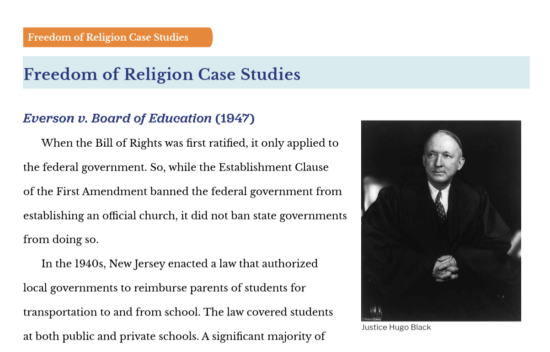
Case studies on landmark freedom of religion Supreme Court cases.