Video
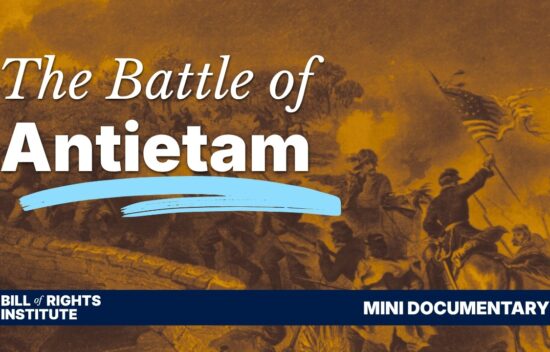
The Battle of Antietam Mini Documentary
Watch
Founding Principles
About this video
In September 1862, Confederate General Robert E. Lee led his army into Maryland, launching the first major Confederate invasion of the North. Facing him was Union General George McClellan, whose hesitation and caution had already tested President Lincoln’s patience.
Along the banks of Antietam Creek, the two armies met in one of the bloodiest days in American history. When the smoke cleared, more than 23,000 soldiers were dead or wounded, and the course of the Civil War and the nation’s purpose had shifted forever.
0:04 In September 1862, Confederate General Robert E Lee invaded the North. Marching the Army of Northern Virginia into Maryland. Meanwhile, Abraham Lincoln looked weary, careworn, and troubled, according to one friend. And depressed and dismal, according to another. Lincoln was concerned because northern morale
0:26 was sagging from a string of recent defeats in Virginia, and the approaching midterm elections could be disastrous for the Republicans. Lincoln also wanted to issue his preliminary Emancipation Proclamation to end slavery. He knew to do this, he needed a Union victory so that it did not appear a desperate measure.
0:48 Unfortunately, Lincoln was dependent upon his arrogant yet hesitant commander of the Army of the Potomac, General George McClellan, to thwart Lee’s invasion. McClellan told his wife no one else could save the country, and was openly disdainful of the president. The general was haughty and vain.
1:09 Yeah, he was overly cautious and constantly overestimated the size of the enemy. To avoid giving battle. Lincoln privately complained that McClellan’s hesitancy gave him a case of the slows. The president was desperate for victory in the wake of McClellan’s defeat at the gates of Richmond in the Seven Days
1:31 Battle in June and General Pope’s disastrous August defeat at the Second Battle of Bull Run in Northern Virginia. Ulysses US Grant, brilliant victories at Fort Henry and Fort Donelson, and the Battle of Shiloh in the West only magnified the miserable failures of his commanders in the East. Lee’s army that invaded Maryland was in rough shape as well.
1:54 The men lacked adequate food, and many marched without shoes. Thousands of stragglers were tired of fighting under such conditions and simply deserted. Lee daringly split up his army and sent men to take Harpers Ferry for the weapons and Bountiful supplies. McClellan pursued the enemy, but he was predictably too cautious.
2:17 On September 13th, Union Corporal Barton Mitchell was talking with a friend and making coffee along a fence when he noticed a package of three cigars wrapped in a piece of paper. He was shocked. It was Lee’s secret operational plans for the campaign. McClellan soon examined it and yelled, now I know what to do! However, he hesitated to act against the smaller,
2:39 scattered armies of the enemy, allowing Lee time to concentrate his forces with a large part of his force assaulting Harpers Ferry. Lee deployed his army at Sharpsburg in a strong defensive position near Antietam Creek, and awaited the Union onslaught. McClellan arrived and prepared his positions.
3:00 He blamed a misty fog for not attacking the next day, but moved three divisions under General fighting Jo Hooker across the Antietam Creek into position that evening. McClellan told his staff. Tomorrow we fight the battle that will decide the fate of the Republic. At daybreak on September 17th, Hooker’s army clashed with Stonewall Jackson
3:25 streets for hours in and around a cornfield in woods near Dunkirk church. The tide of battle shifted a few times, and men on both sides were caught in a fearful and incessant fire that wiped out entire units. McClellan sent in another force to little avail. One observer noted
3:45 whole ranks went down. Dead men were found piled on top of each other in the hellish landscape. The slaughter on both sides, as one soldier reported, was enormous. In just over three hours, 8000 men were killed and wounded.
4:05 McClellan belatedly sent in reinforcements in the middle of the opposing lines to support Hooker’s flank. He sent the divisions in a piecemeal attack in the late morning and early afternoon. This only rendered them ineffective and added to the slaughter. Thousands went down in a matter of minutes under what a participant called a savage thunder of bullets and artillery.
4:31 The fighting was hardest along the sunken road, as the armies fought only meters from each other. The road was now known by a new name, Bloody Lane. Union General Ambrose Burnside finally received orders to cross the southernmost bridge in the early morning.
4:51 He was slow to move and lost many men traversing the bridge. However, he greatly outnumbered the opposing General James Longstreet and eventually pushed the Confederate forces back to the edge of Sharpsburg, threatening their retreat. Suddenly, Confederate General A.P. Hill arrived with his division from Harpers Ferry
5:12 and a forced march of some 17 miles. They slammed into Burnside’s left flank. And this is Vance, petered out in a bloody stalemate. McClellan failed to support him with fresh reserves. As evening descended and the fighting waned, almost 23,000 soldiers lay dead or wounded.
5:34 The Union Army still had some fight in it, but their commander hesitated and let Lee slip back across the Potomac. The battle ended as a tactical draw. Much to Lincoln’s frustration, however. Union forces had won enough of a strategic victory for him to issue the Emancipation Proclamation and declare the slaves
5:56 in the Confederacy forever free, based upon wartime necessity. If those states did not rejoin the Union by January 1st, 1863, the deadliest one day of battle in American history at Antietam contributed profoundly to Union victory in the Civil War and the new birth of freedom, as Lincoln would call it at Gettysburg.
6:19 The battle and resulting emancipation demonstrated to the world the principles of freedom, equality, and self-government, and the Declaration of Independence that were a stake in the war for which the soldiers gave their last full measure of devotion.
Standards
Related Resources
