Video
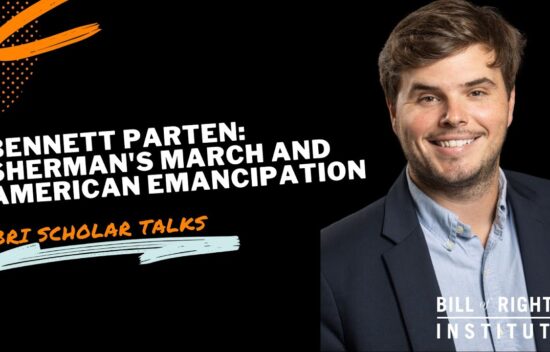
Sherman’s March and American Emancipation with Bennet Parden | BRI Scholar Talks
Watch
Founding Principles
About this video
Examine the impact of Sherman’s March to the Sea on emancipation during the Civil War and Reconstruction. This Scholar Talk video highlights the complex relationship between military strategy and the liberation of enslaved people with BRI Senior Fellow, Tony Williams and Bennett Parten, historian and professor at Georgia Southern University.
0:05 In this episode of Scholars Talks, the guiding question is how did Sherman’s March to the sea support emancipation during the Civil War? Bennett Parten is our guest, and he’s a professor of history at Georgia Southern University who specializes in the Civil War era. He is the author of Somewhere Toward Freedom, Sherman’s March
0:26 and the Story of America’s Largest Emancipation, which we will discuss today. I’m Tony Williams, Senior Fellow at the Bill of Rights Institute, and I want to welcome you to another episode of Scholar Talks in our America 250 series. Ben, I want to thank you very much for joining me. Thanks for having me. Very good.
0:46 You know, I love the book. Congratulations on on, your, new book. And, you know, I just love it because, you know, we know the familiar story of Sherman’s March to the sea raised sort of this institution of hard war, total war, trying to demoralize and sort of crush the South as he goes up, towards,
1:08 Grant and Virginia, you know, link up the armies and so forth. You know, we’re heading towards the end of the war, and yet you also so deftly weave it together with a lesser known part of the story, which is the emancipation of enslaved persons, military emancipation, self emancipation. And you just, nice so nicely tell that story.
1:30 And a very, very well-written book, about this to, complete aspect. So really helps round out the story. So really enjoyed it. Yeah. Well. Thank you. That’s very nice of you. Great. So can you provide for our viewers maybe a little bit of historical background, with both about Sherman’s March to the sea
1:52 and emancipation policy during the war. I know it’s the big, big topics. Right. But if you could give us a little introduction to it. Yeah, sure. So happy to. So Sherman’s march, to the sea, otherwise known as the Savannah Campaign, begins in mid November of 1864. This is the last full year of the Civil War.
2:13 In the East. Grant, has Lee pinned down at Petersburg. The next move it there will be towards Appomattox. The following year. Then, George, Sherman is just taking Atlanta, which is a really important strategic victory for a variety of different reasons. But the march to the see is Sherman’s next move. It’s a roughly 250 mile march.
2:33 It takes about a month and a half, from Atlanta to Savannah. It will include about 60,000, soldiers. But this wasn’t necessarily your ordinary campaign. I mean, one of the things that Sherman is very clear about is that in leaving Atlanta, he has to leave his supply lines, behind.
2:54 And so he instructs his men to forage off the plantations and fields of middle and central Georgia, both as a means of sustaining his army, but also as a means of targeting the emotional and material wherewithal of white Southerners to keep up the fight. This is something that Sherman’s very clear about. And so that since this campaign is going to be one of the most, intimate up close and personal of the entire war,
3:17 and this is one reason why it becomes such an emancipation event, that in the fact that by 1864, the war has fully evolved into a war that will end slavery. This is an evolution that begins early in 1861 with a series of congressional, acts. It also begins in part because wherever the Army goes in the Civil War, even at its earliest stages.
3:38 And so people are always there running to the army, which pushes Congress to act. It’s an evolution that’s going to reach a crescendo of sorts with, Lincoln’s Emancipation Proclamation, which he announces in the fall of 1862 and then authorizes. Or issues, I should say, on January 1st, 1863, and then comes to a real climax here in Georgia with Sherman’s March.
4:01 And so by now, the war is clearly a war in slavery. This is one of the reasons that it becomes the emancipation event that it does. Okay great. And so, thinking about more of the Army side, how does military emancipation fit Sherman’s goals of of hard war? And how does it just so thoroughly disrupt, the Confederate war effort,
4:22 but then also the society and economy, which is rooted in slavery? Yeah. Well, it’s interesting question, because, it kind of doesn’t fit into Sherman’s view of hard war. I mean, it really does. And and maybe the best way to, imagine this or think about this is to think about his time serving as the military governor of Memphis in 1862.
4:43 He is there, in 1862, just as Congress is beginning to work on the second confiscation Act, which is Congress’s precursor to the Emancipation Proclamation. And all the while he’s there, he’s dealing with the problem of Confederate guerrillas. His men are being fired upon by, Confederate partizans, playing up and down the river.
5:05 Civilian ships are being fired upon. And Sherman’s answer is to begin developing this hard war strategy. What he does is he begins sending soldiers out to the villages and towns that harbor these guerillas to burn them, sometimes to leave one single, building just so they can mark the spot on a map. And then he’ll begin to, expelling, local families.
5:25 I think it’s ten local families for every shot fired on one of his men. And so we really can see the origins of his hard war strategy there in Memphis. We’ll do something similar in terms of its, well, certainly the destruction, but also the, expulsion of families in Atlanta, but is in this moment two that he’s beginning to think really critically about emancipation. And the fact is, he doesn’t see it as being central to the war effort at all.
5:48 He wants to keep both the military strategy and emancipation completely separate, in part because he doesn’t see, or he sees freedom as being nothing but an abstraction, and he sees emancipation as something that can slow down his army and be a detriment to his army, rather than something that could actually advance the war effort. Now, by 1864, he’s evolved slightly, but I want to stress slightly.
6:11 We now see slavery, as something that can be targeted to advance the war effort. And he sees it to some degree as part of his hard war strategy, but he’s still very reticent to embrace it fully. And that in some ways, represents or at least embodies how Sherman thinks about emancipation along his march. He’s happy to, free enslaved people.
6:35 He is not all that happy to have him follow his army, but his main priority is completing the campaign. No matter what. Great. And I think we’re going to get back to some of that ambivalence. You know, you know, a few questions. So, but, looking at African-Americans, what decisions shaped, as, as you describe thousands, maybe as many as 20,000 of enslaved
6:59 people’s decision to to self emancipate, to flee the Union lines. And what was their experience with the army during the march? They’re talking about more ambivalence there in the book. Yeah. Yeah. No, sure. And you’re absolutely right. When Sherman gets to Savannah, he speculates that there’s maybe as many as 20,000 free refugees, following, which is a huge number
7:21 that’s roughly equivalent to the size of Savannah itself. But that 20,000 number doesn’t take into account the people who might have run to the army and then were turned back by the army or voluntarily decided to go back on their own, volition. It doesn’t take into account the people who might have run to the Army. Spoke with the Army, spoke with, Sherman, his soldiers, and then decided not to make, the journey itself.
7:45 It it certainly doesn’t take into account that people who experience freedom just as a consequence of this movement. And so when we take all these factors combined, I think what we have here is the largest emancipation event in American history. But we also have to recognize, right, that there is a range of different calculus changes that have to be made by enslaved people. And there are a range of experiences, that it’s I feel experience.
8:08 Right. And in this moment and in terms of the calculations, they’ve got to think about what won their family. Are they going to be able to, to make this journey if they do decide to follow the Army as a family unit? They’ve got to think about what might lie ahead. Right. Where is the army going? What is life going to be like when we get there? Is the freedom that I’m pursuing something that’s
8:29 going to be tangible and real or completely undefined? And then two, they’ve got to think, can they physically make this march right? There’s no guarantee that it’s going to end in Savannah. It’s not even clear that Savannah is the target. And this is a real movement, right? A minute that lasts about a month and a half. And so there’s real questions about whether or not, enslaved people can physically endure the hardship that’s going to come with,
8:51 making this March. But but many do, make this calculation. And the experience with the Army is, itself also a real range. Right? There’s a range of experiences. Some are turned back or forced back. Some are welcomed, to, into the army. Some are, pushed to the back where they follow the army.
9:12 Some joined the army as cooks. Laundress valets, military laborers. But if there’s one throughline I think that defines this experience, it’s that at every step of the march, enslaved people consistently acted as the soldiers allies. Despite the fact that many soldiers did not welcome them, despite the fact that many soldiers carry the same prejudices.
9:34 Right. That we would imagine a 19th century American, maybe having, the soldiers always ally or, excuse me, the, enslaved people always allied with the soldiers. They did everything from serving as intelligence agent, agents to scouts to lookouts. And maybe the best story is that in advance of Sherman’s army, near
9:54 the white families actually buried or hid their their goods or their livestock. But, of course, they didn’t do the actual hiding of these goods themselves. They force enslaved people to do it. And so this armed, enslaved people with knowledge for where the family, corral of horses had been hidden. Where the cemetery, the trunk of valuables had been buried.
10:14 And so enslaved people were very willing to pilot the soldiers to these caches of goods or corrals and use it as a real bargaining chip to, appeal for inclusion within the march. And then just one other quick story, another example of just how central enslaved people were to, the Army and to the Army. Success.
10:35 Comes, just north of Savannah. This is, part of Georgia. That’s for the rice swamps of the, Savannah River. Here, the plantations are always abundant. And here to the march slows to a crawl. There are few days where the foraging parties questioned whether or not they were going to return empty handed, and there were real questions as to whether or not
10:56 the army was actually gonna be able to complete this campaign. And many of the soldiers on Sherman’s left wing might have gone hungry. But in fact, enslaved people there, sustain them by teaching them how to, hold rice and how to prepare rice. Sherman’s army of Midwesterners, folks from Indiana, Illinois, Ohio and elsewhere. If they’ve eaten rice, they certainly didn’t know how to actually produce it.
11:17 But nonetheless, in these really important days at the outskirts of Savannah, Georgia enslaved people. Sustain them and sustain the march by teaching them how to, to eat and prepare rice. Right. And just a just quick follow up, which kind of leads you to my next question as well. But, you know, as you point out, like, it is really strange, sort of,
11:39 you know, union supplies and the food that they were, you know, living off the land and so forth, and, you know, they’re exposed to the elements and so forth. So it’s just, it’s just a really difficult, you know, experience, for them in this model. It is absolutely. And, of course, the greatest danger is the fact that while there isn’t a whole lot of resistance
12:00 in the form of Confederate infantry, infantry, in fact, there’s there’s none at all, really. There is Confederate Calvary that’s always hovering around, that’s always trying to do the best they can to snipe at the Army. And as a consequence, are always there, hovering around the refugees, and who, if given the chance, would capture or sometimes kill the refugees.
12:23 As this, march is happening. Or and capture probably men either execution or being returned to enslavement. Exactly. Yeah, exactly. So, what is their experience, then? Of the freed people, once they arrive in Savannah and and and this experiment or Port Royal, you know, in the surrounding islands and coastal areas,
12:47 there’s not always, not always a pleasant one, is it? No, not at all. And, maybe let me start by saying a little bit about, Port Royal, or the Port Royal experiment, which, I think undoubtedly is one of the most important stories of the Civil War. And for listeners who might not be familiar, this is arguably where freedom happens first in the Civil War.
13:08 Port Royal is, just north of Savannah. South of Charleston is in the islands of South Carolina. It’s truly the low country of South Carolina. And Port Royal matters because it is the deepest deep water port on the southern coastline. And so early in the war, in the fall of 1861, US naval ships sailing to Port Royal said,
13:31 because they want to take it over and use it as a base of operations to blockade of Charleston, Savannah. And when they do, it forces the local Confederates, the local, white plantation owners, into taking flight, and they leave behind about 10,000 enslaved people who, for all intents and purposes, are free in a de facto sense. But this is in the fall of 1861, long before the US government’s
13:55 going to begin making this evolution. In terms of emancipation, and so there’s a real question of what does the government do with these people? How are they legally defined? What’s their status? But fortunately, salmon Chase, who is Lincoln’s secretary of the Treasury? Treasury? He develops a plan along with a man named Edward Pierce,
14:15 to send down, teams of northern philanthropists humanitarians teachers technocrats and other agents to begin, administering aid, to begin building schools, holding religious services. But critically, and this is the critical but they also, want to coerce or coax
14:37 or convince enslaved people to go back into the fields working not as enslaved laborers, but as free laborers. And so this entire project, known as the poor rural Experiment, is really meant to be the tip of the spear. They will begin putting more pressure on the government to evolve, right. And to embrace emancipation and be a project that can really begin to,
14:59 hasten this evolution along and speed up the transition and ease the transition from slavery, to freedom from slave labor, free labor, and the entire history of the Port Royal experiment is one that is very complicated. But it matters for this story, because when Sherman arrives, on the coast of Georgia, he makes a decision to begin sending the 20,000 refugees that are following him,
15:21 down the river, which is a really important artery. Down in my part of the world here in Savannah, just south of the city and south of the Savannah River. He sends them down via the Atlantic and up to Port Royal, on the assumption that this would be a place that is best suited to care for them, as any,
15:41 but he turns out to be wrong, in part because, while there is a certain level of infrastructure there, the arrival of so many refugees is going to turn Port Royal into the epicenter of a sprawling refugee crisis that will expand up and down, the, coastline of South Carolina and Georgia. There’s eventually going to be a lack of food, a lack of shelter.
16:04 And pretty soon, disease is going to begin, running rampant as well. And so the outcome, of what happens with the refugees arrive, in Port Royal, terms. Tragic. Right. And, and and and the problem, in a sense, doesn’t go away. Right. Because when Sherman starts marching and moves on on Columbia and keeps going up into North Carolina,
16:27 the problem comes up again because they’re just more and more. And so thousands and thousands of more enslaved persons coming, to. Yeah, absolutely. I mean, one of the, ideas, that Sherman had and the, the, the, the, the U.S. Army and the War Department had was that in placing them at Port Royal?
16:47 The Port Royal could be a kind of base of operations, could be a colony. That’s the term that many of them use for freed people who flee to the army. So that the army can continue making its march as unencumbered as possible. And so this is meant to be, a real colony sometime, you see it referred to as the Sherman Reserve,
17:08 because one of the things that Sherman’s also going to do is in that winter of 1860, four, 1865, and in fact, it’s January 16th, is that he’s going to issue his special field orders over 15, which begins setting aside requisition plantation, space for exclusively African-American homesteading. This is also going to take place right in the same,
17:31 area, that the Port Royal experiment is taking place as well. And pretty soon land reform is going to fall under, the, ambit or the brief, I suppose you could say, of the Port Royal experiment as well. All right. Let’s see a great segue to our our my next question, final question, which includes reconstruction. So going back to the guiding question, how does Sherman’s
17:52 March to the sea support emancipation during the war? And how does it reveal the complexities of emancipation and reconstruction, as you just pointed out? Yeah sure. Well, unquestionably, I think Sherman’s March is, the campaign that conquers the Confederacy and I think fully destroys slavery. I mean, it’s, easy in hindsight to look at November of 1864
18:16 and assume while the war is going to end and emancipation is going to, be an outcome right of the end of the war. But the fact is that, things were still very uncertain as of November 1864. I mean, Lincoln wins reelection, maybe a week, right? Just before Sherman launches. And this is March. This, this this is all happening right alongside each other.
18:36 So there’s no guarantee that the war is going to end the way that it does. And there’s no guarantee that emancipation is going to be an outcome of it. And so I think the, experience of the march is one that seals and secures emancipation later abolition as one of the great consequences of the civil War. In two. I think we can see the march really as this culminating moment
18:56 of federal emancipation policy and the, the armies movements, all coming together. As I said, this is happening a ten days after the Emancipation Proclamation. It’s happening towards the end of the war. In a way, I think enslaved people really understand, right, that the army is an army of liberation. And, and that if they can flee to the army, they will find some form of freedom.
19:20 But I want to stress some form of freedom. And I think this answers your your final question. The reality, right, is that freedom was always itself undefined. And part of the effort of enslaved people was to try to give it some form of definition in this, harried, historical moment. And to that search is something that never really gets defined
19:42 even as the war ends, and the calendar turns into, you know, the, the spring, summer fall of 1865. And I think that is a reality of the story I’m trying to tell, which is that it has a very ambiguous and unfulfilled, ending. But I think that, too is, a metaphor or at least the storyline
20:02 of the Civil War of Reconstruction more broadly, which is that, the way we understand our Civil war and the way we understand, reconstruction is one of real ambiguity and of, a promise that goes unfulfilled. Well, maybe that’s the topic of your next book. I don’t know. You. Know, Ben, it’s been a real pleasure to talk to you.
20:23 Thank you for joining us. And congratulations. I’m on your book. And, it’s really magnificent. So, we encourage everyone to go out and read it. Yeah. Tony, thanks for having me. It’s been a blast. Thanks. And thank you all for joining us on this episode of Scholar Talks. Please check out our other interviews in the America 250 series on our channel.
20:47 Thanks.
Standards
Related Resources

By the end of this section, you will explain how Lincoln’s leadership during the Civil War impacted American ideals over the course of the war

What is the importance of religious liberty in America? How does the Constitution protect it and what is the reason it is significant today? Examine these questions with students so they can see the model religious liberty in America has become for other nations and is an ongoing experiment.