Video
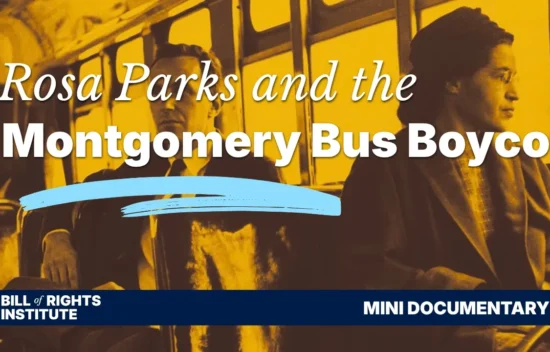
Rosa Parks & The Montgomery Bus Boycott Mini Documentary
Watch
Founding Principles
About this video
On December 1, 1955, in Montgomery, Alabama, Rosa Parks refused to give up her seat on a segregated city bus. Her arrest for violating segregation laws exposed the reality of Jim Crow and became a catalyst for change.
What followed was a sustained act of resistance. Led by E.D. Nixon, Jo Ann Robinson, and Martin Luther King Jr., Black residents of Montgomery organized a boycott that lasted over a year. Despite arrests, harassment, and violence, they held the line and forced a Supreme Court decision that declared bus segregation unconstitutional.
From a single act of defiance on a city bus to mass meetings, carpools, and courtrooms, this mini documentary traces the Montgomery Bus Boycott and its place in the broader development of constitutional rights and equal protection under the law.
0:06 On December
0:06 1st, 1955, in Montgomery, Alabama.
0:09 Rosa Parks was a department store seamstress
0:13 who boarded a crowded city bus after a long day of work.
0:17 She was exhausted from work and sat down when several white people got on the bus.
0:23 The bus driver ordered her
0:24 to get out of the seat so that the whites could sit down.
0:29 Parks refused, even when the bus driver repeated the command.
0:34 The bus driver called the police.
0:36 They arrived and arrested parks for violating local segregation laws
0:40 that separated the races and put blacks in inferior position.
0:46 She later said this seemed to have been the place for me
0:48 to stop being pushed around and to find out what human rights I had.
0:53 If any.
0:56 Parks had not planned the protest that day,
0:58 but she was a trained civil rights activist.
1:01 She was the secretary of the Montgomery and NAACP chapter,
1:06 and had attended civil rights workshops at the Highlander School in Tennessee.
1:11 She had worked to end segregation, and now started a boycott
1:15 that would help ignite the civil rights movement,
1:19 and NAACP leader E.D.
1:21 Nixon bailed parks out of jail, and they worked with the Women’s
1:25 Political Council president Joanne Robinson, organizing a one day
1:31 boycott of the city busses by the black people of Montgomery
1:35 Baptist ministers Martin Luther King, Jr.
1:38 And Ralph Abernathy supported the boycott.
1:42 On December 5th, the Black citizens boycotted the segregated busses
1:46 and walked to work, carpool, or rode in a cab.
1:51 That night, the 26 year old Doctor King
1:53 presided over a mass rally of prayer
1:56 songs and encouraging speeches at a church
2:00 to bolster the courage of the community.
2:03 We are tired, King thundered.
2:06 Tired of being segregated and humiliated,
2:09 tired of being kicked about by the brutal feet of oppression.
2:15 Drawing on the strength of common purpose, they decided to continue the boycott
2:20 until the busses were integrated and justice achieved.
2:24 They continued to carpool for days, weeks and months.
2:30 Many whites
2:31 resisted the demands and reacted against the boycott.
2:35 They formed the White Citizens Council, dedicated to preserving segregation.
2:40 City officials indicted boycott leaders on conspiracy charges.
2:45 The police harassed carpool drivers
2:47 and jailed King for a minor traffic violation.
2:51 Angry whites bombed King’s home with his wife
2:55 and daughter inside, but no one was hurt.
3:00 Participants had the courage to persist and continued the boycott.
3:05 They filed a lawsuit in federal court
3:07 asserting that the segregated busses violated the Constitution.
3:12 Eventually, a federal district court and the Supreme Court ruled
3:16 that the segregated busses were unconstitutional.
3:21 On the morning of December 21st, 1956,
3:25 13 months after the Montgomery Bus Boycott began,
3:29 Black residents rode the busses.
3:32 They sat wherever they wanted.
3:36 The Montgomery Bus boycott helped sparked the civil rights movement.
3:40 Martin Luther King became a national civil rights leader.
3:44 But it all began when a tired
3:47 Rosa Parks wanted a seat on a bus.
3:50 More importantly, she wanted equality, justice
3:54 and respect for her human dignity.
3:57 She made a claim on the promises of the Declaration
4:00 of Independence and a free society.
Standards
Related Resources

By the end of this section, you will explain how and why various groups responded to calls for the expansion of civil rights from 1960 to 1980.

Use this primary source text to explore key historical events.

What about Rosa Parks’ purpose lead her to participate in the Montgomery Bus Boycott?