Video
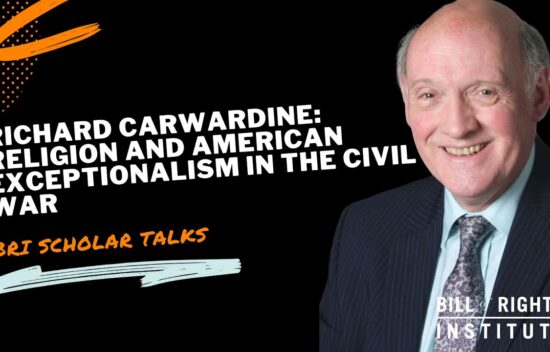
Religion and American Exceptionalism in the Civil War with Richard Carwardine | BRI Scholar Talks
Watch
Founding Principles
About this video
In this episode of Scholar Talks, Tony Williams, Senior Fellow at the Bill of Rights Institute, is joined by Richard Carwardine, Lincoln Prize-winning historian and Emeritus Rhodes Professor of American History at Oxford University, to explore themes from his book Righteous Strife: How Warring Religious Nationalists Forged Lincoln's Union.
This conversation unpacks Abraham Lincoln’s evolving religious views, the deep ties between faith and politics, and how sermons and spiritual rhetoric influenced the war effort and the fight against slavery. Carwardine offers rich insights into Lincoln’s struggle with providence, the moral weight of emancipation, and the way religious nationalism helped define the Union’s mission.
0:04 On this episode of Scholar Talks, the guiding question is what ties did Abraham Lincoln and others during the Civil War make between religion and the idea of an exceptional American nationalism? Richard Carradine is the emeritus Rhodes Professor of American History at Corpus Christi College at Oxford University,
0:26 and the Lincoln Prize winning author of several books on Abraham Lincoln, including his latest, Righteous Strife How Warring Religious Nationalists Forged Lincoln’s Union, which is the topic of today’s discussion. I am Tony Williams, Senior Fellow at the Bill of Rights Institute, and I want to welcome you to another episode of Scholar Talks
0:49 in the New America 250 series. Richard, I want to thank you very much for joining us. Well, thank you very much, Tony, for inviting me. I’m looking forward to our conversation. Well, you know, the reason I love this book as really looking forward to it. And you did not disappoint. I as I think I mentioned earlier when we were chatting,
1:11 the the real beauty of this book is just, you know, the I think it’s really just magisterial in terms of being the book on Lincoln and religion and understanding understanding that milieu. During the Civil War. It’s the book I’ve been waiting for, frankly.
1:32 Well, thank you. It has taken a long time for me to produce. I began work on it 20 years ago, and then it got interrupted by the Lincoln bicentenary and then by the sesquicentennial of the Civil War. And but, as with many authors, Covid came to the rescue. I, I had, had a couple of years without distractions.
1:54 And that’s really when the bulk of the writing was done. A little more time to work on it. Well, you don’t have to answer because I’m going to embarrass you, but you already have my vote. Not that it matters for the Lincoln Prize, so. But no. Congratulations on on the release of the new book. Well. Thank you. Thank you. So why don’t we jump in? So maybe setting the scene a little bit.
2:15 So can you explain Lincoln’s complex religious views and the the sectional denominational divides and Christian unity over topics like slavery and secession? Before the Civil War? Sure. Well, Lincoln’s, religious views before the Civil War are a matter of controversy or a matter of uncertainty.
2:36 I think all one can say for certain is that he attended the Presbyterian Church. The first Presbyterian church in Springfield, with his wife, Mary. She was, they were pew holders. She was a member. He was not a member. He wasn’t a dear. And he attended. He had certainly been attracted to the ideas of Tom Paine.
2:57 And he spoke about being interested in, quote, the doctrine of necessity and kind of high Calvinistic doctrine of a kind of predestination, which linked rather with the, with the ideas of the rationalists of the, of the enlightenment. But we can say that, he read his Bible.
3:18 He knew his Bible as well as any other book, with the possible exception of Shakespeare. They were the two staples of his reading. He had an inquiring mind. He was an intellectual. He he he wanted he tussled with all kinds of intellectual issues. And I think probably by the late 1850s, we can say that he was broadly
3:41 in tune with what we would say today in Unitarian, theology. Not a Christian theology, but a Unitarian theology. He, he certainly, thanks to his law partner Herndon read, some of the, key, Unitarian authors, Theodore Parker being being one of them.
4:02 So he summed it could be summed up in a belief in the fatherhood of God and the Brotherhood of man. One thing we do know is that he had no time for, pro-slavery theology. And I just say a little bit about that. The the the South, as I’m sure your, view is.
4:23 No, in the immediate post-revolutionary early Republic period, thought that slavery would gradually disappear, and they regarded it as a necessary evil. But by the 1840s and 1950s, more and more Southerners were standing up for slavery, the principle of slavery and the goodness of slavery.
4:45 And they developed a pro slavery theology. A Lincoln, was deeply unimpressed with this theology, as indeed were very many other northerners. And the, again, as you know, it was well know that the major churches split over the issue of slavery. The biggest church, Methodism, split in the 1840s. And it was a really important step on the way to Civil War, because the
5:09 breakdown of these national institutions had implications for politics. Lincoln was not a methodist. He was not a Baptist. He was a possibly a Unitarian. He certainly was attached to the Presbyterian Church, and a Presbyterian by the name of Frederick Ross wrote a book on how slavery was ordained of God. And Lincoln wrote a little memorandum to himself,
5:32 in which he said, well, there’s a a biblical tussle. There’s a tussle over the Bible’s position on slavery. But Doctor Ross has come to the rescue, and he’s, he’s given us his answer. And I if I may, I’ll quote I quoted to you because it’s a it’s it’s a nice, ironic passage. He says, Doctor Ross is to decide the question and why he considers it.
5:56 He sits in the shade with gloves on his hand and subsists on the bread that Sambo, as he describes the slave, is earning in the burning sun. If he decides that God will sambo to continuous slave, he thereby retains his own comfortable position. But if he decides that God’s will, that God will sambo to be free, he thereby has to walk out of the shade,
6:17 throw off his gloves, and delve for his own bread. Will Doctor Ross be actuated by that perfect impartiality which has ever been considered most favorable to correct decisions? Well, you can see where the thrust of of that is. Lincoln had no time for pro-slavery theology. And, on the eve of the election of 18
6:40 1860, he is alleged to have had a conversation with, the superintendent, state Superintendent of Education, Newton Bateman, in which he says, our God regards slavery as. And I cannot see how our God could regard slavery as just so. There is a sort of there is a theological position that,
7:02 the pro-slavery theologians that I’ve mentioned above all include, James Henry Thornwell and Benjamin Palmer, and their position is that slavery is scripture is sound. The Old Testament prophets own slaves. Nowhere in the New Testament does Christ, declare slavery to be un sinful or unlawful or wrong.
7:25 They come a a thorn. Thornwell on his student. Palmer. The thorn one is a very distinguished theologian. Palmer was his, student, a very impressive and effective preacher in New Orleans. And he delivers a sermon during the Winter crisis, the secession crisis in New Orleans, which circulates, 60,000 copies.
7:48 I think it’s 60,000 or the 23rd, 20,000 copies there. So it’s a circulation of about 60,000. So it makes a huge impact. And when we look at the secession movement and the leadership of the secession movement, the political secession movement, it’s quite clear that that’s being driven as much by the preachers and the pulpit as it is by the political conventions. So that’s the kind of setting that we, we have
8:11 as we go into the Civil War in 1861. Right. So great. So, so thinking about our guiding question. So, so what ties did Abraham Lincoln, make during the Civil War and others? Between religion and this idea of American exceptionalism, this, religious nationalist. Right.
8:33 Well, link Lincoln on his way to Washington in February of 1861, he stops off at a number of places, including, the new Jersey Senate, at which point he, he refers to, the American people as an almost chosen people, that one kind of Lincoln in,
8:54 qualification, just just tentativeness. At the very time when actually the vast majority of Calvinist traditional preachers are Presbyterians, Congregationalist and increasingly, Methodists, subscribing to the idea of, the United States as having a special mission under God.
9:18 And in sermon after sermon. And there’s a torrent of sermons during, the secession crisis during the first day that, that James Buchanan calls on the 4th of January and, and then subsequently through the war, you read those sermons and you’re completely immersed in this kind of covenant theology
9:40 and this idea that the United States is a modern day Israel, and that nations under God are expected to, to atone for their sins. Nations have a a responsibility, just as individuals do, to behave in a way that in a godly way, in a godly fashion,
10:03 God will reward those nations that, walk in the paths of righteousness and God will God will punish those nations that sin that’s deeply, deeply imbued in the American pulpit in the, 1861 to 65 Civil War, Lincoln,
10:23 Lincoln speaks to those people. I mean, he has innumerable meetings with Presbyterians, with Congregationalists, with Episcopalians, with Methodists, and with Baptists. They’re always coming to the white House in deputations. Some of his generals say, what in the world is I mean, William Tecumseh Sherman says, I wish Lincoln wouldn’t spend so much time with all these grannies.
10:48 So I suddenly get on with the business of state. And the answer is, well, for Lincoln, this is the business of state. This is a very important part of a public, the public realm. It’s his way of keeping on top of public opinion and his absolutely, affair with an understanding of this, providential ism. This idea of God as, the ruler of nations.
11:11 And whereas individuals can be punished in the afterlife, nations have to be punished here now because there is no afterlife for a nation. In fact, the only after a life for a nation is the destruction of the nation. If it actually behaves, so completely outside the scope of, biblical morality. All right.
11:32 Thank you. Thank you. That was very nicely laid out, for our viewers. And so you mentioned these days of, Thanksgiving of fasting. So how do they represent this covenant theology you mentioned, of Lincoln, and how are they tied to the events of the Civil War? Well, first is, had been pretty few and far between
11:54 in the American Republic because they were, at a federal level. They were very familiar to the colonial, settlers, to the inhabitants of the colonies, as they were indeed to, British Christians in the, the 17th and 18th centuries. That because of the separation of church
12:14 and state, there was a real tussle in the early Republic as to how legitimate it was for the federal government to call first days. Madison called one, George Washington called one. Madison called when when Andrew Jackson was asked to call one at the time of the cholera epidemic, he said no, this is this is this is tying church and state.
12:35 It’s that I mean, there’s another story to be told there. I’m not going to I tell it in the book. I’m not going to tell you here now, but I’ve kind of the the resistance on the part of Jacksonian to the Puritanism of the state and, the way in which New England approaches to religion were, to be resisted. And, but as I say, the first days,
12:58 and days of federal, federal days of Thanksgiving, only come in significant numbers under Lincoln and Lincoln issues. Three separate calls for fast days. One is in the after the defeat of Bull Run. In September, August, September of that protected September of 1861.
13:20 The second on the eve of the the battles of 18, the summer of 1863, when there have been some severe losses in the period leading up to that, and then again after the terrible summer’s events in Virginia in the Eastern Theater in 1864, the battle of the Spotsylvania, the the wilderness.
13:42 And on each of those occasions, Lincoln calls fast days. In addition, he calls days of of Thanksgiving. After certainly after, Vicksburg and Gettysburg in 1863 and again after, the victories in the, the fall of Atlanta, and the, the victories of the of,
14:03 September 1864, these are moments where the theology that I have explained earlier, this providential is theology of nations under God, spelled out in, in some detail, whether Lincoln wrote all of these fast proclamations is a matter of conjecture.
14:26 I think my own view is that, the later one show much more evident intervention of, of Lincoln than the, the very early ones, which I think were quite possibly written by Seward. But interestingly enough, when, Lincoln goes into the telegraph office in 1861, in September of 1861
14:47 and he says, well, he says, gentlemen, I’m pleased to see you are working so fast. On my first day it was a it’s a terrible dad joke. I think it’s pretty good. But he says, he says, I’m pleased to see you working so well on my first day. So he takes he certainly takes ownership of it.
15:10 And likewise, the Thanksgiving days, of course, the the first really, real federal national first day is that November of 1863. Sarah Hale has approached Lincoln through William Seward, to establish what then has become the the national festival ever since.
15:32 And yes, these are, these are these are religious occasions. These are profoundly theological occasions when the whole nation is called to, well, certainly on fast days to fast, although it has to be said, it’s more done, by, by a nod than by real fasting.
15:53 But these are days when it’s expected that, the citizens would attend church, that they would be they would be preached at by, by, ministers who, likely to deliver a sort of a Calvinist theology and exploring the ways in which the nation, the American nation, has failed God.
16:15 Now, obviously, as we may say in a moment or two, for some people that failing has absolutely to do with slavery. But for others it has to do with not with slavery, but with, the shortcomings of the people in other particulars. Right. And, yeah, that was a great segue into my next question, which is.
16:36 Yes. And obviously this is a very important and big question. How did slavery and especially, you talk a lot about the reactions to emancipation, and even the crafting of the NAACP proclamation. How does that figure into this divide over religious nationalism? The conservatives, abolitionists. So.
16:56 Yeah. Yeah. Well, one of the things I, try and do in the book, and you say I succeed. So thank you, is to is to just to show how completely, interwoven religion and politics are, and party politics are in the Union. During the war, we we knew that the war we we’ve long known that the war
17:17 came about by virtue of a division between northern and southern churches. But what I tried to show is that there is a real a cleavage within the, the union community, the those who support the war who want, don’t want to see the South, setting up. It’s permanently a separate polity, but a division, a profound division between what I call anti-slavery
17:40 or religious nationalists and conservative religious nationalists, those anti-slavery nationalists are those who, are a an amalgamation, coalition of those who before the war were abolitionists, radical abolitionists who before the war were calling for immediate emancipation. And those who before the war were the predominant, predominant majority
18:01 of the Republican Party who wanted to see an end to the spread of slavery, and who thought that by containing it, it would gradually die. Well, when the war comes, what we see is a fusion of those two groups into a sort of anti-slavery coalition. Not all of those moderate anti-slavery people become abolitionists, but they are much more open to the idea that the war now provides an opportunity
18:25 to do something about slavery that could not be done in peacetime, when the South was protected by the federal Constitution. There I think, Chief principle in, all of this, the principles of the Declaration of Independence, they see that’s their lodestar.
18:47 It’s not a theological document, although it is invested with a kind of theological meaning. They are millennials, but they they expect society, American society to improve. And the ultimate improvement is emancipation. And through emancipation, there will be inaugurated the thousand year reign of Christ.
19:08 That kind of millennial’s theology is very prevalent, on the side of the, on the part of the anti-slavery nationalists, conservative nationalists, equally committed to the nation. They are equally religious. I would say they contain them somewhat like Charles Hodge.
19:29 They a leading light of old school Presbyterians, a formidable theologian at Princeton and the pulpits of the Presbyterian Church have been populated by his disciples and his students, over many, many years. Hodge is absolutely devoted
19:50 to the Union, absolutely opposed to secession. But in 1836, he’s written, for the Princeton Review, a piece explaining that slavery was indeed, a legitimate institution biblically of authorized. And it’s it’s a long road for him to travel from that position in 1836 to accepting emancipation, which eventually he does,
20:15 but only only, after the Emancipation Proclamation and and not before it. And the other school Presbyterians are amongst those who resist the idea of emancipation becoming a war. I’m. And what they want, what the conservatives want is a return to the Union, as it was under the Constitution,
20:35 as it was protecting the the rights of slaveholders and actually retaining the racial order that preceded the war. Whereas anti-slavery emancipation is anti-slavery and emancipation is nationalists, increasingly willing to see, free blacks if not given absolute equality.
20:57 In fact, most, most of the anti-slavery nationalists would not have been looking for a complete equality. But there’s a radical group of white anti-slavery nationalists and, of course, African American anti-slavery nationalists who do want a racially blind America.
21:17 And this is, in, in, in my book, a really dramatic change in the of the Civil War, the arrival of black troops who fight for their freedom. They are the presence in Washington of Frederick Douglass and other senior African American figures who are meeting Lincoln and are persuading,
21:39 what you might call the political, the, the influential politicians of the time, on the anti-slavery side, that they have an equal stake. They should have an equal stake, in, in America, post emancipation. So those are the two groups that I’m talking about in the book Anti-Slavery and Conservative Religious nationalists.
22:01 Thank you. And such a rich tapestry and just such a complex, story. So, thank you. And, just the question I really love here, how does the Gettysburg Address and Lincoln’s second inaugural really beautifully represented this pinnacle of Lincoln’s view
22:24 of religious nationalism and understanding of providential ism in American life? Yeah. I mean, I think probably the, that the Gettysburg Address, which is ultimately speaks of America under God, is a less evidently theological, document,
22:44 although it has kind of the resonances of the King James Bible. You know, it’s, it’s free or, you know, it’s it’s it’s it’s formulated, you know, in a, in a language which, is semi, scriptural. It’s it’s core claims for America as the, as the, as a, as a, as a, as a land, which is
23:09 implicitly under God, implicitly, on the route to full democracy. It is indeed, as you’re suggesting, an important document in that respect. But it is, I think, less explicitly religious and scriptural than the second inaugural. It’s a it’s it’s a providential document.
23:31 It’s a document which is utterly apprehensive, apprehending of God’s purposes. I think Lincoln, we talked about what Lincoln’s views were before the war, and maybe we’ll talk about how the war changed those in a moment. But, what we see in this document is Lincoln speaking the language of our providential ism, and that God has purposes for nations.
23:56 He has purposes for the American nation. And it is very likely evident to act not just very likely. It is very evident that God is unhappy with the American nation. And what makes the document so remarkable and so unusual, and so at odds with the majority pulpits of the North,
24:19 is that instead of saying, as you might have expected, a triumphalist president to say, because after all, in March of 1865, it was very clear that the war was in its final stages and the Union was going to triumph. But instead of triumphalism, he says, we both north and south pray to the same God.
24:40 He can’t answer both. Well maybe in praying to the same God, we are actually speaking a language that he doesn’t accept from either of us. That maybe we are both North and South are are to blame for the sin of slavery. This is an American sin. It is not simply a southern sin. We have been commercially, and politically,
25:04 embraced in the sin of slavery. We’ve we’ve we have not we’ve not stood up as we should have done. And God is punishing his punish, going, punishing us all. It is, in fact, a remarkable plea for kind of national unity in, in a basement, in really just a basement before God for the the sins that the nation has, has committed.
25:29 Lincoln said I I’ve got it here. I did, I thought I it would be good to, to read this. He he, he knew when he delivered this that he was saying something that was not likely to be acceptable to many, many people. And he wrote this to, to Thurlow Weed, the political boss.
25:52 Thurlow Weed, who had written to to Lincoln and Lincoln. I think Lincoln misread his letter, thinking that Thurlow Weed had commanded the second inaugural. What he, Lincoln I know we had done that. But anyway, Lincoln took it to be such. And he said, you’d expected the speech I quote to wear as well as perhaps better than anything I have produced,
26:16 but I believe it is not immediately popular. Men are not flattered by being shown that there has been a difference of purpose between the Almighty and them to deny it, however, in this case is to deny that there is a God governing the world. And that’s Lincoln in a private letter, very clearly
26:37 stating that this document, the second inaugural, it was not just for public consumption, but he personally, Lincoln believes there is a God governing the world, a mysterious God who intervenes in human affairs. And that’s a dramatic statement. And then he he ends and says it is a,
26:59 it is a truth which I thought needed to be told. And as whatever of humiliation there is in it falls most directly on myself I thought others might have for me to tell it. So there’s that extraordinary humility. We are all sinful, and I’m saying that I am one of.
27:20 I am one of us. Who have committed this, this sin. And to that extent, it’s reasonable for me to say that this is a sin of all Americans. It is a remarkable document. And, the nearest thing that, I guess one has ever had from a president
27:40 that, it could be called a sermon. It’s just so remarkable and beautiful, right? I mean, the humility, as you say, the magnanimity, the reconciliatory tone, towards the south, and it just seems to me like he’s just so honestly grappling with what you really see is sort of the inscrutable will of God, right?
28:01 Everyone thinks they sort of know the will of God. And when things turn out well for you, God’s on your side. But he’s just so honestly wrestling exactly now. Yeah. If you put it very, very well. His the deist god was utterly predictable. The god of Tom Paine was there. He was the clockmaker, and the world was just writing according to Lincoln’s God.
28:25 Now is unpredictable. Working, working, on the basis of justice. Justice is at the heart of this second inaugural. But how God chooses to punish the unjust is for God to decide. But he’s doing that. That’s what he’s doing. It’s a remarkable.
28:46 And as you say, it’s reconciliatory, but with malice towards none, with charity to all. So this is an embrace of pro-slavery nationalists, an embrace of conservative unionist nationalists and religious nationalists, and a embrace of the emancipation is nationalists. And sadly, that coalition, that he wants
29:10 does not survive reconstruction. But it’s a it’s a it is what it is what achieves the victory in the Civil War. Right. And we could use a little bit of that tone today might add, here in America for sure. You know, you’ve, you’ve, sat with this, you’ve thought about it, you’ve now written about it, you’ve heavily
29:31 researched it for for a couple of decades or more now. And so, you know, I’m gonna ask you a tough question, but but, as we wrap up here, but did Lincoln’s faith grow during the war, you know, and if so, how? I think it did. I think, I don’t think he became the Christian that, many Christians wanted him to be.
29:54 I think they they, they kept pushing him. They kept asking him and, but there’s no clear evidence that he ever saw Christ as anything more than a prophetic figure, as a, as a, as a, as a, not as a divine figure, inspired by God, but not but not God.
30:17 But what he does, do during the war is turn to faith. To I mean, he’s he’s he’s a, a seeker after faith and a seeker after the true reading of God. He I won’t say there’s anything like guilt
30:38 in a Lincoln search for, an almighty. But I do think that as the bringer of war, as the person who sees the deaths of hundreds of thousands in the eye, and, of course, three quarters of a million north and south who are the victims of war as he suffers the terrible death of his own son, our favored favorite son,
31:00 when he and February of 1862, as he loses the emotional support of his wife, through the rest of the war, basically, as he seeks, I suppose, for a surrogate, a surrogate son in John Hay. His his his secretary. It is no surprise, it seems to me that,
31:21 he would turn for, nourishment for, for the to the Bible and, he’s to be found frequently reading the Bible. He’s, the housekeeper on one occasion, crept up behind him to see what what he was reading and discovered that, no surprise, he was reading the book of job.
31:42 And, he he clearly spent as much time reading the the Old Testament as the New Testament, recognizing that the, were lessons to be learned there, but also recognizing that the, the this is what’s at the heart of the second inaugural, that forgiveness and reconciliation, the true Christian virtues.
32:05 So, I think Lincoln becomes a Christian in spirit, in the sense of the reconciliatory Christ, the the sacrificial Christ. And of course, then Lincoln himself is perceived at the time of his assassination is precisely that the sacrificial figure, the Christian martyr.
32:25 But I do think Lincoln, Lincoln’s faith deepens. I mentioned earlier, the providential ism becomes much more apparent. I mean, Lincoln, Lincoln’s hostility to slavery in the 1850s is really based on enlightenment thought and on the sense of, that there are certain scriptural passages which in which he believes slavery does not gel with.
32:47 So, you know, in the sweat of thy brow shalt thou eat bread. He turns to Genesis for that. But essentially these are decorative, I think more decorative passages during the Civil War. I think, faith becomes, a matter of significant importance to him and his relationship with Philip Phineas Gurley. The, New York, Avenue Presbyterian Church is an important one.
33:12 And I’m looking forward to a book from John O’Brian on the relationship between, Gurley and Lincoln. I think O’Brien would have quite a lot to say that would be helpful to understand Lincoln’s own theological, faith journey during the war. Okay, well, look forward to that one, too. But Richard Carradine, I want to thank you so much for this delightful conversation.
33:37 And congratulations on the new book. So we wish you, much success with that. Tony. Thank you very much indeed. I treasure I treasure your, recommendation and compliment. It’s, it’s very nice to have, Thank you. Thank you for joining us. For the ones who are honored. And thank you all for joining us on this episode of Scholar Talks.
33:58 Please check out the other episodes of our America 250 series on YouTube and subscribe to our channel. Thank you.
Standards
Related Resources

By the end of this section, you will explain how Lincoln’s leadership during the Civil War impacted American ideals over the course of the war

What is the importance of religious liberty in America? How does the Constitution protect it and what is the reason it is significant today? Examine these questions with students so they can see the model religious liberty in America has become for other nations and is an ongoing experiment.