Video
Reflections on 9/11: How Did 9/11 Change Everyday Life for Americans? | BRIdge from the Past
Watch
Founding Principles
Virtues
About this video
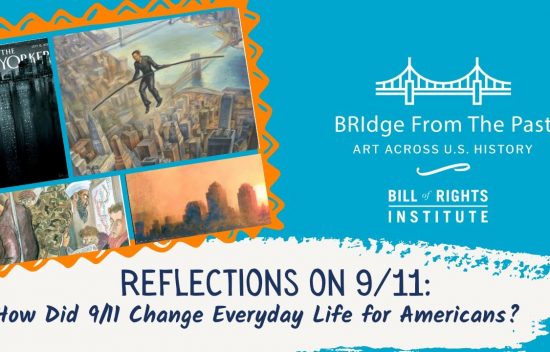
What does September 11th mean to you? In this video, Mary explores images from The New Yorker that capture the many emotions Americans went through directly following the attack and in the years after as they grappled with its long-lasting effects. How did 9/11 change everyday life for Americans? How does it still affect us today?
0:01 Hi everybody. Welcome to another episode of Bridge from the Past art across US history. I’m your host, Mary, and this series is for students like you to get ahead in your US. History class just by looking at pictures. Today we’re looking at covers from The New Yorker magazine that are response to the terrorist attacks that took place on September 11, 2001.
0:23 These attacks, now known as 9/11, had profound effects on the United States. How can we start to understand the effects by looking at these images? Let’s jump in. Before we look at these images, what are three things we need to know about the attacks on 9/11?
0:45 Well, first, the terrorist group Al Qaeda was responsible for these attacks. 19 militants associated with Al Qaeda hijacked four airplanes and carried out suicide attacks. Two of the planes were flown into the Twin Towers of the World Trade Center in New York City. A third plane crashed into the Pentagon just outside Washington, DC.
1:06 And the fourth plane crashed in a field in Shanksville, Pennsylvania. Almost 3000 people were killed, and this attack shocked Americans to their core. I remember watching this attack when I was in college at the time, and just thinking, I was watching a movie, I was watching the Twin Towers. They had been struck and they started to fall down.
1:28 So it really had such a profound effect on Americans. This was only the third time that Americans were attacked on their own soil. The first was by the British during the War of 1812. The second was the attack on Pearl Harbor that brought the United States into World War II. So this effect, again, had such a big effect on everyday Americans, as well as the larger foreign
1:50 policy and domestic policy of the United States. So these attacks lead to what President George W. Bush will call war on terror. And this war on terror really defines presidency. So you’re going to see attacks on Al Qaeda and their Taliban allies in Afghanistan and a controversial invasion of Iraq. At home, you will see increased efforts
2:12 to investigate and stop terrorism as part of the war on terror. So Congress passes something called the USA Patriot Act. Usually you hear it referred to as the Patriot Act. Critics say that this gives the government too much power to pry into the private lives of Americans. And then supporters will say that it makes Americans safer and it’s necessary given this war on terror.
2:34 So it’s still on the books today, and it’s still debated today. You’ll also see the creation of federal agencies like the Transportation Safety Administration, or TSA. If you’ve ever boarded an airplane after 9/11 and gone through all the security, you know who TSA is. And it also leads to the Department of Homeland Security.
2:54 So these are some of the big picture effects of 9/11. But what about everyday Americans and how they process this? This, you know, sort of watershed or huge change. So again we are looking at magazine covers from The New Yorker and The New Yorker is a weekly magazine, it was found in 1925, it’s read across the United States
3:18 and internationally and it’s well known for the illustrations on its cover. So this cover is from September 24, 2001. So it’s really right after the attacks and it’s defined by black, it’s stark, there’s the Twin Towers and nothing else.
3:38 So here is, I can go forward here here’s an image on the right of just after the attacks on both of the towers so two planes actually crash into these towers and then the towers 110 floors each fall to the ground and you can watch image of this happening on YouTube. I remember watching it in real time and again it was just like is this real?
4:01 Is this really happening? It was so hard to process that something like this was going on and I think, and again I’m speculating a little bit but that’s part of the fun of looking at images as primary sources that this artist was probably feeling the same way. These two buildings define the cityscape
4:22 of New York and they’re gone, they’re just gone, they fell to the ground. So there’s nothing but this sort of blackness, this hole in the city skyline the next thing I want to show you is a cover from one year later. So this is from September 16, 2002 and this cover is so different so instead of the dark I see the light
4:45 and this is entitled dawn over Lower Manhattan this one from 2002, this one on the left is just entitled 9/11 2001. So if I’m looking at this 2002 cover I can still see even though there’s light and there’s a dawn breaking that the skyline is still very much
5:06 defined by the absence there’s this big empty space where these towers used to be. So even though dawn is breaking and life has moved on in a way the effects or the absence of this towers and all of the people who lost their lives in that initial attack and in the falling of the towers and in the cleanup in the aftermath is still very much with everyone on their minds.
5:29 So this again is not too long after the initial attack. So this is from October 2001 and this is entitled Street Scene. So I can see here you see men and women going to work. I see a briefcase, I see a purse. Someone is carrying some sort of package.
5:50 So kind of people to all walks of life in New York City going the hustle bustle of the city has continued. But there’s also down here in the corner we have these flowers and candles and a picture of a fireman because so many firemen and police officers and first responders lost their lives helping
6:11 the people in the towers and around the towers when they fell down. So there was this real sense of even though life has to go on this memorializing and remembering the heroism and the sacrifice of these first responders. So here again, you have October 29, 2001. So a little over a month after
6:31 the attacks, and this is entitled Local Heroes. And you can see these are kids. Trickortreating in New York, and they’re all dressed as policemen and firemen because these are the real heroes, not the superheroes or the comic figures. But this is still this sort of surge of patriotism and love and support for the people
6:51 who lost their lives and helped clean up and carry on and try to save people. This image again, November 5, 2001. So a little less than two months after the 9/11 attacks, this is entitled What So Proudly We Hailed. And I can see right away my eye is drawn towards all of these flags.
7:12 So I have all these American flags on the taxi cab. They’re flying on top of the cab. They’re on the actual cab itself in this sign that says God Bless America. And the driver looks scared. He looks bewildered. He has an interesting expression on his face. So the title of this, What’s So Proudly We Hailed, is an allusion to the national anthem.
7:35 So again, there’s this surge of patriotism and pride and support after these attacks, but there’s also this undercurrent of fear, and there was also the suspicion of Islamic Americans because the Al Qaeda terrorist group that carried out these attacks is a group of Islamic extremists. This cover is hinting at sort of.
7:56 The dark side of an effect of the attacks on 9/11. Two more covers here. So this is 2003 and this is 2004. And you can also see this fear, especially of Islamic terrorism, is sort of part of this American psyche after these attacks.
8:17 So this illustration here on the left. Is entitled The Tourist. And you can see the play on. The leader of Al Qaeda, Osama bin Laden is reading the subway map. And you have someone asleep here on the subway, people doing the hustle bustle. Of their daily commute. And on the right here, it’s the. Holiday season, and you see people shopping,
8:39 and you have the same figure through the sinister face again, ringing a bell. Dressed up as Santa Claus. Again, this fear that life is never. Going to be the same again, that. There’S always this undercurrent of fear or when is the next attack going to come is still present. The last image I’m going to leave. You with is called Soaring Spirit.
9:01 And this is from the 2006 issue. So, five years after the attacks, and. This is an allusion to a high wire walk between the Twin Towers that took place in 1974. So, at the time, to do a tight rope walk between the Twin Towers 110 floors above
9:21 the ground is incredibly brave, some might say crazy thing to do. But this man, Philip Pete was his name, attempted it. So he had this soaring spirit to try it. And again, there are no buildings there anymore. He’s not walking on anything. So I think the spirit is this allusion to it’s not the same. How are we going to carry on?
9:42 How are we going to move forward after these attacks? So I am going to leave you with this question. How did 9/11 change everyday life for Americans? So these covers give us a few glimpses into that. I would encourage you to talk to your parents, your teachers, your coaches, anyone. Who is around when this attack happened in Sea. What do they remember and what does it mean?
10:04 This year is going to mark the. 20th anniversary of the attacks on 9/11. So it will be interesting to think. What will the cover look at look like this year? That’s all we have time for on. Today’S episode of Bridge from the Past. I hope you learned something. Be sure to like this video and subscribe to our channel. We’re back every other Thursday with new primary sources to explore.
10:28 Thanks, everybody. Take care. We’ll see you next time.
Standards
Related Resources

In this lesson, students will review and analyze the self-sacrifice of the 40/35 Firehouse crew on 9/11. Students will consider how to demonstrate the virtue of self-sacrifice in their own lives. Students will achieve the following objectives.
Remember the anniversary of the September 11 terrorist attacks on the United States. You and your students can commemorate the day with this lesson focused on civic values.
