Video
Reconstruction Middle School Video
Watch
Founding Principles
Virtues
About this video
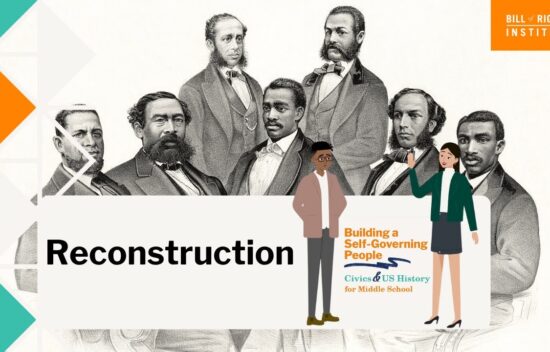
In this middle school history lesson, explore the Reconstruction era that followed the Civil War. Using Thomas Nast’s 1874 political cartoon The Union as It Was and the Currier and Ives lithograph The First Colored Senators and Representatives, students analyze how art captured both the progress and the resistance that defined the nation’s attempt to rebuild.
Students use DBQ methods to guide their thinking: Group, VIEW, Evidence, Context, Thesis. By categorizing sources, applying the VIEW analysis, pulling direct evidence, adding historical context, and writing a clear thesis, students learn to make evidence-based arguments about how successful Reconstruction was in ensuring equality and rebuilding the nation.
0:02 Welcome to the museum.
0:04 Today we’re heading into one of the most challenging and important
0:07 chapters in American history reconstruction.
0:10 The time period
0:11 when the nation was brought back together right after the Civil War.
0:16 We’ll be looking at two pieces of artwork
0:18 to help us understand our big historical question.
0:21 How successful was reconstruction in addressing the challenges
0:24 of rebuilding the nation and ensuring equal rights for African-Americans?
0:28 Let’s examine how artists use their work to reflect the struggles,
0:31 hopes, and setbacks of the reconstruction era.
0:34 Let’s start with this political cartoon.
0:38 This is a political cartoon by Thomas
0:40 Nast, published in 1874.
0:43 NASA was known for using art to express strong political opinions.
0:47 And this piece is full of symbolism.
0:49 The title The Union as it was is bitterly ironic.
0:53 Let’s look closely in the center we see a black family cowering
0:57 beneath a skull and crossbones.
0:58 Above them hovers a Ku Klux Klan
1:01 or a KKK member in white robes and a man labeled White League.
1:04 These were two groups that used violence and intimidation
1:07 to stop African Americans from exercising their right to vote.
1:11 And the words worse than slavery.
1:13 This is a white man’s government and lost cause.
1:15 Complete the foreground, revealing NASA opinion that the restrictions
1:19 on and condition of Black Americans was dire.
1:23 In the background, we see what appears to be destruction with a schoolhouse sign
1:28 book spread on the floor.
1:29 Flames are smoke and sadly, a lynched or hung body.
1:33 This visual in particular, combined with a cowering family and presses upon
1:37 the viewer the terror and fear inflicted upon black citizens during this time.
1:42 Through the symbolism and text.
1:43 NASA’s arguing that reconstruction is failing
1:46 not because of laws, but because of violence and resistance in the South.
1:51 Now compare that to this lithograph from just two years before
1:55 showing the first African-American members of the US Congress.
1:59 Here we see seven black legislators, including Hiram Revels,
2:02 the first African-American senator, and Joseph Rainey,
2:06 the first black member of the House of Representatives.
2:09 Each man is labeled dressed formally
2:12 and presented with professionalism and dignity.
2:16 This artwork shows the immense progress made by black people
2:19 politically in the early years of reconstruction.
2:22 These leaders were elected thanks to new laws
2:24 like the 15th amendment, which gave African American men the right to vote.
2:29 This success came with challenges.
2:31 Many white Southerners resisted black political power using new restrictive
2:36 voting laws, intimidation and violence, just like we saw in NASCAR.
2:40 Tune.
2:42 The rights guaranteed to Black Americans that were enshrined in the Constitution
2:46 by Congress were then overshadowed by a number of restrictions on voting,
2:51 including poll taxes, grandfather clauses, and literacy tests.
2:56 Together, these two images tell a fuller story of reconstruction.
3:00 Both the achievements and the fierce opposition.
3:13 Now that we know more about the history
3:15 and our sources, let’s go back to our historical question.
3:18 How successful was reconstruction in addressing the challenges
3:21 of rebuilding the nation and ensuring equal rights for African-Americans?
3:25 To answer that, we need to use our skills.
3:28 I’m going to walk through five of them, just like I would in my own thinking.
3:32 First, I ask myself, how can I group the sources?
3:36 Well, I see that one image shows failure and violence
3:39 while the other shows progress in representation.
3:42 That’s two strong categories resistance to reconstruction.
3:46 Achievements of reconstruction.
3:48 Grouping this way helps me organize my evidence.
3:51 Let’s use the view method to analyze Nass cartoon voice.
3:56 The artist is Thomas Nast, a northern
3:58 political cartoonist who supported equal rights.
4:01 Intent is criticizing southern violence
4:04 and warning northern audiences that reconstruction is collapsing.
4:08 Environment. It’s 1874.
4:11 Many northern politicians are losing interest in enforcing reconstruction laws.
4:15 Who NASA wants the public and lawmakers to see what’s happening in the South.
4:21 View helps us understand why Nast made this cartoon so emotional and alarming.
4:26 Next, I pulled direct evidence from the sources from Nast cartoon.
4:30 A black family is hovered over by the Klu Klux Klan and the White League.
4:34 There is a burning schoolhouse and a hanging body
4:37 that shows that African-Americans face extreme violence.
4:40 From the Currier and Ives print.
4:42 Hiram Revels and Joseph Rainey are shown with their names and roles in Congress
4:47 that proves some African-Americans did gain political power.
4:52 Let’s add historical context.
4:54 After the Civil War,
4:55 the federal government passed the 13th, 14th, and 15th amendment,
4:59 which ended slavery and gave African American citizenship and voting rights.
5:04 During reconstruction, U.S.
5:05 troops protected these rights in the South because of the failure of the states.
5:09 But over time, federal support weakened.
5:12 White supremacist groups
5:13 grew stronger, and southern states violated the rights of black citizens.
5:17 That context explains why we see both progress and backlash in these images.
5:22 Now let’s write a thesis, a
5:24 1 or 2 sentence answer to the DB2 question.
5:28 How about this?
5:29 Reconstruction achieves some success in rebuilding the nation and securing
5:33 African-Americans political rights, as shown by the election of black leaders.
5:37 But it also faced strong resistance, including violent attacks
5:41 that limited the success of these efforts.
5:44 That thesis includes both sides of the story.
5:47 Just like the sources.
5:50 Reconstruction
5:51 wasn’t perfect, and it faced a lot of resistance,
5:54 but it was a time when Americans took bold steps toward justice.
5:58 And those steps matter.
6:00 African Americans organized, voted, ran for office, built
6:04 schools, and pushed the nation to live up to its founding ideals.
6:07 When movements are grounded in principles like equality and justice,
6:11 they have the power to spark real change, even when it’s hard.
Standards
Related Resources
How successful was Reconstruction in addressing the challenges of rebuilding the nation and ensuring equal rights for African Americans?

Analyze primary sources using the VIEW method, group them by historical themes, and use evidence and context to develop and support a clear thesis about a historical topic.

How have Americans worked to create and sustain a self-governing, free society?