Video
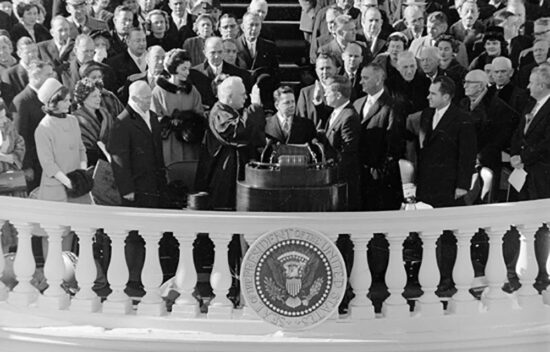
Reading John F. Kennedy’s Inaugural Address | A Primary Source Close Read w/ BRI

Watch
Founding Principles
Virtues
About this video
BRI Staff Kirk Higgins and Joshua Schmid look back at the famous inaugural speech of John F. Kennedy and discuss his timeless messages that still apply today. How did JFK ground himself in the past while still promising progression and change? And how did he define his responsibility in the context of world politics and in the tradition of the American presidency?
0:03 Hello and welcome to a new year of Primary Source Close Reads with the Bill of Rights Institute. My name is Kirk Higgins and I’m the Director of Content at the institute. And this week, I am fortunate to be joined by my colleague, Josh Schmid. I’m excited to be here. Thanks Kirk. Thanks for joining me, Josh. So if you’re new to the channel, these Primary Source Close Reads are where we take a primary source and break it down to its component parts and look
0:26 at different things to try to identify interesting themes or historical context or other bits and pieces that we find interesting in these texts. We think these texts are really important when studying history, and we hope whether or not these documents are new to you or whether or not you’re really familiar with them, that we pick up on some new things and interesting things that you could take and employ in your classrooms as you’re teaching your students.
0:47 These videos are going to be coming out every other Thursday throughout this spring semester, and so we hope you’ll enjoy them. And this first one is going to be on the inauguration. So we’re getting ready for a presidential inauguration when we’re recording this. And so it was top of mind for us, and we thought looking at John F. Kennedy’s inaugural address would be really rewarding. So, Josh, let’s take a look.
1:10 So John F. Kennedy’s inaugural took place on January 21, 1961. So as we come up on another January 20 and another inauguration, I think it’s interesting to kind of think about this moment before we dive into the text and thinking about kind of what’s taking place generally. So obviously, we know that the inauguration is actually required by the Constitution.
1:31 So article Two, section One, clause Eight, requires that the president take an oath of office. So it doesn’t require all of the all of the ceremonies and things that we’ve come to become accustomed to, but it does require that the president takes a public oath. And so that is sort of the impetus for this larger gathering, and it’s this moment of transition of power. I know, Josh, you put together a couple of eLessons on this idea,
1:53 but it’s the idea that we’re moving from one set of individuals holding office to another set of individuals holding office. That’s a momentous thing that takes place. It’s a free transition of power. It’s something that is, I think is a bigger deal than sometimes we give credit for, because it is people voluntarily stepping aside and others taking the office.
2:17 And it occurs on January 20 because of the 23rd Amendment, which states that it needs to occur on January 20. I think Congress typically takes office earlier in January. I don’t remember the exact date or if it’s even a set date, but January 20 is when the new president comes into office. So that sets, I guess, the table for what we’re talking about.
2:38 And in this moment, the President is taking on different roles. And I think it’s interesting to think about the executive in this kind of way of different hats he’s wearing almost when thinking about their speeches. So one is that Presidents tend to look at these moments as historical moments, and they are, right. There’s only been 46, I guess, presidents now. Every one of those is a moment,
3:01 and it’s imortalized, it’s remembered, it’s known. And this speech is sort of a recognition of that. Presidents tend to harken back to that. It’s also a democratic moment. So this transition of power is happening because it’s the end of a democratic process, which I think is also often reflected. It’s also that Presidents have taken this moment to reassure the public
3:24 that they have been duly elected and what that means. And so in that, the President is wearing a couple of different hats again, right. He’s a domestic political leader, and he’s also the Commander in Chief. So he’s a head of our military and he’s also a world leader. Right. So he’s both becoming our President, the President of the United States, but he’s also now becoming this larger individual on the world stage who’s now
3:48 going to be negotiating with leaders from a different position. So I call those things out because I think it’s interesting. Josh, as we’re wading through this today. There’s a couple of things we can watch for that point towards these different items. Right. So the tone that the President is taking on, how he’s talking about different things, he or she is talking about different things, the audience,
4:09 who they’re talking to at a given moment, so what they may be saying to the world or what they may be saying to the people of the United States. And then also how they’re outlining their political priorities, what it could mean for what they’re going to do over the next 100 days. That’s probably something we’ll be talking about a lot here soon, is what happens in that 1st 100 days in office.
4:30 And then finally what their vision is for the nation. And this is sort of like a leadership thing, right. They’re laying out what they think is going to be their path forward over the next four years or possibly eight years. But then, Josh, I thought it might be helpful if you could provide us just with a little historical context. I think anytime we’re looking at any primary source, but in particular at these
4:51 inauguration speeches, I think it’s really important to know the situation in which the President is ascending into the office. Sure. So the election of 1960 saw John F. Kennedy run against Richard Nixon. John F. Kennedy was a senator from Massachusetts, and Richard Nixon had served as vice
5:15 president to the previous President, Dwight Eisenhower. And this election was actually the second closest popular vote margin in US. History. So it was only about 100,000 votes that separated the two candidates.
5:35 The electoral vote was a bit wider of a margin, but I say that to show that there was a decent amount of partisanship at this time and a close divide between the two candidates. Now, JFK had some barriers to overcome. He was only 43 years old, so that made him the youngest president to take office.
6:01 And he was also a Roman Catholic, and every previous president had been Protestant. So Nixon and his supporters kind of latched onto these things, but Kennedy kind of turned that around and actually said, yes, I’m young,
6:22 but that means that I’m going to be vibrant, energetic, and yes, I’m Roman Catholic, but that shows that I can be an agent for change. Look at how great this country is that this can happen. Now, both candidates were relatively moderate on domestic issues.
6:42 There wasn’t a lot of differences between them. But Kennedy attempted to show himself as more of a progressive, and most famously in his New Frontier speech, which I have the text here today on this slide, and you can see he’s really emphasizing the possibility of progress in the country in areas like science,
7:09 space, peace and war, ignorance and prejudice, poverty and surplus. He’s believing that through a lot of effort, we can overcome these issues. Also on the mind of a lot of Americans is the foreign policy issue of the Cold War, which perhaps was even more important than even the most pressing domestic issues.
7:35 And so both candidates attempted to portray the other as being too flexible and too weak in stopping communism in areas like the Soviet Union, Cuba and an ever strengthening China. Great. Yeah, I think that foreign policy is something that’s definitely going to come
7:56 to the fore as we take a look at Kennedy’s speech. And I think it’s an important context to lay out because it’s a new president who’s coming onto the stage in the midst of this international conflict that’s already underway. And I think that shows, again, thinking about the President as a leader shows that they really need to put a foot forward and show not only at home domestically to kind of keep support,
8:20 what kind of leader they’re going to be, but also internationally. And I think that’s definitely something. We’ll be taking a close look at the speech here. So, again, just a couple of things to watch. And thank you, Josh. Great historical context. I think it’s really helpful. And as we’re going through, we’ll keep an eye on sort of how the president’s tone is reflecting some of the things that Josh is just talking about, the political partisanship
8:44 and the other elements that were emerging from the election. We’ll also want to watch the audience, who he’s talking to, how he’s pointing out those political priorities that he just ran on in the election and what that means for his speech, and then also how he’s setting out a vision for how he wants his presidency to be afforded or to move forward.
9:05 We’re just going to look at a couple of different selections of the speech as opposed to the entire speech. We’ll have the link to the full document that we quoted from and I’ve also noticed the lines that I’m pulling from here in case anybody wants to follow along. But I started here with this opening line. We observed today not a victory of party, but a celebration of freedom symbolizing an end as well as the beginning, signifying renewal as well as change.
9:29 I’m already seeing, Josh, some of those things that you pointed out in that other speech that Kennedy was talking about. He’s really consistent with his campaign message. Yeah definitely. So just from the beginning he’s trying to balance progress and kind of tradition. It seems like he’s saying there is an end.
9:53 And by saying that there’s an end, it implies that there had been something good before, I would assume. And also what stands out to me about this is not a victory of party but a celebration of freedom. And that’s also something that I think he’s trying to harken back to is
10:15 that we’ve had this peaceful transfer of power in the past and we’re going through it again and it’s great that we’re continuing that trend. So while this was a partisan election, this is still a Democratic moment like you referenced to earlier, where majority of rules, but we’re also going to respect minority rights.
10:38 And then of course, he talks about the beginning and the renewal. So he’s also looking forward to at the beginning of his speech. Yes. And he’s placing himself within the history of the broader American experience. Right. Saying the same solemn oath our forebears prescribed nearly a century and three quarters ago.
10:58 Right. He’s a part of something that’s larger than himself. His recognition of that, I think, is him telling the audience that he is the next in line, the next American to assume this office and he’s aware of the importance of that moment.
11:20 And then he goes on again, I think really harping in on this moment. Right. We dare not forget today that we are the heirs of that first revolution. Again, that connection back to things in the past really building on and I think building momentum towards what he wants to portray is this important moment in American history.
11:41 I think here he’s already dipping into as well with his tone sort of this idea of our proud of our ancient heritage and unwilling to permit the slow undoing of those human rights to which our nation has always been committed, into which we are committed today at home and around the world. To me, he’s really outlining a vision for saying
12:03 what the American experience has been up to this point and what he thinks it’s going to be in the face of challenges both domestically and abroad. This also seems to be a historical moment from his point of view. He uses the language of the torch has been passed to a new generation.
12:23 And then he goes on to describe what’s unique about this generation they went through World War II. The hard and bitter piece that I’m assuming he’s referring to the Cold War. So even though that conflict ended, they immediately went into a cold conflict.
12:47 And he also just seems to be very humble. Again, let’s not forget where the heirs of the first revolution, but he’s also proud of this historical moment and what this new generation is capable of. Yeah. And again, I think that that’s the democratic moment of it coming out too.
13:09 Right. I think he’s reinforcing that. Even though he’s been elevated to this high position, he wants to be seen as a truly democratic leader. And maybe he’s really emphasizing that because of what’s going on worldwide, trying to differentiate what’s happening in the United States from what’s happening in other parts of the world. Just my own supposition there, but I think it’s consistent. And again, I think this is what’s
13:30 interesting about these inauguration speeches that you see. We’re able to see both something about the historic moment that’s taking place, but also how the individual, the president, sees themselves in it and then how it is that they want to go forward shaping their own vision for the country. And so here, I think, is where Kennedy sort of those lines felt very domestic to me.
13:52 And here, in lines 21 to 24, he seems to put on his world leader hat, like he’s assuming this new office and saying to those old allies whose cultural and spiritual origins we share, we pledge a loyalty of faithful friends. United, there is little we cannot do in a host of cooperative ventures. Divided, there is little we can,
14:12 we can do for we dare not meet a powerful challenge at odds and split us under. To me, he’s trying to galvanize support and trying to reinforce the commonality that he shares with those allies that we’ve held for a long time, which I’m assuming, just from the way he’s phrasing this, our European allies.
14:32 Right. It appears to be very much an assurance to those allies. He’s saying, we’re not going to go rogue and do things on our own, because divided, there is little that we can do. He says. So perhaps there was a fear at the time of, is the US.
14:55 Going to abandon us to the Soviets? So he’s basically saying, no, we’re going to be the leader here, but we’re not going to be a forceful leader. We’re going to work with you guys. Yeah absolutely. And then it goes on to say to our sister republic south of the border.
15:17 So when I read this, I got Monroe doctrine. I remember something about that from the 19th century. Right. And this to me, seemed like a reassertion of that doctrine. And so here I think he’s giving his vision to the world more broadly. Right. So that unifying message that you were just talking about. Whether it’s through the United Nations or whether it’s through other world cooperative kinds of ventures.
15:40 And then here. Too. He’s reasserting. I think. The special importance that the united places on the western Hemisphere from a foreign policy standpoint and particularly at this moment during the cold War. What they were going to do to continue to support those other nations in the western Hemisphere.
16:01 Particularly those who are aligning with ideals of freedom and liberty that the Kennedy’s government would have been in favor of. Yeah. I see him putting on again the world leader hat and also kind of the commander in chief hat because this message is obviously directed
16:22 at the Soviet Union that we’re not going to stand by and allow you to be aggressive or to subvert governments in the western hemisphere and try and turn them communist and presumably the only way we can stop the Soviet Union from doing that is through military force or at least the threat of military force.
16:47 Yeah absolutely. And I think he continues on this theme, right? And this takes up the majority of the speeches, him looking outwards and sort of being this world leader and he makes another pledge in saying that we’re pushing for peace, that we are willing to support those who need support in order of moving towards and you highlight this is sort of progressive notion, right?
17:10 Trying to avoid this being engulfed, the destruction unleashed by science, engulf all humanity and planned for accidental self destruction, right? Sort of pushing against that negative vision but then trying to show the world the way that he wants to move and saying so let us begin a new remembering on both sides that civility is not a sign
17:31 of weakness and sincerity is always subject to proof. Let us never negotiate out of fear, but let us never fear to negotiate. And not only I think I thought when I was reading this section that he’s both talking to the world, he wants a world to understand that. But that last line and maybe I’m reading too much of a present context in it but that also seemed to saying that remembering on both sides
17:56 of stability is not a weakness sounded domestically political too if it was a rancorous election and there were people divided. I think it seemed almost that he was also pointing inwards to the American people and saying look. You can be civil and that’s not going to be you looking weak or you admitting that the other side is right in some capacity that you’re uncomfortable with.
18:16 It’s just a way of us being able to come together to be able to negotiate and discuss and come to compromises that we need to be able to move forward. Yeah definitely. Civil discourse is at the heart of the American experiment and it also could apply to international relations here where you have your set of principles
18:39 that you are very firm on and especially against the Soviet Union. You’re not going to back off those first principles but on the other hand you want to show an openness to the other side in order to work towards a common goal. Yeah. And again, too, thinking about tone, I think we’ll see this again a little bit later on.
19:00 But his tone is very helpful, which I think fits the young, energetic, youthful I guess today we would call it brand. But sort of that young, energetic and youthful approach that he’s taking. Right? I mean, I think he wants to give a hopeful, positive message but he’s still trying to show that he’s being strong, that he’s not doing this out of weakness, that he’s doing it because he thinks that this is the best path forward.
19:24 His tone really reflects that. And then he goes on, I think, to place all of the American people into that historical context, too with these lines here in saying that in your hands, my fellow citizens, more than mine will rest the final success or failure of this course. I think he’s calling upon the American
19:45 people to be a part of this historic moment. But I also, like in the line just above that, sorry for going in reverse, but him mentioning, look, this isn’t going to be done in the first 100 days, right? Or even the first 1000 days, he’s really saying, look, and this is, I think, what leaders often do. He’s trying to set some realistic expectations for what the American people
20:07 are going to see, what the world is going to see over the next few months. And at this moment, when he has his largest amount of portable capital, he’s going to work to make some changes. But he’s recognizing that it’s going to be much more difficult than him just trying to wish it upon the world. Right. And this is one of my most favorite parts
20:28 of this passage because he’s really setting a limit on his capabilities. He’s showcasing the virtue of humility. He’s saying, don’t get your hopes up because ultimately you can’t expect too much from me because this is ultimately on all of us as Americans and it’s likely not even going
20:53 to happen in our lifetime, perhaps that we achieve these goals. And I think that’s just a great way of looking at it and not becoming too arrogant and thinking that you can do too much. Yeah absolutely. And that it’s going to take all of us, right? It’s not just him, the executive,
21:13 which again, it’s arguing back to this democratic kind of ideal, right? We’re all in this together. We’re a nation together. And so this big challenge that’s facing us is one that we all have to tackle. And so then we get to, I think, probably the most famous line of this speech, right? The ask not what your country can do for you.
21:35 Ask what you can do for your country. Which I think he’s been building to this entire time. I think rhetorically it feels like that was meant to be sort of the culmination of the speech. But here again, he’s placing all Americans within this historical moment, right in the long history of the world, only a few generations have be granted
21:55 the role of defending freedom in its hour of maximum danger. So again, positioning the American people to understand that he recognizes the threat that he perceives that communism poses to the United States, but also just what it means at this moment of international instability
22:15 for them to be really sticking to the challenges and the benefits that come from this system of government and really honing in on that. And I love the energy, the faith, the devotion which we bring to this endeavor will lighten our country and all who serve it in the glow from that fire can truly like the world.
22:38 That’s a really tremendous line that is setting a vision for what he thinks is going to be if we work together, if we are dedicated to this cause, we can truly change the landscape of not only the United States, but of the world. Yeah, and I think he again showcases
22:59 humility here and he’s also really trying to contrast the United States with the Soviet Union, I think with that line, ask not what your country can do for you, ask what you can do for your country. Whereas the Soviet Union, they’d be more likely in a communitarian
23:20 society where individuals would ask, what can the country do for me? How can it provide for me? He’s instead encouraging this civic virtue of what can I as an individual do for my country? And then in his final line, he’s also encouraging the world to again work with the United States.
23:44 We don’t want to take the lead on our own and do everything on our own. We need to work with you guys. Again, it’s a very humble statement saying that we need everyone. Yeah absolutely. Well, thank you again, Josh, for going through this with me. It was a lot of fun and thank you all for tuning in.
24:06 If you like this video, please be sure to subscribe to the channel. We’re going to be putting out these primary source Close Reads every other Thursday, so come back on January 28 for a closer look at Theodore Roosevelt’s New Nationalism speech from 1910. It should be a lot of fun, but we’re also putting out a lot of new videos this year. So we’ll be putting out new videos every Tuesday and Thursday on all things US history and civics.
24:29 And these will include, again, these Close Reads, but also interviews with distinguished scholars and homework help videos for students as well as some other analysis kinds of videos. So it should be a lot of fun. Join our conversation on Facebook, Twitter and Instagram as well for updates on programs and events and other ways to get involved with the Bill of Rights Institute.
24:49 And finally, we’d love to hear from you all. So if you have ideas for how we can improve these shows or different primary sources or things you’d like to see us cover, please let us know. Comment here on the video or get in touch with us on social media. We’d really appreciate it. So thank you again, Josh. Thanks again and we’ll see you all next time.
Standards
Related Resources
How did John F. Kennedy’s call for responsible actions by the American citizenry in his Inaugural Address?

How did President John F. Kennedy achieve his purpose of protecting the United States during the Cuban Missile Crisis?

Dive into some of the most important speeches and documents from United States history. These videos dissect these documents, define key terms, and explore the lasting impact of the featured documents.