Video
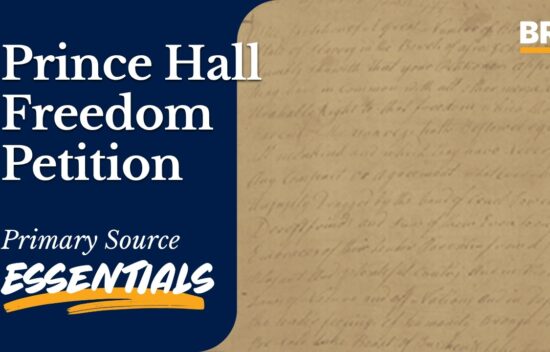
Prince Hall Freedom Petition | Primary Source Essentials
Watch
Founding Principles
About this video
How did enslaved individuals use natural rights arguments to fight for freedom? In this episode of BRI’s Primary Source Essentials, delve into the 1777 Prince Hall Freedom Petition to the Massachusetts legislature. Learn how Prince Hall and other petitioners asserted their natural and unalienable rights, condemning slavery as a violation of their humanity and liberty. Explore their efforts to claim ownership of their rights and the broader emancipation movement that emerged in northern states after the Revolution. Discover the lasting impact of these arguments in confronting the paradox of slavery and freedom in the American Republic.
0:01 Welcome to Primary Source Essentials. In this episode, we will briefly discuss the natural rights principles of the 1777 Prince Hall Freedom Petition to the Massachusetts legislature During the 1760s and 1770s. The American colonies followed the English tradition and petitioned the King and Parliament with their grievances and claim their constitutional and natural rights.
0:25 Enslaved people, especially in New England, followed the example and petitioned state legislatures and launched freedom suits for their liberty. In early 1777, only months after the Declaration of independence, Prince Hall and seven other black men brought their own freedom petition to the Massachusetts Council and the state House of Representatives.
0:47 The petitioners asserted that they were entitled to the natural and unalienable rights of all humans. Much like the Declaration of Independence, they stated that they had, quote, freedom which the great parent of the universe bestowed equally on all mankind. The petitioners argued that they had never consented
1:08 to surrender their liberty or equality of rights. They condemned slavery as a violation of their natural rights because they were, as they wrote, sold like beasts of burden and condemned to slavery for life. In short, they wanted to be free, have ownership over themselves and their rights, and enjoy the fruits of their labor.
1:30 So this and other freedom suits were part of a bigger emancipation movement in northern states. After the American Revolution, based upon the principles of liberty, equality and self-government and the Declaration of Independence. However, slavery also continued to spread and grow in the South, and led to a continued reckoning with the paradox of slavery and freedom
1:52 in the American Republic for decades Thanks for watching, and check out the other videos in Primary Source Essentials.
Standards
Related Resources

What progress has been made across time in the fight for realizing Founding principles of liberty, equality, and justice for African Americans?

How did legislators, courts, and individuals interact with and interpret the principles of liberty and justice in the quest to end slavery from colonial times to the outbreak of the Civil War?