Video
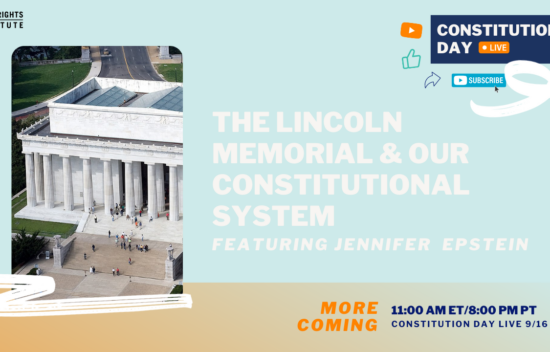
Preservation and Perseverance: The Lincoln Memorial & Our Constitutional System
Watch
About this video
What does the Lincoln Memorial tell us about our country and our constitutional system? As part of our celebration of upcoming Constitution Day, Mary visits the Lincoln Memorial in Washington D.C. to observe the stunning monument firsthand. Join her and special guest Jennifer Epstein of the National Park Service as they dive deep into the history, construction, and meaning of the physical representation of Abraham Lincoln’s impact on the United States and who he was as a person. What does an up-close look at this monument tell us about Lincoln’s legacy? Why is the preservation of historical places like the Lincoln Memorial so important?
Handout: https://billofrightsinstitute.org/activities/preservation-and-perseverance-the-lincoln-memorial-and-our-constitutional-system-viewing-guide
0:03 Hi everybody. Welcome to a very special episode of Bridge from the past. I’m your host Mary, and this series is all about using images or places to help us make sense of America’s past. I’m standing in front of the Lincoln memorial on the National Mall in Washington, DC. And I’m not alone. I’m thrilled to be joined by Jennifer Epstein of the national park service.
0:25 Ranger Jen is here to help me make sense of this special place. What can we learn about Lincoln by visiting the Lincoln memorial, but not just Lincoln? What could we learn about ourselves and our role in our constitutional system? Let’s jump in and see. Jen, thank you so much for being with us today. Sure. Happy to be here. I would like to start with your story, if you don’t mind.
0:47 So we’re really big on stories here at the Bill of Rights Institute. So how did you come to be in your role as a park ranger here on the mall? I was inspired by my fifth grade teacher to get into the field of history. I don’t know what she did, I don’t know how she did it, but somehow after fifth grade, I just knew I wanted to do something with history.
1:08 And I visited a lot of historic sites, and I met a lot of park rangers over the years. And when I went to college in a historic town, it was an opportunity to volunteer with the park service and just got me started from there. And I just feel like in my job, I get to be hopefully that inspiration to new students that my teacher was to me.
1:28 And that’s kind of what motivates me to want to tell the stories, because that’s what we do, too, is tell stories, and that’s what we like to do. So let’s jump into the story of Lincoln itself. So what is the symbolism in the architecture of this monument? So this memorial is built 100 years ago. 100 years ago, the big theme of this memorial was all about unity.
1:51 And the idea that president Lincoln helped to unify the country, continued the civil war to get the country back together. From the number of columns around the outside to the states around the top, there’s a lot of symbols of unity, and that’s really what they were going for when they designed this memorial. So you mentioned the theme of unity.
2:11 So other than the state’s names around the monument itself, how else did they build on the theme of unity in designing the monument? Yeah, one of the things I think you don’t realize when you’re looking at this is that the rock that forms the memorial came from six different states. And that was another way of incorporating unity, because they could say
2:32 that the rock and the memorial was literally built out of rock that came from all parts of the country, some from the north and some from the south. So the statue of Lincoln is made of Georgia marble, while the outside is Colorado, marble, and there’s Alabama marble in the ceiling, and there’s Tennessee on the floor, but there’s Massachusetts granite. And it’s just a really neat way to say,
2:54 look, we built this memorial, and it literally represents a united nation. I’m curious about the location of the memorial. So we’re here on the National Mall, and the Washington Monument is here. The capital is here. What was the significance of placing a memorial on this site? So in Lincoln’s Day, this site would not have been here.
3:16 This would have been part of the Potomac River. And so this is all reclaimed land. The river went almost up into where the Washington Monument is today. And so it was actually a bit of a controversy deciding to put the Lincoln Memorial here because this had just been reclaimed land in the late 18 hundreds, and there was nothing out here. And there were members, a particular member of Congress who was
3:38 very upset at the idea that they were going to build a memorial to honor President Lincoln in the middle of this swamp that’s. So interesting about the Potomac River. So the Potomac River is behind the Lincoln Memorial, and just across the river is Virginia, which would have been the Confederacy at the time of the Civil War. And one of the best views that I’m not sure people always think about is when you come up here to visit,
3:59 and I hope you do if you haven’t had a chance to to come visit is to go up the steps and turn to the left or right and go around the backside of the Lincoln because you then can see that view of Virginia. And imagine imagine if you’re President Lincoln’s Day. Virginia is who you’re fighting in the Civil War, and look how close you are. And you really get that perspective from the backside of the Lincoln. That’s a really powerful idea. Again, of unity.
4:22 You have this conflict, this Union, like torn asunder and this President that was saving the Union. That’s really lovely. And you’re talking about places, and you just see how close it is. And another theme of unity is the bridge behind us, known as the Arlington Memorial Bridge was built in the 1930s to connect DC
4:42 and Virginia. And so it’s literally that connection, again, of unity reuniting the north and the south. And if you follow that bridge, it leads you to Arlington National Cemetery. And the house up on the hill was that of Robert E. Lee. And Robert E. Lee is the general who President Lincoln is fighting against. There’s all kinds of amazing historical connections in this one spot.
5:03 And so it is this power of place. Yeah, history is all around us all the time. As I used to always say to my students, I’d like to ask you about the Central Hall. If you go up the steps into the memorial itself, you see a very large statue of Abraham Lincoln. So what is the significance of the statue, him being seated, the epitaph or inscription above his head?
5:24 Sure. Yeah. So the sculptor of the statue, the designer, was Daniel Chester French, very well known artist of his day. And his original sculpture was much smaller. He made a model of it and he brought it to Washington to see how it looked in the building. And it was way too small. It was about half the size of the current statue, and so it didn’t quite fit, and he had to make his statue bigger.
5:48 And so the model was nearly doubled to what you have today is his head to toe was 19ft, and he sits on an eleven foot pedestal. So like 30ft from when you’re standing there. But yeah, it really had to do a little bit with the building. And I tell students all the time, you walk up all those steps, you want to be rewarded by what you see. You don’t want to just see a tiny little statue of Lincoln.
6:10 You need to see a big statue. I walked up all those steps. And so I think that had a lot to do with it, the seated versus standing. There are so many columns in the building that I think the artist was afraid if he was standing, he might just kind of blend in with the columns. And so part of that design choice was having him be seated and that kind of pose there.
6:34 One of the things that strikes me about the statue of Lincoln is how serious his face looks. And I always interpreted that as he’s the president during this incredibly stressful time of conflict, and it’s meant to convey almost the burden of the presidency. Am I in left field there?
6:55 In fact, specifically the hands, too, because one of the hands is in a fist and one of the hands is open. And that was done deliberately by the artist because he wanted to show, as you said, that stress of sending soldiers off to fight and the falling apart of the country. That was a very stressful thing to deal with. But he also had a great sense of humor,
7:15 and he loved to have his children come play during cabinet meetings, which probably drove everybody else in the cabinet crazy. But the hands are specifically done so that one is in a fist to represent that stress, and the other is the more relaxed, I’d like to think, fun loving guy who would tell jokes and things like that. We had a lot of people who think that’s the myth of the sign language,
7:37 and he’s doing his initials as an A and L, and that was not intentional. That’s not what it’s supposed to represent. It’s really the moods you described being about the idea of the stress versus the more relaxed. Man. I love I love the actual intent behind the hands more than the myth of the sign language, because I don’t when I think of Abraham Lincoln, I think of this I think of a penny.
7:59 And he’s very serious, and he’s like this great big man, this larger than life man that you see with this giant statue and the memorial. But I also love the humanizing part of it, which I don’t think you hear as much. But he had a great sense of humor, which is so crucial. Another thing you can’t miss when you go inside the central hall are the speeches of Lincoln on the other side,
8:23 of course, the Gettysburg Address and his Second Inaugural. What was the significance of putting those two particular speeches on the wall? I think they were just the ideas that are so connected with Lincoln. The idea of the Gettysburg Address. I mean, it’s this famous speech he gave at the dedication of the cemetery in Gettysburg after the battle, months after the battle,
8:43 and he thought he wouldn’t be remembered and that everyone would forget what he said, and it’s become the most famous speech. So those ideas really important. I mean, he quotes the Declaration of Independence, and he’s talking about equality. So that’s an important idea. And then his second inaugural, just six weeks before his death, he’s again talking about what’s going
9:05 to be the future and that we need to heal the wounds and come back together again. If you’re coming to this memorial, these are the ideas that people want to walk away with and be reinforced about what Lincoln means to us as a nation. I’ve never not been here and not have a huge crowd, and you can tell there are obviously people coming from other countries. So I think it’s meaningful not just for people in the United States to visit,
9:29 but, as you said, people around the world as well. Another thing that’s really striking to me about going into the memorial itself is this epitaph, the inscription over the statue of Lincoln, which reads, in this temple, as in the hearts of the people for whom he saved the Union, the memory of Abraham Lincoln is enshrined forever. We have some really powerful words here, like temple enshrined.
9:52 So you can see this idea of unity was really a big deal. So, yeah, that statement was written by an art critic at the time who wanted to capture kind of the sentiments of what this memorial is supposed to be about. But I think what’s really significant as we look back 100 years is what’s not included in that statement. The emphasis, again, on unity.
10:14 Temple, which relates back to the architecture piece that you mentioned, that we’re talking about what kind of building this is. But, yeah, no mention of the equality or emancipation, which are key ideas. If you ask any student out there today, why do we have this Lincoln Memorial? It often goes back to the Emancipation Proclamation or the idea of linking, working to help end slavery.
10:36 And that’s not at all included in much of what’s in this memorial. Yeah, you mentioned in the speech of the Gettysburg Address, he quotes the Declaration of Independence. And in his second inaugural, he’s looking to the future. So this idea of it was designed with unity but moving forward, that could perhaps change over time.
10:57 Sure. And as you said, we’re celebrating the 100th anniversary of the memorial’s dedication. So do you think the meaning of the memorial has changed over time? It’s funny. As I was listening to you talk, I was taken back to one of the speeches at the dedication was by President Warren Harding, everyone’s favorite president. Right. But Warren Harding at the dedication said,
11:18 and I may slightly get it wrong, but something to the effect of this memorial is more for future generations than it is for today. And so that’s kind of interesting that he was even thinking ahead, that this is about what it’s going to be for future generations. I may have this totally wrong, but to me, I don’t think many people are coming here today for this idea of unity as much as they are this idea of freedom.
11:42 And we see that really change over time with events that have happened here. I think our audience probably is familiar with some of the things that have happened here over the years. Certainly Dr. King in the March on Washington in 1963, very famous concert in 1939 with Marion Anderson, who was denied the chance to perform nearby because of her race, and 75,000 people came out to listen to her.
12:06 I recommend googling her and watching her on YouTube because it’s really a neat event. But that really changes the face of this memorial. And we start using this as a site for demonstrations and rallies and things like that. And it now is much more, I think, associated with freedom than maybe it is unity. And maybe they all kind of blend together in these times.
12:27 But when you look at the dedication of this memorial, the audience was segregated. That’s not equality represented 100 years ago. It was definitely about unity. And now we see events happening here that really show this is more about Lincoln’s legacy of freedom for all. One of the things I love about the memorial is that even
12:48 at the dedication in 1922, one of the speakers is the president of the Tuskegee Institute, and he’s talking about this idea. It’s almost like a call that things need to be worked on. It’s almost as if those events are additional dedications of the memorial over time and how it’s really about a call
13:10 to us as Americans that there’s always work to be done, there’s always progress to be made, and the work is really unfinished. Yeah, it’s so true. There was an African American newspaper known as the Chicago Defender in 1922 after the dedication, said, this memorial hasn’t officially been dedicated because of the way the dedication was run, because of the fact there was the segregated audience, because Dr.
13:32 Moton had to get his speech approved and then changed before he could deliver it. So, yeah, there were some who saw it as not officially being dedicated. It may be opened, but not dedicated, I think are the words that this newspaper used. And many looked at this as a celebratory event, the opening of this memorial, and others didn’t.
13:52 And so perspective is a really important part of all of this. Well, perspective is so important in history, and I think history is really for the future. We study the past to inform the present and the future. And I feel like the Lincoln Memorial is such a wonderful encapsulation of that story. We have these wonderful ideas in the Declaration of Pendants with Abraham Lincoln quotes with which Dr.
14:16 Martin Luther King quotes that are ideals that we’re always striving for, and we fall short, and we continue to fall short, but there’s always work to be done. And I think that’s really, really beautiful and really powerful. Speaking of stories, I think our story is coming to a close here. There’s so much more to say and so much more to learn.
14:38 Jen, where can people go on your website if they want to learn more about the Lincoln or the National Mall? Sure. Our Lincoln Memorial website is NPS. Govlinc. And my job is as an education specialist, which means that I’m available for field
14:59 trips and planning with teachers or doing virtual programs, which now we do. So happy to engage with any of you all. If you’re looking for programs related to the Lincoln Memorial or any of the sites here on the National Mall. Yeah, our main site nps.gov/nama. N-a-m-a. Okay great.
15:20 So we started by asking what visiting this place could tell us not only about Abraham Lincoln, but about us and our role in our constitutional system. And we learned about the symbolism of unity and the design of the memorial. But the memorial is really, I think, more about just one man as extraordinary as Abraham Lincoln really was. It’s a memorial for us. Right.
15:41 To remind us that our work is ongoing, our story is ever changing, and we are a crucial part of that. And these ideals. In the Declaration of Independence, in the Gettysburg Address, in Dr. Martin Luther King’s I Have a Dream speech, they’re for us and the future as well. Den, thank you so much for your time today. It was a pleasure speaking with you.
16:02 Thank you. I hope you guys learned something. If you did learn something, be sure to hit the like button and subscribe to our channel. We’ll help you with all sorts of questions related to history and civics throughout the school year. I’ll be back soon with another image or place to help us think about the importance of America’s history. As always, everybody, keep your eyes open, keep asking questions.
16:25 And until next time, take care.
Viewing Guides
Standards
Related Resources

What does the Lincoln Memorial mean to us today? In this episode of BRIdge from the Past, Mary examines images of the 1922 dedication of the Lincoln Memorial as it celebrates its one-hundredth anniversary in 2022. What do these images reveal about the state of the country in 1922? Has the meaning of this memorial changed since then?


By the end of this section, you will explain how Lincoln’s leadership during the Civil War impacted American ideals over the course of the war